Change Control in Pharmaceutical Manufacturing: 8 Essential Steps
Change Control in Pharmaceutical Manufacturing is a structured quality-system process used to evaluate, approve, implement, and document proposed changes that may affect a pharmaceutical product, process, facility, equipment, system, or quality attribute.
Changes are a normal part of the pharmaceutical product lifecycle process improvements, equipment replacement, supplier changes, regulatory requirements, deviations, CAPA, technology transfer, or continual improvement can all introduce them. But a change shouldn’t be implemented just because it looks beneficial; its potential impact on product quality, patient safety, validated processes, regulatory commitments, and the quality system needs assessment first. ICH Q10 identifies a formal change-management system as a core element of a pharmaceutical quality system and calls for quality risk management to evaluate proposed changes.
What Is Change Control in Pharmaceutical Manufacturing?
Change Control in Pharmaceutical Manufacturing is the documented process through which a proposed change is identified, assessed, reviewed, approved, implemented, and subsequently evaluated. The objective is to make sure changes are introduced in a controlled manner without unintended negative effects on product quality or a process’s validated state. ICH Q10 states that the change-management system should provide assurance that changes are properly evaluated and implemented with no unintended consequences.
A change-control system may cover manufacturing processes, raw materials, packaging materials, equipment, facilities, utilities, analytical methods, specifications, computerized systems, SOPs and other controlled documents, suppliers, cleaning processes, testing procedures, and validated processes. For APIs, ICH Q7 specifically expects a formal change-control system covering changes that could affect production and control, including review and approval by the quality unit.
Why Is Change Control Important?
A pharmaceutical manufacturing process operates within an established state of control. An uncontrolled change can affect product quality, critical quality attributes (CQAs), critical process parameters (CPPs), process validation, cleaning validation, analytical testing, equipment qualification, stability, regulatory commitments, data integrity, and patient safety.
Change Control in Pharmaceutical Manufacturing helps organizations understand the potential consequences of a proposed change before implementation, not after. ICH Q10 connects change management with continual improvement, process performance monitoring, product quality monitoring, and CAPA.
Examples of Changes Requiring Change Control
Not every change is identical, and the applicable procedure determines whether a given change requires formal change control.
Equipment Change
Replacing an existing manufacturing machine with a different model may require assessing equipment qualification, process parameters, cleaning requirements, capacity, product-contact materials, and validation requirements.
https://pharmavk.com/cleaning-validation-in-pharma-critical-guide-to-maco-hbel-pde/
Raw Material Change
Changing a supplier or material specification may require evaluating material quality, supplier qualification, specifications, analytical testing, product impact, and regulatory requirements.
Manufacturing Process Change
Changes to mixing time, temperature, processing parameters, or manufacturing steps can affect process performance and product quality.
Analytical Method Change
A change to an analytical procedure may require method verification or validation, depending on the nature and extent of the change.
Packaging Change
Changing a packaging component may require assessing product compatibility, container-closure performance, stability, packaging specifications, and regulatory requirements.
Computerized System Change
Changes to software, laboratory systems, manufacturing systems, or computerized controls may require assessing computerized-system validation or assurance activities.
Change Control Process: 8 Essential Steps
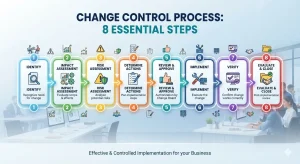
1. Identify and Initiate the Change
The proposed change should be clearly described current state, proposed state, reason for change, expected benefits, products or processes affected, departments involved, and an initial impact assessment. The reason should be scientifically or operationally justified.
2. Perform an Impact Assessment
The proposed change should be evaluated for potential impact across product quality, manufacturing process, specifications, analytical methods, equipment, utilities, validation, stability, documentation, training, regulatory submissions, and supplier qualification. ICH Q10 states that proposed changes should be evaluated relative to product and process understanding and applicable regulatory commitments.
3. Perform Quality Risk Assessment
Risk assessment is a key part of Change Control in Pharmaceutical Manufacturing. The organization determines the potential risks tied to the proposed change and the level of evaluation required, using tools like FMEA, risk ranking, fishbone analysis, HACCP, or a risk matrix. Effort and formality should be proportionate to the level of risk an approach ICH Q10 explicitly describes.
4. Determine Required Actions
Based on the impact and risk assessment, the change-control team identifies actions required before implementation equipment qualification, process validation, cleaning validation, analytical method validation or verification, stability studies, additional testing, SOP revision, batch-record revision, training, regulatory assessment, or supplier qualification. These should be clearly documented with responsible persons and target dates.
https://pharmavk.com/sop-lifecycle-in-pharmaceutical-industry/
5. Review and Approve the Change
Appropriate functions review the proposed change QA, QC, Production, Engineering, Validation, Regulatory Affairs, Supply Chain, IT, or Microbiology, depending on its nature. ICH Q10 recommends appropriate cross-functional expertise when evaluating proposed changes, and QA or the designated quality unit plays an important oversight role in ensuring the change is adequately assessed and controlled.
6. Implement the Approved Change
The change should be implemented only after required approvals and prerequisite activities are complete installing new equipment, revising SOPs, updating specifications, conducting validation, training personnel, updating computerized systems, changing suppliers, or modifying manufacturing parameters, all following the approved change-control plan.
7. Verify the Change
After implementation, the organization verifies whether planned activities were successfully completed reviewing validation results, test results, first batches, equipment qualification results, training completion, document approval, and process-performance data. For API manufacturing, ICH Q7 states that the first batches produced or tested after implementation should be evaluated.
8. Evaluate Effectiveness and Close the Change
The final stage determines whether the change achieved its intended objective without unintended effects. ICH Q10 states that after implementation, the change should be evaluated to confirm its objectives were met and that there was no adverse impact on product quality. Once required actions and effectiveness checks are complete, the change can be formally closed per the company’s procedure.
Change Control Classification
| Classification | General Concept |
|---|---|
| Minor | Limited impact and lower level of risk |
| Major | Significant potential impact requiring extensive assessment |
| Critical | Potentially high impact requiring enhanced evaluation and controls |
Important: exact classification terminology and criteria are company- and procedure-specific there’s no universal requirement that every pharmaceutical company use exactly these three categories. The classification should drive the appropriate level of documentation, review, testing, validation, and approval. For API manufacturing, ICH Q7 notes changes can be classified by nature, extent, and potential effects, with scientific judgment determining appropriate testing and validation.
Change Control and Validation
A proposed change may affect an already validated process changing equipment, process parameters, manufacturing scale, cleaning procedure, analytical method, or manufacturing site may require assessing the existing validation status. The organization determines whether additional qualification, validation, or verification is necessary. FDA’s process-validation guidance uses a lifecycle approach emphasizing process understanding, performance, and continued monitoring. A change shouldn’t automatically trigger a fixed number of validation batches required studies should be scientifically justified based on the nature and risk of the change.
https://pharmavk.com/revalidation-in-pharma-6-critical-situations-explained/
Change Control and Regulatory Assessment
Some changes may affect information in a marketing authorization or other regulatory filing, so regulatory impact should be assessed before implementation when applicable. ICH Q10 specifically states that proposed changes should be evaluated relative to the marketing authorization, with an assessment determining whether a regulatory filing change is required under regional requirements. This matters especially for changes involving manufacturing site, manufacturing process, specifications, analytical methods, raw materials, packaging, product composition, or critical process parameters the regulatory assessment should follow the requirements applicable to the product and market.
Change Control vs. Deviation vs. CAPA
| Quality System | General Purpose |
|---|---|
| Change Control | Controls a planned change |
| Deviation | Documents and investigates an unplanned departure from an approved requirement or procedure |
| CAPA | Addresses identified problems and their causes through corrective and preventive actions |
For example: planned equipment replacement → Change Control; unexpected equipment failure during manufacturing → Deviation; a recurring problem requiring systemic corrective action → CAPA. In practice, these systems interact — a deviation investigation may result in CAPA, and that CAPA may subsequently require implementation through change control. ICH Q10 identifies CAPA and change management as elements of the pharmaceutical quality system.
Common Mistakes in Change Control
- Implementing a change before approval: the approved change-control process should be followed before implementation, not after the fact
- Inadequate impact assessment: failing to identify affected products, processes, documents, or validation activities creates quality-system gaps
- Weak risk assessment: risk assessment should consider actual potential impact rather than assigning a classification without justification
- Missing regulatory assessment: changes affecting regulatory commitments may need evaluation before implementation
- Incomplete training: personnel affected by a revised procedure or process need training before performing the changed activity
- Failure to update documents: affected SOPs, specifications, batch records, forms, and drawings should be revised as required
- Closing without effectiveness evaluation: finishing implementation activities doesn’t necessarily prove the change achieved its intended objective
Best Practices for Change Control
- Clearly define the proposed change and document the reason for it
- Identify affected products and processes
- Perform a documented impact assessment and apply quality risk management
- Involve appropriate cross-functional experts
- Assess regulatory impact where applicable
- Identify validation and qualification requirements
- Define implementation actions and responsibilities
- Obtain required approvals before implementation
- Update affected documents and train relevant personnel
- Evaluate the first batches or relevant post-change data where appropriate
- Verify that change objectives were achieved
- Assess effectiveness and close the change with appropriate documentation
Frequently Asked Questions
What is change control in pharma?
A formal quality-system process used to evaluate, approve, implement, document, and assess planned changes that may affect pharmaceutical products, processes, systems, facilities, or quality.
Why is change control important in GMP?
It helps ensure planned changes are evaluated for potential impact and implemented in a controlled manner without unintended effects on product quality.
Who approves change control in pharma?
This depends on the company’s quality system and the nature of the change relevant functions may include QA, QC, Production, Engineering, Validation, and Regulatory Affairs, with the quality unit generally holding an important approval or oversight role for GMP-relevant changes.
Is risk assessment required for change control?
Yes. ICH Q10 states that quality risk management should be used to evaluate proposed changes, with effort and formality proportionate to the level of risk.
Does every change require validation?
Not necessarily. The need for validation, qualification, verification, testing, or other studies should be determined by the nature and potential impact of the change.
What is the role of QA in change control?
QA typically provides quality-system oversight, reviews risk and impact assessments, ensures required actions are defined and completed, and verifies the change is appropriately documented and controlled per company procedures.
Can a change control be linked to CAPA?
Yes. A CAPA may require a planned change to a process, procedure, equipment, or system, and the implementation of that change may be managed through the change-control system.
Conclusion
Change Control in Pharmaceutical Manufacturing is an essential component of a pharmaceutical quality system, giving a structured way to assess planned changes and understand their potential impact on product quality, processes, validation, and regulatory commitments before implementation. A strong change-control process includes impact assessment, quality risk management, cross-functional review, appropriate approval, controlled implementation, documentation, and post-implementation evaluation. The goal isn’t to prevent change it’s to let manufacturers introduce necessary improvements while maintaining an appropriate state of control throughout the product lifecycle.
References