Dissolution Testing in Pharmaceutical QC: Principle, Procedure and Acceptance Criteria
Dissolution Testing in Pharmaceutical QC is an important quality-control test used to evaluate the release of an active pharmaceutical ingredient (API) from a dosage form into a specified dissolution medium under controlled conditions.
For solid oral dosage forms such as tablets and capsules, dissolution testing provides information about the rate and extent of drug release. The test is performed using a specified apparatus, medium, temperature, agitation speed, and sampling procedure, followed by quantitative analysis of the dissolved drug. The applicable test conditions and acceptance criteria should always come from the approved product specification, individual monograph, and validated analytical procedure. USP identifies dissolution testing through General Chapter <711> Dissolution, while the harmonized pharmacopoeial texts include Ph. Eur. 2.9.3 and JP 6.10.
What Is Dissolution Testing?
Dissolution testing measures the amount of drug substance released from a pharmaceutical dosage form into a specified medium over a defined period. The test can show the rate and extent of drug release, batch-to-batch consistency, manufacturing process performance, formulation performance, and potential changes in product quality. USP describes dissolution testing as a standardized procedure using specified apparatus and conditions, together with acceptance criteria, to evaluate drug-product performance.
Why Is Dissolution Testing Important?
Dissolution is an important quality attribute for many oral dosage forms because changes in formulation or manufacturing can affect drug release. Factors like API particle size, polymorphic form, granulation, compression force, tablet hardness, disintegrant concentration, binder concentration, lubrication, coating characteristics, and manufacturing-process changes can all influence dissolution behavior. Dissolution Testing in Pharmaceutical QC is therefore commonly used during routine release testing, stability studies, formulation development, and investigation of manufacturing changes, as applicable to the product.
Principle of Dissolution Testing
The basic principle:
Dosage Form → Dissolution Medium → Controlled Agitation → Drug Release → Sampling → Quantitative Analysis
The dosage unit is placed into a specified dissolution medium maintained at the required temperature. The apparatus provides controlled agitation, allowing the API to dissolve into the medium. Samples are collected at specified times and analyzed using an appropriate validated analytical method, such as UV-Visible spectrophotometry or chromatography, depending on the approved procedure. The amount of drug released is then calculated and compared with the applicable acceptance criterion.
Common Dissolution Apparatus
1. Apparatus 1: Basket
The dosage form is placed inside a rotating basket, which rotates at the specified speed while the dosage form interacts with the dissolution medium.
2. Apparatus 2: Paddle
A paddle rotates above the dosage form placed in the dissolution vessel the most widely used apparatus for tablet and capsule dissolution testing.
3. Flow-Through Cell
Dissolution medium passes through a cell containing the dosage form under controlled conditions. ICH Q4B Annex 7 recognizes Apparatus 1, Apparatus 2, and the flow-through cell within the harmonized dissolution framework, subject to specific conditions.
Important Dissolution Test Parameters
Dissolution Medium
Specified in the applicable monograph or validated method purified water, buffer solution, acidic medium, or other specified aqueous media. Composition, pH, volume, and preparation requirements should follow the approved procedure.
Temperature
For many oral dosage-form dissolution tests, the medium is maintained close to physiological temperature, commonly around 37°C, with the exact requirement defined by the applicable method.
Rotation Speed
Depends on the selected apparatus and product-specific method it shouldn’t be changed simply to obtain a desired result.
Dissolution Time
Product-specific: a monograph may specify a single time point for an immediate-release product, or multiple time points when a dissolution profile is required.
Sampling
Samples should be withdrawn at the specified locations and times according to the approved procedure. Sampling timing, filtration, and sample handling can all affect the reported result.
Dissolution Testing in Pharmaceutical QC: 10 Critical Steps
Step 1: Prepare the Dissolution Medium
Prepare the specified medium per the approved analytical procedure, verifying relevant parameters such as pH where applicable.
Step 2: Set Up the Apparatus
Ensure the dissolution apparatus is appropriately qualified/calibrated or performance-verified per the site’s approved program and applicable requirements. ICH Q4B Annex 7 specifically states dissolution apparatus should be appropriately calibrated to ensure compliance with regional GMP requirements.
Step 3: Add the Dissolution Medium
Transfer the specified volume of medium into each dissolution vessel.
Step 4: Establish the Required Temperature
Allow the medium to reach the specified test temperature.
Step 5: Introduce the Dosage Units
Place the tablets or capsules into the vessels according to the approved procedure.
Step 6: Start the Apparatus
Operate the apparatus at the specified rotational speed or flow rate.
Step 7: Withdraw Samples
Withdraw samples at the specified time points, performed consistently to minimize variability.
Step 8: Filter the Sample Where Required
If filtration is part of the approved procedure, use a suitable filter that doesn’t adversely affect the analyte measurement. USP guidance notes filters used for dissolution samples shouldn’t cause adsorption of the active ingredient or introduce interfering substances.
Step 9: Analyze the Samples
Determine the concentration of dissolved API using the validated analytical procedure.
Step 10: Calculate Percentage Drug Release
Calculate the amount of API released and express it as a percentage of the labeled amount, where applicable.
Dissolution Calculation
A simplified calculation:
% Drug Released = (Amount of drug dissolved / Label claim) × 100
The actual calculation may need additional corrections depending on the sampling procedure, dilution factors, medium replacement, and other method-specific considerations. For multiple time-point dissolution profiles, calculations may also need to account for drug removed in previous samples and whether withdrawn medium was replaced USP specifically notes these considerations in dissolution-method documentation.
What Is Q in Dissolution Testing?
Q represents the specified amount of dissolved active ingredient, expressed as a percentage of the labeled content, as defined in the applicable individual monograph. For example, if a monograph specifies Q = 80%, that’s the specified amount of drug that should be dissolved under the stated test conditions. Actual acceptance criteria should be taken from the applicable monograph rather than assuming one universal Q value applies to every product.
Dissolution Acceptance Criteria
Dissolution acceptance criteria are product- and method-specific. For the USP <711> acceptance procedure for immediate-release dosage forms, testing may proceed through stages when results don’t meet the criteria at the preceding stage:
| Stage | Number of Units | General Criterion |
|---|---|---|
| S1 | 6 | Each unit meets the specified individual criterion |
| S2 | Additional 6 | The combined results meet the applicable stage criterion |
| S3 | Additional 12 | The combined results meet the applicable final-stage criterion |
The exact acceptance table and criteria depend on the dosage form and applicable monograph.
Important: don’t use these S1/S2/S3 values as a substitute for checking the current individual product monograph.
Dissolution Profile
A dissolution profile measures drug release at multiple time points — for example, 5 min → 10 min → 15 min → 30 min → 45 min → 60 min. A profile can provide more information than a single time-point test and may be useful during formulation development, process development, comparative studies, and regulatory assessments. Where appropriate, dissolution profiles may be compared using statistical or model-dependent approaches specified by the applicable regulatory or development strategy.
Dissolution vs. Disintegration
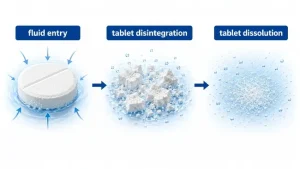
| Parameter | Dissolution | Disintegration |
|---|---|---|
| Measures | Drug release into medium | Breakdown of dosage form |
| Main output | Amount/rate of drug dissolved | Time required to disintegrate |
| Directly measures drug release? | Yes | No |
| Test equipment | Dissolution apparatus | Disintegration apparatus |
| Relationship | Can be influenced by disintegration | May influence subsequent dissolution |
A tablet can disintegrate relatively quickly but still show an unsuitable dissolution profile, because drug release depends on additional formulation and physicochemical factors.
Dissolution vs. Assay
Assay determines the amount of active ingredient present in the product. Dissolution determines the amount released into the specified medium under defined conditions. Assay ≠ Dissolution a batch can have an acceptable assay result while still requiring investigation of an unexpected dissolution result.
Factors That Can Affect Dissolution Results
Formulation Factors
API particle size, API polymorphic form, excipient selection, binder concentration, disintegrant concentration, lubricant concentration, and tablet porosity.
Manufacturing Factors
Granulation process, drying conditions, milling, blending, compression force, compression speed, and coating process.
Analytical Factors
Medium preparation, pH, temperature, rotation speed, sampling position, sampling time, filtration, analytical method, and instrument condition.
Dissolution Apparatus Qualification and Verification
The dissolution apparatus must be appropriately controlled to ensure reliable testing equipment qualification, mechanical calibration, performance verification, rotation speed, vessel condition, paddle/basket alignment, temperature control, and apparatus cleanliness are all important considerations. USP has published guidance covering mechanical calibration and performance verification for Apparatus 1 and 2, noting that this best-practice guidance doesn’t supersede the official requirements of General Chapter <711>. USP currently describes its Dissolution Performance Verification Standard (DPVS) – Prednisone as part of its approach to performance verification for Apparatus 1 and 2.
Common Dissolution Testing Errors
1. Incorrect Medium Preparation
Incorrect pH, concentration, or volume can affect the result.
2. Incorrect Rotation Speed
A difference in agitation can change the dissolution rate.
3. Poor Temperature Control
Dissolution is temperature-sensitive, so the specified temperature must be maintained.
4. Incorrect Sampling
Incorrect sampling time or position can introduce variability.
5. Filter Adsorption
The filter may interact with the analyte and affect the measured concentration.
6. Air Bubbles
Air bubbles attached to the dosage form or apparatus can affect the exposed surface area and potentially influence results.
7. Apparatus Misalignment
Mechanical issues involving the vessel, shaft, basket, or paddle can affect hydrodynamics and test performance.
8. Incorrect Calculation
Calculation errors can occur due to incorrect dilution factors, standard concentrations, or sample-volume corrections.
What Should QC Check Before a Dissolution Test?
A QC analyst should verify the applicable approved procedure and relevant equipment status before testing correct product and batch, correct dissolution method and apparatus, correct dissolution medium, medium volume and pH where applicable, equipment status, temperature, rotation speed, sampling time and location, filter suitability, standard preparation, system suitability, and the calculation procedure. Exact checks should follow the approved SOP, analytical method, and applicable pharmacopoeial requirements.
What Happens If Dissolution Fails?
An unexpected dissolution result shouldn’t automatically be attributed to the manufacturing process. The laboratory should follow the approved OOS/OOT investigation procedure, considering:
Analytical Error → Instrument/Equipment → Sample Preparation → Calculation → Method Execution → Manufacturing Process → Raw Materials
Any investigation should be documented and scientifically justified.
Role of QA in Dissolution Testing
QA may review approved analytical procedures, QC raw data, calculations, chromatograms or analytical records, equipment status, deviations, OOS/OOT investigations, change controls, CAPA, and batch documentation. Specific responsibilities depend on the pharmaceutical site’s quality system.
Frequently Asked Questions
What is dissolution testing?
Dissolution testing measures the amount of active pharmaceutical ingredient released from a dosage form into a specified medium under controlled conditions.
Which pharmacopoeial chapter covers dissolution testing?
USP <711> Dissolution, Ph. Eur. 2.9.3 Dissolution Test for Solid Dosage Forms, and JP 6.10 Dissolution Test are the relevant harmonized pharmacopoeial texts. ICH Q4B Annex 7 addresses their interchangeability under specified conditions.
What are the main dissolution apparatus?
Apparatus 1 (Basket), Apparatus 2 (Paddle), and the Flow-Through Cell.
What is Q in dissolution?
Q is the specified amount of dissolved active ingredient, expressed as a percentage of labeled content in the applicable monograph.
Is dissolution the same as disintegration?
No. Disintegration measures the breakdown of a dosage form, while dissolution measures drug release into the dissolution medium.
Why is dissolution important in pharmaceutical QC?
It helps assess the drug-release performance and consistency of applicable dosage forms under defined test conditions.
Can dissolution acceptance criteria be the same for every tablet?
No. Acceptance criteria are product- and method-specific and should be taken from the applicable monograph, approved specification, or regulatory filing.
Conclusion
Dissolution Testing in Pharmaceutical QC is an important quality-control test used to evaluate drug release from dosage forms under standardized conditions. Reliable dissolution testing depends on appropriate control of the apparatus, medium, temperature, agitation, sampling, analytical procedure, and calculations.
For pharmaceutical QC and QA professionals, understanding dissolution apparatus, test parameters, the Q value, acceptance stages, dissolution profiles, common errors, and investigation principles matters for both routine laboratory work and technical interviews. The applicable current pharmacopoeial monograph and approved product-specific method should always take precedence over generic examples presented in educational material.
References