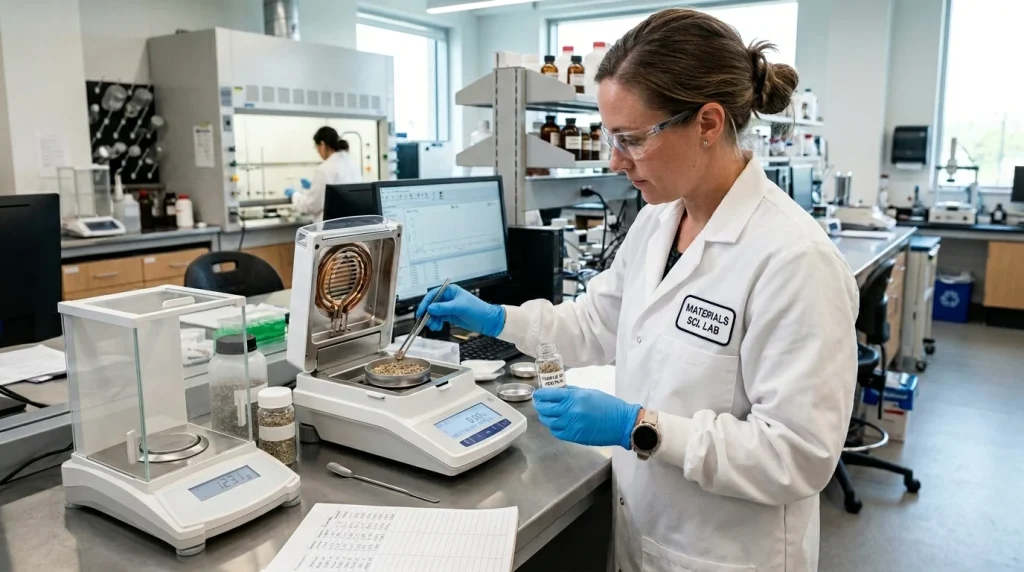
Moisture determination in pharmaceutical QC is an important analytical activity used to determine water content or, depending on the specified method, assess loss of volatile material in pharmaceutical materials and products. Water can influence chemical stability, physical properties, manufacturing performance, and product quality.
Several analytical approaches may be used depending on the material and the intended purpose of testing. Karl Fischer titration is commonly used when specific determination of water is required, while Loss on Drying (LOD) measures mass loss under specified drying conditions and is not necessarily specific to water.
The appropriate test method and acceptance criterion should always be based on the applicable pharmacopoeial monograph, approved specification, and validated analytical procedure.
What Is Moisture Determination?
Moisture determination refers to the analytical evaluation of water content or, where applicable, the loss of volatile material from a pharmaceutical sample under specified test conditions.
Water may be present in different forms, including:
- Free or surface water
- Adsorbed water
- Absorbed water
- Water of crystallization or hydration
The nature of the material and the purpose of testing determine which analytical method is appropriate.
Why Is Moisture Determination Important in Pharmaceutical QC?
Moisture can affect several pharmaceutical quality attributes.
1. Chemical Stability
Water can contribute to chemical degradation reactions such as hydrolysis in susceptible materials.
For moisture-sensitive APIs and formulations, controlling water content can therefore be important for maintaining stability.
2. Physical Properties
Moisture may influence:
- Powder flow
- Compressibility
- Caking
- Stickiness
- Particle behavior
- Tablet properties
These changes can affect manufacturing and finished-product performance.
3. Manufacturing Performance
Moisture can influence processes such as:
- Granulation
- Drying
- Milling
- Blending
- Compression
- Encapsulation
- Powder handling
Therefore, moisture control may be relevant throughout pharmaceutical manufacturing.
4. Product Quality and Stability
Changes in moisture during storage can contribute to physical or chemical changes.
Factors such as packaging, environmental humidity, container-closure performance, formulation characteristics, and storage conditions can influence moisture levels.
When scientifically justified, moisture may therefore be monitored as part of product specifications or stability programs.
Common Methods for Moisture Determination
The appropriate method depends on the material, analytical purpose, specification, and applicable pharmacopoeial requirement.
Common approaches include:
- Karl Fischer titration
- Loss on Drying
- Azeotropic distillation
- Gravimetric methods
- Other validated instrumental moisture methods
Karl Fischer Titration
Karl Fischer titration is a chemical method used specifically to determine water.
It is particularly useful when the analytical requirement is for water content rather than total volatile material.
Two common approaches are:
Volumetric Karl Fischer
In volumetric Karl Fischer titration, water is determined from the amount of standardized Karl Fischer reagent consumed during the titration.
It is generally suitable for samples containing comparatively higher amounts of water.
Coulometric Karl Fischer
In coulometric Karl Fischer analysis, iodine is generated electrochemically and the electrical charge associated with its generation is used to determine the amount of water.
It is commonly used for low levels of water.
The appropriate technique should be selected according to the sample and validated analytical procedure.
Loss on Drying
Loss on Drying (LOD) is a gravimetric test in which a sample is exposed to specified drying conditions and the resulting loss in mass is determined.
An important point is that LOD does not necessarily measure water alone.
The measured loss may include water as well as other volatile substances, depending on the material and test conditions.
Therefore, LOD and Karl Fischer results should not automatically be considered equivalent.
https://pharmavk.com/lod-vs-loq/
Karl Fischer vs Loss on Drying
| Parameter | Karl Fischer | Loss on Drying |
|---|---|---|
| Main purpose | Determine water | Determine mass lost during drying |
| Principle | Chemical determination of water | Gravimetric measurement |
| Specific for water? | Yes, when appropriately applied | Not necessarily |
| Typical result | % water or ppm water | % loss on drying |
| Main advantage | Water-specific measurement | Simple gravimetric approach |
| Main consideration | Reagent, instrument and sample control | Drying conditions and possible loss of other volatiles |
A simple way to remember the difference is:
Karl Fischer → How much water is present?
Loss on Drying → How much mass is lost under specified drying conditions?
The applicable pharmacopoeial monograph or approved analytical procedure should determine which test is required.
Factors That Can Affect Moisture Results
Accurate moisture testing requires appropriate control of analytical conditions.
1. Sample Handling
https://pharmavk.com/Handling-Suspecte/
Samples can gain or lose moisture when exposed to the environment.
Therefore:
- Minimize unnecessary exposure
- Use appropriate containers
- Close containers promptly
- Follow the approved sample-handling procedure
2. Environmental Humidity
High or changing humidity can affect moisture-sensitive and hygroscopic materials.
3. Sample Homogeneity
The sample should be representative of the material being tested.
Poor sampling or inadequate mixing can contribute to variable results.
4. Sample Quantity
The sample quantity should follow the approved analytical procedure.
An inappropriate sample quantity may affect the reliability of the result.
5. Instrument Condition
For instrumental methods, the equipment should be maintained and operated according to approved procedures.
Required calibration, verification, conditioning, or system checks should be completed before analysis.
6. Reagent Quality
For Karl Fischer analysis, reagent quality and suitability are important.
The laboratory should follow the approved procedure for reagent preparation, storage, standardization, and suitability checks.
Karl Fischer Titration: Basic Procedure
The exact procedure depends on the instrument, sample type, and validated analytical method.
A general workflow is:
Instrument Preparation → Reagent Check → Required System Checks → Sample Preparation → Titration → Calculation → Data Review
Step 1: Prepare the Instrument
Ensure that the Karl Fischer instrument is ready for analysis according to the approved SOP.
Step 2: Check Reagent Condition
Verify that the reagent is suitable for use and meets applicable laboratory requirements.
Step 3: Perform Required Checks
Complete applicable conditioning, drift checks, standardization, or other system suitability/performance checks.
Step 4: Prepare the Sample
Weigh or introduce the required sample quantity according to the approved analytical procedure.
Step 5: Perform the Titration
The instrument determines the amount of water present using the Karl Fischer reaction.
Step 6: Record the Result
Calculate and report the result in the units specified by the analytical procedure.
Step 7: Review the Data
Review the raw data, calculations, instrument information, and applicable acceptance criteria before reporting the result.
Example of Moisture Calculation
Suppose a validated analytical procedure gives the following result:
Water content = 1.8% w/w
If the approved specification is:
Water: NMT 2.0%
the result meets the stated specification.
However, interpretation must always be based on the approved specification and analytical procedure applicable to that material.
Moisture Determination in Pharmaceutical Materials
Raw Materials
Moisture testing may be relevant for raw materials because water can affect:
- Material stability
- Powder properties
- Processing behavior
- Storage stability
- Manufacturing consistency
The applicable specification should define whether water, LOD, or another moisture-related test is required.
APIs
Moisture may affect:
- Chemical stability
- Solid-state properties
- Handling characteristics
- Purity
- Storage stability
The appropriate analytical method depends on the API and its approved specification.
Finished Products
Moisture may be evaluated in products such as:
- Tablets
- Capsules
- Powders
- Granules
- Lyophilized products
- Certain semisolid formulations
The relevance of moisture depends on the dosage form and formulation.
Moisture Content vs Water Activity
Moisture content and water activity are not the same measurement.
Moisture Content
Moisture or water content describes the amount of water determined by the applicable analytical method.
Water Activity
Water activity describes the availability of water for physical, chemical, and microbiological processes.
Therefore:
Moisture content = How much water is present?
Water activity = How available is that water?
Both can provide useful information, but they answer different analytical questions.
Moisture and Stability Studies
Moisture may be an important consideration during stability studies when it is relevant to product quality.
Changes in moisture can be associated with:
- Packaging characteristics
- Environmental humidity
- Container-closure performance
- Formulation properties
- Storage conditions
When moisture is a relevant quality attribute, it may be monitored according to the approved stability protocol.
Analytical procedures used for release or stability testing should be appropriately validated for their intended purpose.
Role of QC in Moisture Determination
Depending on the laboratory’s responsibilities, QC analysts may perform or support:
- Sample receipt and preparation
- Instrument operation
- Reagent preparation
- Standardization where applicable
- Moisture analysis
- Raw-data recording
- Calculations
- Result review
- Reporting
- Analytical record maintenance
All activities should follow approved SOPs, analytical methods, specifications, and data-integrity requirements.
Role of QA
QA may provide oversight of:
- Analytical documentation
- Deviations
- OOS investigations
- Change controls
- Analytical validation documentation
- Data-integrity controls
- Audit and inspection readiness
The exact responsibilities depend on the site’s quality-management system.
What If a Moisture Result Is OOS?
If a moisture result is outside the approved specification, the laboratory should follow the applicable OOS or laboratory investigation procedure.
A general investigation may include:
- Verify the original result and calculations.
- Review instrument status and relevant checks.
- Review reagent suitability.
- Review sample preparation and handling.
- Check for transcription or calculation errors.
- Review environmental conditions where relevant.
- Evaluate the analytical procedure and raw data.
- Follow the approved OOS investigation process.
- Perform additional testing only when scientifically justified and permitted by the procedure.
- Document the investigation and conclusion.
A failing result should not simply be discarded because a later result passes.
Common Mistakes in Moisture Determination
Mistake 1: Assuming LOD Measures Only Water
LOD measures mass loss under specified drying conditions and may include volatile substances other than water.
Mistake 2: Treating Karl Fischer and LOD as Interchangeable
The two methods measure different analytical attributes and should be used according to the applicable specification and procedure.
Mistake 3: Leaving Hygroscopic Samples Exposed
Moisture-sensitive materials can exchange water with the environment and potentially affect the analytical result.
Mistake 4: Ignoring the Applicable Monograph
The individual pharmacopoeial monograph or approved specification may specify the required method and acceptance criterion.
Mistake 5: Repeating an OOS Result Without Investigation
Additional testing should be scientifically justified and performed according to the approved OOS/laboratory investigation procedure.
Frequently Asked Questions
Which method is commonly used for water determination?
Karl Fischer titration is commonly used when specific determination of water is required. However, the applicable monograph or approved analytical procedure determines the appropriate method.
Is Karl Fischer better than Loss on Drying?
Neither method is universally better. Karl Fischer is appropriate when water itself needs to be measured, while LOD is appropriate when loss of volatile material under specified drying conditions is the required attribute.
Is Loss on Drying specific for water?
No. Depending on the material and test conditions, LOD can include loss of volatile substances other than water.
Why is moisture controlled in pharmaceutical manufacturing?
Moisture can influence chemical stability, physical properties, processing behavior, and other product-quality attributes.
Is moisture content the same as water activity?
No. Moisture content describes the amount of water measured by an analytical method, whereas water activity describes the availability of water.
What should QC do if moisture is OOS?
QC should follow the approved OOS or laboratory investigation procedure, review the original data and analytical process, and perform additional testing only when scientifically justified.
Conclusion
Moisture determination in pharmaceutical QC is an important analytical activity used to evaluate water content or, depending on the method, loss of volatile material under specified conditions.
Karl Fischer titration is commonly used for specific water determination, while Loss on Drying measures mass loss during defined drying conditions. These methods should not automatically be considered interchangeable.
Understanding the differences between Karl Fischer, Loss on Drying, moisture content, and water activity helps QC and QA professionals select and interpret moisture-related tests appropriately.
The applicable pharmacopoeial monograph, approved specification, validated analytical procedure, and laboratory SOP should always take precedence over general educational guidance.
References
- United States Pharmacopeia (USP), General Chapter <921>: Water Determination.
- United States Pharmacopeia (USP), General Chapter <731>: Loss on Drying.
- United States Pharmacopeia (USP), General Chapter <922>: Water Activity.
- International Council for Harmonisation (ICH), Q2(R2): Validation of Analytical Procedures.
- United States Pharmacopeia (USP), General Chapter <1112>: Application of Water Activity Determination to Nonsterile Pharmaceutical Products.