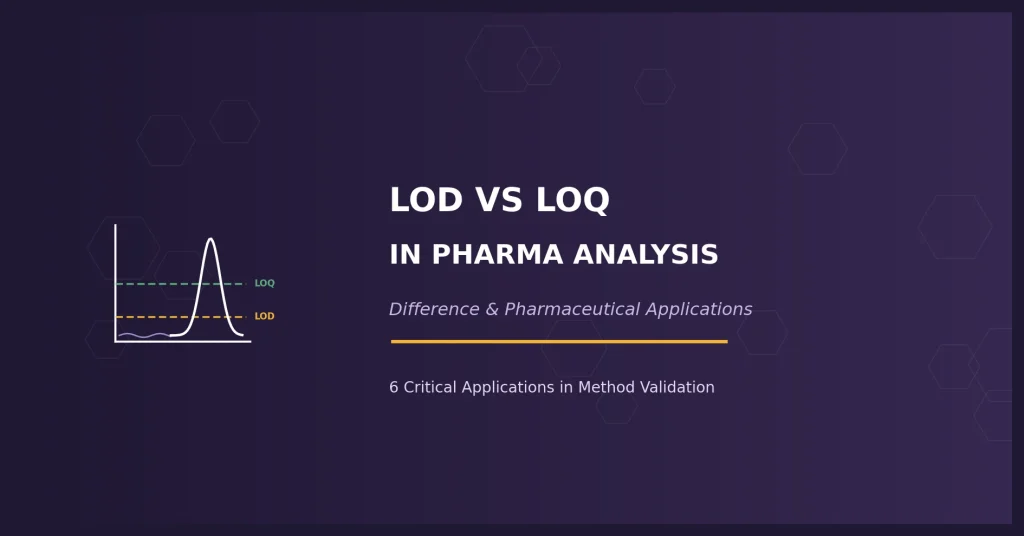
LOD vs LOQ: Difference and Pharmaceutical Applications
In pharmaceutical quality control, analytical methods must be capable of detecting and, when required, accurately quantifying small amounts of an analyte. Two important parameters used to describe the sensitivity of an analytical procedure are the Limit of Detection (LOD) and Limit of Quantitation (LOQ). Although closely related, LOD vs LOQ comes down to different purposes: LOD indicates the lowest amount of an analyte that can be reliably detected, while LOQ represents the lowest amount that can be quantitatively determined with suitable accuracy and precision.
These concepts matter especially when developing and validating analytical methods for impurities, degradation products, residual substances, and other low-level components in pharmaceutical products. ICH Q2(R2) identifies detection limit (DL) and quantitation limit (QL) as lower-range-limit considerations for appropriate analytical procedures, particularly when the analytical range is close to these limits.
What Is LOD?
Limit of Detection (LOD) is the lowest amount or concentration of an analyte in a sample that can be detected by an analytical procedure — although it may not be possible to determine its exact quantity with suitable accuracy and precision. In simple terms, LOD answers: “Can the analyte be detected?”
For example, if an impurity is present at a concentration close to the LOD, the method may indicate the impurity is present, but the reported numerical value may not be reliable enough for quantitative reporting. ICH Q2(R2) refers to this parameter as the Detection Limit (DL).
What Is LOQ?
Limit of Quantitation (LOQ) is the lowest amount or concentration of an analyte that can be quantitatively determined with suitable accuracy and precision using an analytical procedure. In simple terms, LOQ answers: “Can the analyte be measured reliably?”
An analytical method can generally detect an analyte at a concentration around its LOD, but reliable numerical quantitation requires the concentration to be at or above the established LOQ. FDA guidance similarly describes the detection limit as the lowest amount that can be detected but not necessarily accurately quantified, while the quantitation limit concerns quantitative determination with suitable precision and accuracy.
LOD vs LOQ: Key Difference
The main difference between LOD and LOQ is the level of certainty associated with the analytical result.
| Parameter | LOD | LOQ |
|---|---|---|
| Full form | Limit of Detection | Limit of Quantitation |
| ICH Q2(R2) terminology | Detection Limit (DL) | Quantitation Limit (QL) |
| Main purpose | Detect the analyte | Quantify the analyte |
| Result | Presence can be detected | Reliable numerical result can be obtained |
| Accuracy and precision | Not necessarily suitable for quantitative reporting | Suitable accuracy and precision should be demonstrated |
| Typical use | Detection of very low levels | Quantitation of low-level analytes |
| Relative level | Lower | Higher |
| Common application | Detection of impurities or contaminants | Quantification of impurities and degradation products |
ICH Q2(R2) specifically distinguishes DL and QL as lower-range limits and notes that QL is relevant where quantitative determination at low concentrations is required.
Why Are LOD and LOQ Important in Pharmaceutical Analysis?
Pharmaceutical products may contain very small quantities of impurities, degradation products, residual substances, or other analytes that need to be controlled, so a suitable analytical method must have adequate sensitivity for its intended purpose. LOD and LOQ matter for impurity testing, degradation product analysis, stability studies, residual solvent analysis, trace-level contaminant testing, cleaning verification and validation, process-related impurity testing, pharmaceutical method validation, and environmental/analytical monitoring where applicable. ICH Q2(R2) states that analytical procedure validation should demonstrate a procedure is fit for its intended purpose, with validation characteristics selected based on intended analytical use.
https://pharmavk.com/method-suitability-test-microbiology/
How Are LOD and LOQ Determined?
The appropriate approach depends on the analytical procedure, technology, and intended purpose. ICH Q2(R2) describes several approaches for establishing lower range limits.
1. Visual Evaluation
Used for instrumental and non-instrumental procedures: samples with known concentrations of the analyte are analyzed to establish the minimum level at which the analyte can be reliably detected or quantified. Useful when the analytical response can be clearly evaluated visually.
2. Signal-to-Noise Approach
Particularly relevant to procedures with baseline noise, such as some chromatographic methods — the response from a low-concentration sample is compared with the response from a blank or baseline region. ICH Q2(R2) states a signal-to-noise ratio of approximately 3:1 is generally acceptable for estimating the detection limit, while at least 10:1 is acceptable for the quantitation limit:
LOD ≈ signal-to-noise ratio of 3:1 LOQ ≈ signal-to-noise ratio of at least 10:1
These are general approaches, not universal acceptance criteria for every analytical procedure.
3. Standard Deviation and Slope Approach
ICH Q2(R2) also describes an approach based on the standard deviation of the response and the slope of the calibration curve:
LOD = 3.3σ / S LOQ = 10σ / S
Where σ = standard deviation of the response and S = slope of the calibration curve. These equations apply when appropriate for the analytical procedure and should be supported by suitable validation data.
4. Accuracy and Precision at the Lower Range
For quantitative procedures, the lower limit can also be supported by demonstrating acceptable accuracy and precision at low concentrations — particularly useful when reliable quantitative measurement close to the lower range limit is required. ICH Q2(R2) includes this among the approaches for evaluating lower range limits.
Simple Example of LOD and LOQ
Consider an HPLC method developed to determine a pharmaceutical impurity, with LOD = 0.03 µg/mL and LOQ = 0.10 µg/mL.
- A sample containing ~0.02 µg/mL: the impurity may not be reliably detected.
- A sample containing 0.05 µg/mL: the impurity may be detectable, but it’s below the LOQ — reliable quantitative reporting may not be appropriate based solely on this.
- A sample containing 0.15 µg/mL: above the LOQ, so the method may be capable of quantifying it, provided suitable performance has been demonstrated at that level.
This illustrates an important principle: detection does not automatically mean reliable quantitation.
Relationship Between LOD, LOQ and Analytical Sensitivity
LOD and LOQ are closely related to the sensitivity of an analytical procedure — a highly sensitive method can detect smaller quantities of an analyte. But sensitivity shouldn’t be judged only by a low numerical LOD or LOQ; the method must also be suitable for its intended purpose, including appropriate specificity/selectivity, accuracy, precision, and other relevant performance characteristics. ICH Q2(R2) emphasizes that validation should be designed around the intended purpose of the procedure, rather than applying the same validation approach to every method.
LOD vs LOQ: 6 Pharmaceutical Applications
1. Impurity Testing
LOD and LOQ matter especially when impurities — organic impurities, process-related impurities, degradation products, related substances — need to be detected or quantified at low concentrations. For quantitative impurity methods, the LOQ should match the level at which quantitative reporting is required.
2. Stability Studies
A drug substance or product may generate degradation products over time, and a sufficiently sensitive method helps detect changes at low concentrations. A stability-indicating procedure should be capable of detecting relevant changes in quality attributes during storage; ICH Q2(R2) discusses using appropriate stressed and degraded samples to demonstrate stability-indicating properties.
3. Cleaning Validation
Analytical methods used for cleaning validation or verification may need sufficient sensitivity to detect residues at established acceptable levels. FDA’s GMP guidance for APIs states validated analytical methods used for cleaning-related testing should have sufficient sensitivity to detect established acceptable levels of residues or contaminants.
4. Residual Solvent Analysis
Residual solvents may need control at low concentrations — methods like gas chromatography can be developed and validated to detect and quantify them at appropriate levels, depending on intended use and applicable specifications.
5. Degradation Product Analysis
During development and stability testing, degradation products may occur at low levels. LOD helps establish whether a degradation product can be detected; LOQ matters when it needs to be quantitatively determined.
6. Trace-Level Testing
Some analytical procedures involve measuring substances at very low concentrations, where establishing appropriate lower-range performance helps demonstrate the method is suitable for its intended purpose.
LOD vs LOQ: A Simple Way to Remember
A simple way for students and freshers to remember the difference:
LOD = Detect LOQ = Quantify
Think of it like this: LOD → “I can see it.” LOQ → “I can measure it reliably.” This distinction is especially useful during pharmaceutical QA and QC interviews.
Common Mistakes When Understanding LOD and LOQ
- Treating LOD as a quantitative result — detection at the LOD doesn’t automatically mean the analyte can be accurately quantified
- Assuming LOQ is always exactly three times LOD — the relationship depends on the methodology and assumptions used; the commonly encountered 3.3σ/S and 10σ/S expressions are specific calculation approaches, not a universal rule
- Using the same LOD and LOQ for every method — these depend on the analytical procedure, analyte, matrix, instrumentation, and intended purpose
- Ignoring matrix effects — sample matrices can influence analytical response and affect method sensitivity
- Focusing only on numerical values — a very low LOD doesn’t by itself demonstrate a method is fit for purpose; relevant validation characteristics must be considered based on intended use
LOD, LOQ, and Specification Limit: What’s the Difference?
| Term | Meaning |
|---|---|
| LOD | Lowest level that can be reliably detected |
| LOQ | Lowest level that can be quantitatively determined with suitable performance |
| Specification limit | Established acceptance criterion for the product or analyte |
A method’s LOD or LOQ describes analytical capability, while a specification limit describes an acceptance requirement — the analytical method must have appropriate capability for whatever specification or reporting requirement it’s meant to support.
Role of QA and QC in LOD and LOQ
QC Role
QC generally performs the analytical work and generates the data needed to establish or verify method performance — preparing standards and samples, performing analytical runs, recording raw data, calculating LOD and LOQ where applicable, evaluating precision and accuracy, maintaining chromatograms and analytical records, and reporting results.
QA Role
QA provides oversight of the analytical validation process and associated documentation — reviewing validation protocols and reports, acceptance criteria, deviations, calculations, raw data integrity, change controls, method validation documentation, and compliance with applicable procedures and regulations.
LOD and LOQ in Analytical Method Validation
LOD and LOQ shouldn’t be considered independently from the overall analytical method validation strategy. Depending on the procedure and intended use, relevant validation characteristics can include specificity/selectivity, range, response, accuracy, precision, detection limit, quantitation limit, and robustness. ICH Q2(R2) provides a framework for selecting and evaluating these characteristics based on the analytical procedure and its intended purpose.
https://pharmavk.com/dissolution-testing-in-pharmaceutical-qc/
LOD vs LOQ: Interview Questions
1. What is LOD?
LOD is the lowest amount of an analyte that can be reliably detected by an analytical procedure but may not be quantitatively determined with suitable accuracy and precision.
2. What is LOQ?
LOQ is the lowest amount of an analyte that can be quantitatively determined with suitable accuracy and precision.
3. Which is lower, LOD or LOQ?
Generally LOD, since detection requires less analytical capability than reliable quantitative measurement.
4. What is the typical signal-to-noise ratio for LOD?
ICH Q2(R2) states approximately 3:1 is generally considered acceptable for estimating the detection limit, when this approach applies.
5. What is the typical signal-to-noise ratio for LOQ?
At least 10:1 is generally considered acceptable for estimating the quantitation limit, when the signal-to-noise approach applies.
6. Where is LOQ particularly important?
When low concentrations of impurities or degradation products need to be quantitatively determined.
Frequently Asked Questions
Is LOD lower than LOQ?
Generally, yes. LOD represents the level at which an analyte can be detected, while LOQ represents the lower level at which it can be quantitatively determined with suitable performance.
Can an analyte be detected below the LOQ?
Yes. An analyte may be detectable at a concentration below the LOQ, but the method may not provide a sufficiently reliable quantitative result at that level.
Is LOD the same as detection limit?
Yes. ICH Q2(R2) uses the term Detection Limit (DL), while LOD is a commonly used term for the same concept.
Is LOQ the same as quantitation limit?
Yes. ICH Q2(R2) uses Quantitation Limit (QL), while LOQ is the commonly used abbreviation.
Are LOD and LOQ required for every analytical method?
Not necessarily. Their evaluation depends on the analytical procedure, its intended purpose, and the applicable validation strategy — ICH Q2(R2) indicates lower-range-limit evaluation is particularly relevant when the analytical range is close to the DL or QL.
Conclusion
LOD and LOQ are important concepts in pharmaceutical analytical method development and validation. LOD focuses on reliable detection, while LOQ focuses on reliable quantitation — LOD helps determine whether a low-level analyte can be detected, while LOQ establishes the lowest level at which quantitative measurement can be performed with suitable performance.
Their appropriate evaluation depends on the analytical procedure, analyte, matrix, technology, and intended purpose. ICH Q2(R2) provides several approaches for evaluating lower range limits, including visual evaluation, signal-to-noise, statistical calculations using response variability and slope, and evaluation of accuracy and precision at low levels. For pharmaceutical QC and QA professionals, understanding LOD vs LOQ matters not only for analytical method validation but also for impurity testing, stability studies, cleaning-related testing, and other low-level analytical applications.
References