Antimicrobial Effectiveness Testing (AET) also known as Preservative Effectiveness Testing (PET) or USP <51> is a standardized laboratory method used to measure how well a product’s preservative system kills or inhibits microorganisms over a 28-day period. It’s particularly relevant for multidose and preserved pharmaceutical preparations, where repeated use can introduce microorganisms into the product.
AET helps demonstrate that a preservative system provides appropriate microbiological protection throughout the product’s relevant lifecycle and use conditions. This article covers the underlying principle, why AET matters, and the four-step process used to run the test.
What Is Antimicrobial Effectiveness Testing?
Antimicrobial Effectiveness Testing is a challenge test: specified microorganisms are deliberately introduced into the product, and their numbers are tracked over defined time intervals to see whether the preservative system controls them as required. It’s also commonly called Preservative Effectiveness Testing (PET), and is formally defined in USP General Chapter <51>.
https://pharmavk.com/method-suitability-test-microbiology/
Principle of Antimicrobial Effectiveness Testing
The basic principle involves deliberately introducing specified microorganisms into the test product and monitoring their numbers over defined time intervals. The general concept:
Inoculate → Incubate → Recover → Count → Compare with Acceptance Criteria
If the preservative system is effective, the microorganisms show the required reduction or controlled growth pattern specified by the applicable compendial method.
Why Is Antimicrobial Effectiveness Testing Important?
An effective preservative system helps control microorganisms that may enter the product during manufacturing or, especially, during repeated use. Antimicrobial Effectiveness Testing helps pharmaceutical manufacturers:
- Evaluate preservative performance
- Support the microbiological quality of preserved products
- Identify inadequate preservative systems before they reach the market
- Support formulation development
- Verify microbiological protection under the applicable test conditions
- Reduce the risk associated with microbial proliferation during product use
https://pharmavk.com/cleaning-validation-in-pharma-critical-guide-to-maco-hbel-pde/
How Is Antimicrobial Effectiveness Testing Performed?
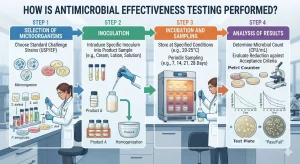
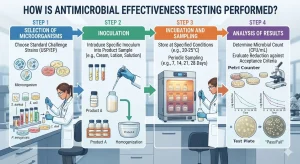
Step 1: Selection of Microorganisms
Specified challenge microorganisms typically representative bacteria and fungi per the applicable compendial method are selected based on the product type and relevant regulatory requirements.
Step 2: Inoculation of the Product
The selected microorganisms are introduced into the product at a defined starting concentration, simulating potential contamination during use.
Step 3: Incubation and Sampling
The inoculated product is incubated under controlled conditions, with samples taken at defined intervals commonly initial, day 7, day 14, and day 28 to track how the microbial population changes over time.
Step 4: Analysis of Results
Microbial counts recovered at each interval are compared against the acceptance criteria defined in the applicable compendial method. A passing result shows the required log reduction or controlled growth pattern, demonstrating the preservative system is adequately protecting the product.
Frequently Asked Questions
What is the difference between AET and PET?
None — Antimicrobial Effectiveness Testing (AET) and Preservative Effectiveness Testing (PET) are two names for the same test, most formally defined as USP <51>.
How long does Antimicrobial Effectiveness Testing take?
The standard test period is 28 days, with microbial counts typically checked at initial, day 7, day 14, and day 28 intervals.
Which products require Antimicrobial Effectiveness Testing?
It’s especially relevant for multidose and preserved pharmaceutical preparations, where repeated container access can introduce microorganisms as well as other preserved aqueous products where microbiological protection during use needs to be demonstrated.
What happens if a product fails Antimicrobial Effectiveness Testing?
The preservative system needs reformulation adjusting preservative type, concentration, or combination followed by re-testing to confirm the revised formulation meets the acceptance criteria.
Is Antimicrobial Effectiveness Testing the same as a Method Suitability Test?
No, though they’re related. A Method Suitability Test confirms a product doesn’t interfere with a lab’s ability to detect microorganisms at all; Antimicrobial Effectiveness Testing specifically measures how well the product’s preservative system reduces or controls microorganisms over time.
Conclusion
Antimicrobial Effectiveness Testing gives pharmaceutical manufacturers documented evidence that a product’s preservative system can actually do its job controlling microbial contamination introduced during manufacturing or repeated use, over the product’s real-world lifecycle. Running the four-step process correctly, with the right challenge microorganisms and sampling intervals, is what separates a preservative system that looks adequate on paper from one that’s actually been proven to work.
References