About
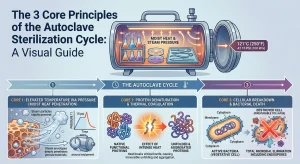
An autoclave uses moist heat under pressure to achieve complete sterilization. It works through three core mechanisms.
Elevated Temperature via Pressure:
By trapping steam and raising internal pressure to 15 psi (100 kPa), the boiling point of water increases from 100°C to 121°C. This superheated moist heat penetrates cell walls far faster and deeper than dry heat.
Protein Denaturation:
The extreme heat disrupts the non-covalent bonds (such as hydrogen and disulfide bonds) holding bacterial proteins and structural enzymes together. The proteins unfold, lose their 3D shape, and irreversibly aggregate—a process called thermal coagulation.
Cellular Breakdown:
Once key structural proteins and metabolic enzymes break down, the cell membrane ruptures, essential life processes halt instantly, and the bacteria die.
Conclusion:
This combination of temperature and pressure is so effective that it destroys active vegetative cells along with heat-resistant bacterial endospores (such as Bacillus and Clostridium species) within 15–20 minutes.