Disinfectant efficacy testing in pharmaceutical industry practice helps demonstrate that a selected disinfectant can effectively reduce or eliminate microorganisms under defined conditions of use essential for maintaining microbiological control in cleanrooms and other controlled environments. Effectiveness depends on several factors: the microorganism, disinfectant concentration, contact time, surface type, temperature, organic load, and application method.
This article covers what disinfectant efficacy testing involves, why it matters, how a study is designed and run step by step, the common test methods, and how disinfectant validation ties into a facility’s broader contamination-control strategy.
What Is Disinfectant Efficacy Testing in Pharmaceutical Industry?
Definition
Disinfectant efficacy testing in pharmaceutical industry practice is a microbiological evaluation performed to determine whether a disinfectant can consistently achieve the required level of microbial reduction under specified conditions. In pharmaceutical manufacturing, testing is generally designed around the actual cleaning and disinfection programme, not just to show a chemical has antimicrobial activity in a lab.
A study may evaluate bacterial vegetative cells, yeasts and moulds, bacterial spores, environmental isolates, and standard reference microorganisms across different manufacturing surfaces, disinfectant concentrations, contact times, and environmental conditions. USP General Chapter <1072> emphasizes that a sound cleaning and sanitization programme should control microbial contamination while also considering the disinfectant’s spectrum of activity and compatibility with surfaces.
Key Features
| Factor | Why It Matters |
|---|---|
| Disinfectant concentration | Determines antimicrobial activity |
| Contact time | Determines how long microorganisms remain exposed |
| Microorganism | Different organisms have different resistance levels |
| Surface type | Stainless steel, glass, plastic, and other materials may behave differently |
| Organic load | Organic material can interfere with disinfectant activity |
| Temperature | Can influence microbial inactivation |
| Application method | Wiping, spraying, mopping, or immersion can affect performance |
| Neutralization | Prevents residual disinfectant from continuing to kill microorganisms during recovery |
| Recovery method | Determines whether surviving organisms can be accurately detected |
A pharmaceutical disinfectant programme should also consider whether the disinfectant is suitable for routine use and whether a separate sporicidal agent is needed many commonly used disinfectants, including 70% isopropyl alcohol, are not effective against bacterial spores.
Why Is Disinfectant Efficacy Testing in Pharmaceutical Industry Important?
Benefits
- Microbial contamination control: the primary objective is reducing microbial contamination on surfaces in controlled manufacturing environments
- Support for GMP compliance: a scientifically justified disinfection programme backs the facility’s overall contamination control strategy
- Evidence-based disinfectant selection: testing lets manufacturers choose disinfectants based on demonstrated performance, not just supplier claims
- Identification of effective contact time: the study can show whether the disinfectant works within the contact time specified in the SOP
- Support for environmental monitoring: environmental monitoring data helps identify organisms relevant to the facility that should be considered in efficacy studies
- Surface compatibility: disinfectants need to be effective and suitable for the surfaces they’re used on; USP <1072> flags surface compatibility as a key selection factor
Applications
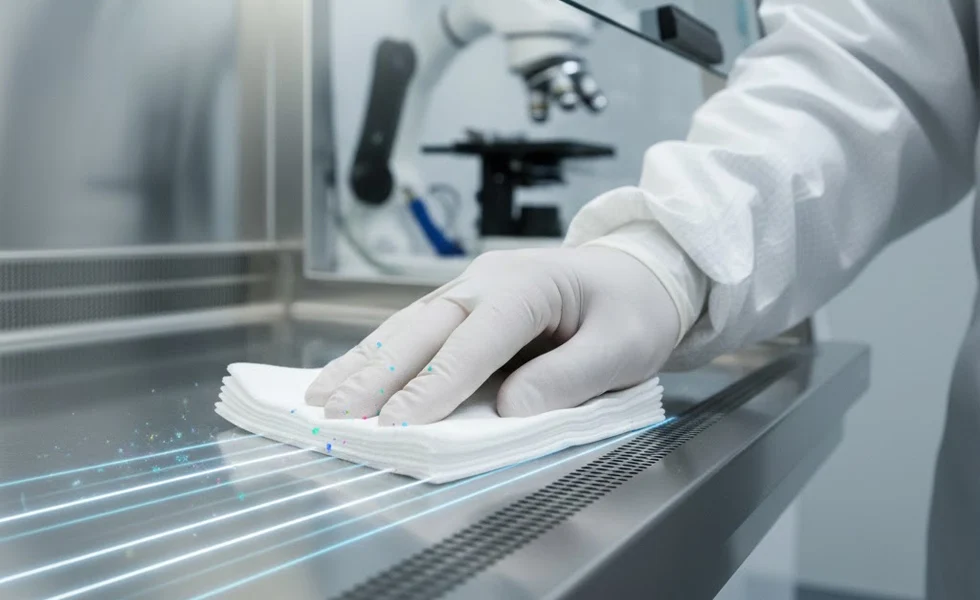
Disinfectant efficacy testing can support disinfection programmes for cleanrooms, aseptic processing areas, filling rooms, material and personnel airlocks, corridors and controlled areas, manufacturing equipment, work surfaces (stainless steel, glass, plastic), equipment exteriors, and environmental monitoring sampling areas. The exact scope should be established through a documented, risk-based approach.
How Does Disinfectant Efficacy Testing in Pharmaceutical Industry Work?
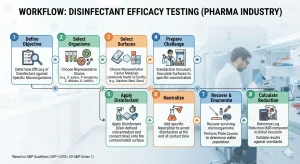
A typical study follows a controlled sequence from design through final report.
Step 1: Define the Study Objective
The protocol should define the disinfectant name and formulation, concentration, intended contact time, target surfaces, test microorganisms, test method, acceptance criteria, controls, replicates, neutralization procedure, and recovery method and should be approved before testing begins.
Step 2: Select Test Microorganisms
Microorganisms are chosen based on the intended application, regulatory expectations, disinfectant spectrum, and facility-specific environmental monitoring data. Common challenge organisms include representative Gram-positive bacteria, Gram-negative bacteria, yeasts, moulds, and bacterial spores. Facility environmental isolates add valuable, site-specific information a robust programme shouldn’t assume one microorganism represents every contamination risk.
Step 3: Select Representative Surfaces
Testing should reflect the surfaces the disinfectant will actually be used on stainless steel, glass, polycarbonate, PVC, epoxy-coated surfaces, and other facility materials. Regulatory inspection observations have highlighted the importance of including surfaces representative of actual use areas.
Step 4: Prepare the Microbial Challenge
A defined microbial inoculum is applied to the test surface or carrier, providing an appropriate challenge under controlled, reproducible conditions. Appropriate controls establish the initial microbial population, microbial recovery, neutralizer effectiveness, neutralizer toxicity, and disinfectant effectiveness.
Step 5: Apply the Disinfectant
The disinfectant is applied per the intended procedure concentration, application volume, contact time, temperature, surface condition, and technique all matter. Test conditions should reflect actual or justified worst-case conditions. FDA guidance emphasizes that disinfecting procedures should be detailed enough to ensure reproducibility, including preparation, work sequence, and contact time.
Step 6: Neutralize the Disinfectant
After the specified contact time, the disinfectant must be neutralized or removed so it doesn’t keep killing microorganisms during sample processing. An ineffective neutralization system can produce falsely high microbial reductions, so the neutralization procedure itself should be demonstrated effective and non-toxic to the test organism.
Step 7: Recover and Enumerate Surviving Microorganisms
Surviving microorganisms are recovered using an appropriate microbiological method. Results may be expressed as CFU recovered, log10 reduction, percentage reduction, or a pass/fail result against predefined criteria.
Step 8: Calculate Microbial Reduction
Antimicrobial effectiveness is commonly expressed as a logarithmic reduction:
Log reduction = log₁₀ (Initial microbial count / Final microbial count)
For example, an initial population of 1,000,000 CFU reduced to 100 CFU gives log₁₀ (1,000,000 / 100) = a 4-log₁₀ reduction. The required reduction should always be defined in the approved protocol beforehand, not chosen after reviewing results.

Disinfectant Efficacy Testing Methods
Surface Carrier or Coupon Testing
Microorganisms are inoculated onto representative material coupons and exposed to the disinfectant useful for understanding performance on specific surfaces. Key considerations: surface material, inoculum concentration, drying conditions, disinfectant concentration, contact time, neutralization, recovery method, and replicate number.
Suspension Testing
Evaluates disinfectant activity against microorganisms suspended in a liquid system. Useful for intrinsic antimicrobial activity, but may not fully represent real-world surface disinfection conditions.
In Situ or Surface Qualification
Disinfectant effectiveness evaluated under actual facility conditions, which can capture factors not fully represented in lab testing. USP <1072> includes in situ qualification as part of disinfectant programme considerations.
Environmental Isolate Testing
Isolates recovered through routine environmental monitoring can be added to a disinfectant efficacy programme, providing site-specific information on whether the disinfectant is effective against organisms actually found in the facility. These should complement not replace the scientifically justified reference organisms required by the chosen test method.
Disinfectant Validation in Pharmaceutical Industry
Disinfectant validation is the documented process of demonstrating that a selected disinfectant and its defined application method can consistently achieve the required microbial reduction under specified conditions.
Objectives of Disinfectant Validation
- Demonstrating antimicrobial effectiveness and establishing disinfectant suitability
- Confirming the specified concentration and supporting the specified contact time
- Evaluating representative surfaces and assessing relevant microorganisms
- Establishing appropriate acceptance criteria and demonstrating effective neutralization
- Supporting the facility’s contamination control strategy and providing documented evidence for GMP compliance
FDA’s broader validation principles emphasize that validation should be supported by scientific data showing a process consistently performs as expected and meets predetermined specifications.
Validation Protocol
| Protocol Element | Description |
|---|---|
| Objective | What the study is intended to demonstrate |
| Scope | Areas, surfaces, and disinfectants covered |
| Responsibilities | Personnel responsible for execution and approval |
| Disinfectant | Product, formulation, and concentration |
| Microorganisms | Reference organisms and/or justified environmental isolates |
| Test surfaces | Representative facility materials |
| Contact time | Defined exposure period |
| Temperature | Specified test condition |
| Organic load | Defined where relevant |
| Neutralization | Validated neutralization system |
| Recovery | Microbial recovery method |
| Controls | Required positive, negative, and neutralization controls |
| Acceptance criteria | Predefined microbial reduction requirements |
| Deviations | Documentation and assessment |
| Final report | Results, conclusions, and approval |
Acceptance Criteria for Disinfectant Efficacy Testing
Acceptance criteria should be scientifically justified and set before testing begins based on required log reduction, absence of growth, specified microbial reduction, method-specific pass/fail criteria, the manufacturer’s validated claim, or applicable pharmacopoeial/regulatory expectations. One universal criterion shouldn’t be applied to every disinfectant study; USP <1072> specifically discusses acceptance criteria and challenge testing, including consideration of microbial groups such as fungal spores.
Role of Disinfection in Contamination Control
Role in Cleanroom Disinfection
In pharmaceutical cleanrooms, disinfection is a core part of contamination control, working together with cleaning, environmental monitoring, personnel practices, material transfer controls, air handling systems, cleaning validation, aseptic practices, and the broader contamination control strategy not as a standalone activity. EU GMP Annex 1 for sterile medicinal products, revised in August 2022 and effective from August 2023, reinforces this modern contamination-control approach.
https://pharmavk.com/pupsit-in-pharmaceutical-manufacturing/
Role of Sporicidal Disinfectants
Vegetative bacteria and spores don’t share the same resistance to disinfectants. A routine disinfectant may work well against vegetative microorganisms but have limited activity against bacterial spores which is why many facilities add a sporicidal disinfectant to their programme, based on risk assessment and environmental monitoring trends. FDA guidance similarly notes that common disinfectants may not be effective against spores and recommends including a sporicidal agent where appropriate.
Environmental Monitoring and Disinfectant Selection
Environmental monitoring results feed directly into how a disinfectant programme is reviewed. Repeated recovery of particular microorganisms may trigger investigation, trend analysis, a review of disinfectant effectiveness, cleaning procedures, contact time, or concentration, additional challenge testing, or CAPA where appropriate. The goal isn’t just passing environmental monitoring results it’s maintaining a genuine state of microbial control.
https://pharmavk.com//environmental-monitoring/
Common Problems and Challenges
- Incorrect contact time: a disinfectant can look effective in the lab but underperform if the surface doesn’t stay wet for the validated contact time
- Incorrect disinfectant concentration: improper dilution significantly affects performance; preparation and verification need controlled procedures
- Poor neutralization: incomplete neutralization can artificially inflate apparent antimicrobial effectiveness
- Inadequate recovery: an unsuitable recovery method may miss surviving microorganisms
- Limited surface selection: testing only one surface may not represent a facility with multiple construction materials
- Ignoring environmental isolates: relying only on generic organisms may miss unusual or persistent organisms the facility actually sees
- Organic interference: organic material can reduce effectiveness and should be considered where relevant
- Overreliance on supplier data: supplier efficacy data helps with selection, but manufacturers should check whether the supplier’s test conditions match their own use case
- Failure to reassess the programme: changes in disinfectants, surfaces, isolates, cleaning procedures, or facility design may call for reassessment; recent FDA inspection observations cite incomplete surface coverage and missing challenge organisms as recurring deficiencies
Best Practices for Disinfectant Efficacy Testing
- Use a written SOP: covering preparation, concentration, application method, contact time, frequency, surface cleaning, storage, handling, expiry/in-use period, and safety precautions
- Define worst-case conditions: minimum effective concentration, maximum practical contact time, organic load, temperature, surface type, and product age, where scientifically justified
- Include representative surfaces: based on actual facility construction and equipment materials
- Validate neutralization: confirming the neutralizer stops disinfectant activity without harming the recovered microorganisms
- Use appropriate controls: to confirm observed reductions come from the disinfectant, not other factors
- Include relevant microorganisms: scientifically justified reference organisms plus relevant environmental isolates
- Trend environmental monitoring results alongside disinfectant efficacy data rather than reviewing them separately
- Maintain documentation: approved protocols, raw data, calculations, incubation records, microbial ID results, deviations, investigations, final reports, CAPA records, and periodic reviews
- Reassess after significant changes: a new disinfectant or formulation, a new surface or cleanroom, changes to contact time or concentration, or significant environmental monitoring trends
Frequently Asked Questions
What is disinfectant efficacy testing?
A microbiological study used to demonstrate that a disinfectant can effectively reduce microorganisms under specified, controlled conditions.
Why is disinfectant efficacy testing important in pharmaceutical manufacturing?
It provides scientific evidence that the disinfectant and its application procedure are suitable for controlling microbial contamination in manufacturing environments.
Which microorganisms are used for disinfectant efficacy testing?
This depends on the test method and risk assessment, but studies typically include representative bacteria, yeasts, moulds, bacterial spores, and relevant environmental isolates.
Is 70% IPA effective against bacterial spores?
No 70% isopropyl alcohol is not effective against Bacillus spores, which is why a disinfection programme may need a suitable sporicidal agent where justified by risk and environmental monitoring.
Why is neutralization important?
Neutralization stops the disinfectant from continuing to act after the specified contact time. Without it, a study can overestimate how effective the disinfectant really is.
What is log reduction in disinfectant testing?
It expresses the decrease in viable microorganisms after treatment — for example, a reduction from 10⁶ CFU to 10² CFU is a 4-log reduction.
Should environmental isolates be included?
Yes, when scientifically justified — particularly where environmental monitoring identifies organisms relevant to the facility’s contamination-control strategy.
How often should disinfectant efficacy be tested?
There’s no single universal frequency. It should be set through the site’s risk assessment, validation programme, change-control system, environmental monitoring trends, and applicable GMP expectations.
Is disinfectant efficacy testing the same as cleaning validation?
No. Disinfectant efficacy testing evaluates antimicrobial effectiveness; cleaning validation evaluates whether a cleaning process consistently removes residues and contaminants to predefined levels. The two are related but address different objectives.
Conclusion
Disinfectant efficacy testing in pharmaceutical industry practice is a core part of an effective cleaning and contamination-control programme. A well-designed study evaluates the disinfectant, concentration, contact time, microorganisms, representative surfaces, neutralization, recovery method, and predefined acceptance criteria. Rather than choosing a disinfectant on its antimicrobial claim alone, manufacturers should demonstrate real-world performance and keep re-evaluating the programme through environmental monitoring, risk assessment, change control, and periodic review. Done well, this supports microbial control, GMP compliance, and product quality.
References