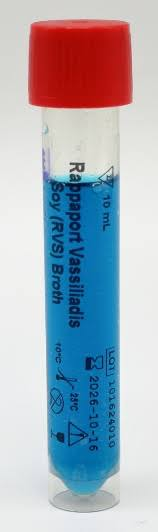
RVSEB (Rappaport–Vassiliadis Soya Peptone Broth) media contains some heat sensitive ingredients that can degrade at 121°C losing their
nutritive quality.
This media shall not support the growth of specified microorganisms.
When these media are sterilized at high temperature, the microorganism can grow but shall
not develop the characteristic colonies due to the degradation of the heat sensitive
ingredients.
Sterilization of the media and material is generally done at 121 °C but sometimes it is
required to do at low temperature (115°C) because of heat sensitivity of the material. This
sterilization below 121 °C is called Low-Temperature Sterilization.
The purpose of the medium they contain double sugar molecules so you should not be
autoclaved more than 115 degree celcius it will be denatured.
This medium is selective for Salmonella species because they are typically resistant to
malachite green, high osmotic pressure and low pH. S. typhi and S. choleraesuis are sensitive
to malachite green and may be inhibited.
Soya peptone provides the essential nutrients for the growth of the bacteria. Phosphate salts
act as buffer to maintain the pH.
Magnesium chloride maintains the high osmotic pressure and Salmonella generally survive at
little high osmotic pressure.
Malachite green inhibits other microorganisms other than Salmonella.
Reasons:
- To prevent degradation of selective agents
- To preserve nutrient quality
- To maintain proper pH and composition
- To achieve sterility without damaging the medium