

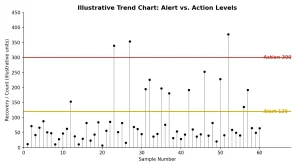
Alert Level vs Action Level is a distinction that matters anywhere environmental or process data is trended against thresholds cleanrooms, manufacturing, and laboratory settings like pharmaceutical or bioburden control. An alert level acts as an early warning for potential process drift, while an action level signals a true excursion that needs immediate investigation and corrective steps.
Think of an alert level as a car’s “check engine light” worth noting, not yet an emergency. An action level means “pull over and fix it now.” This article breaks down what each threshold means, how the required response differs, and a practical checklist for setting both limits.
https://pharmavk.com/environmental-monitoring/
What Is an Alert Level?
Definition
A statistical or operational threshold that signals a minor shift or upward trend away from normal conditions.
Meaning
The process is still within acceptable limits, but operations might be drifting from baseline. It means “pay attention.”
Response
An alert level doesn’t require a formal quality deviation or immediate corrective action. Operators typically review environmental data, temporarily increase monitoring frequency, check HVAC performance, or consider retraining staff.
What Is an Action Level?
Definition
A critical boundary of the acceptable operating range.
Meaning
The system or process has experienced a true excursion or loss of control.
Response
An action level requires a formal deviation report, product quarantine, root-cause investigation, and a Corrective and Preventive Action (CAPA) plan. Immediate intervention is mandatory to protect product quality.
https://pharmavk.com/Why-is-CAPA-Correct/
Alert Level vs Action Level: Key Differences
| Feature | Alert Level | Action Level |
|---|---|---|
| Primary role | Early warning sign | Control limit and failure notice |
| Deviation required | No (data remains within acceptable bounds) | Yes (raises a formal quality deviation) |
| Investigation | Optional trend review and increased monitoring | Mandatory root-cause analysis and CAPA |
| Product impact | No batch quarantine needed | Potential batch quarantine or rejection |
EU GMP Annex 1 and USP General Chapter <1116> both describe the use of alert and action levels as part of an effective environmental monitoring programme, with levels set based on historical facility data rather than fixed industry-wide numbers.
Practical Checklist for Setting Alert and Action Levels
- Collect data : review 6-12 months of environmental monitoring (EM) data for each area.
- Trend results : analyze CFU counts to identify normal microbial patterns.
- Define limits: set alert and action levels using historical trends, statistical analysis, and regulatory requirements.
- Consider area classification: apply stricter limits to critical areas such as Grade A/B.
- Review periodically : reassess limits after major changes or at scheduled intervals.
- Train personnel : make sure staff understand excursions, investigations, and required actions.
Frequently Asked Questions
What happens if an alert level is exceeded?
Typically no formal deviation is required the team reviews the trend, may increase monitoring frequency temporarily, and checks for contributing factors like HVAC performance. It’s a signal to watch more closely, not an automatic failure.
Is a CAPA required for an alert level?
Not usually. CAPA is generally reserved for action-level excursions, where a true loss of control has occurred. An alert level triggers closer monitoring rather than a formal corrective action plan.
How are alert and action levels set?
They’re established using historical environmental monitoring data, statistical trend analysis, area classification (e.g., Grade A/B vs. C/D), and applicable regulatory expectations not copied from a generic industry table.
https://pharmavk.com/how-do-you-set-alert-and-action-limits-formula/
Do alert and action levels only apply to environmental monitoring?
No. While most common in environmental and microbiological monitoring, the same alert/action concept can apply to other trended process parameters where early warning and firm control limits both add value.
Conclusion
Alert Level vs Action Level comes down to one core idea: an alert level says “watch this,” while an action level says “act now.” Setting both correctly based on real facility data, area classification, and periodic review helps a monitoring programme catch drift early, avoid unnecessary deviations, and still respond firmly when a genuine excursion occurs.
References


Great breakdown — the ‘check engine light vs. pull over’ analogy makes the alert-vs-action distinction click instantly for anyone new to EM trending.