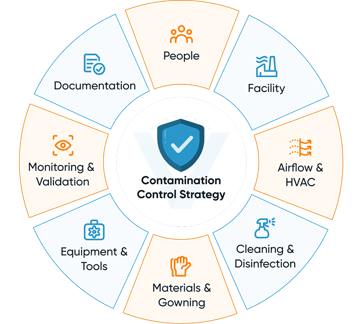
A Contamination Control Strategy (CCS) is vital because it establishes a proactive, risk-based framework that prevents microbial, particulate, and pyrogen contamination.
Rather than relying on final product testing alone, CCS focuses on preventing contamination before it occurs.
CCS is a proactive plan that keeps contamination out of the manufacturing process not just out of the final product.
An effective CCS includes several key elements such as cleanroom and facility design, HVAC and HEPA filtration systems, environmental monitoring, aseptic techniques, personnel training, cleaning and disinfection programs, pharmaceutical water and clean steam systems, equipment qualification, process validation, risk assessments, and continuous improvement.
Implementing a strong CCS provides numerous benefits:
- Reduces the risk of microbial contamination
- Improves process consistency,
- Minimizes batch failures and product recalls
- Strengthens GMP compliance,
- Supports successful regulatory inspections
- Enhances product quality
- Protects patient safety
Modern regulatory guidelines, including EU GMP Annex 1, emphasize the importance of a documented Contamination Control Strategy.
This concept was formalized in EU GMP Annex 1 (revised 2022), which now mandates that every manufacturer of sterile (and increasingly, non-sterile) products must have a documented, live CCS covering the entire facility and product lifecycle.
Why Has the CCS Become So Important?
- It Shifts Quality from Reactive to Proactive
- It Connects Previously Siloed Systems
- It Is Now a Hard Regulatory Expectation
- It Reduces the Risk of Costly Batch Rejections and Recalls
- It Demonstrates Ongoing Control, Not Just a Point-in-Time Validation
- It Improves Cross-Functional Risk Awareness
Modern GMP guidelines, including EU GMP Annex 1, expect pharmaceutical manufacturers to develop and maintain a documented Contamination Control Strategy.
A well-designed CCS demonstrates that contamination risks have been scientifically identified, controlled, and continuously monitored throughout the product lifecycle.
A Contamination Control Strategy connects people, processes, equipment, facilities, and quality systems into one unified approach to contamination prevention.
It’s the one that prevents contamination from happening in the first place.