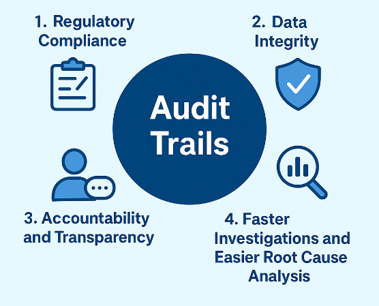
Audit trail review is critical in the pharmaceutical industry to ensure data integrity, maintain product quality, and guarantee patient safety. It provides an immutable, chronological log of all digital eventsnsuch as when, why, and by whom data was entered, modified, or deleted.
Generally audit trail records:
- Who was the one who did it (user ID)?
- What was done (e.g. data change, deletion)
- By the date and time (date and time) that it happened.
- The place or device of doing it.
- Why, where applicable (e.g. comment or reason code)
Specifically, regular audit trail review serves three essential functions:
- Regulatory Compliance: Global authorities like the U.S. FDA (21 CFR Part 11) and the EMA strictly mandate review processes to verify that electronic records are complete, accurate, and secure. Failing to review these logs often leads to warning letters or product rejections.
- Data Integrity Enforcement: It upholds the ALCOA+ principles (Attributable, Legible, Contemporaneous, Original, Accurate, Complete, Consistent, Enduring, and Available) by making it impossible to hide or falsify data without a traceable digital footprint.
- Root Cause Analysis: When a deviation or process failure happens, the audit trail acts as a “black box” that allows Quality Assurance (QA) teams to trace the exact sequence of events, accelerating investigations and preventing future issues.
What Are the Types of Audit Trails?
- Data Audit Trails
- Metadata Audit Trails
- Configuration/Parameter Audit Trails
- System/Operational Audit Trails
- Electronic Signature Audit Trails
- Workflow/Process Audit Trails
- Device/Equipment Audit Trails
- Access/Authorization Audit Trails
Where is Audit Trail Review Performed?
Audit Trail Review is commonly performed in:
- Laboratory Information Management Systems (LIMS)
- High-Performance Liquid Chromatography (HPLC) software
- Manufacturing Execution Systems (MES)
- Electronic Batch Records (EBR)
- Environmental Monitoring Systems
- Quality Management Systems (QMS)
When and How Often Should Audit Trails Be Reviewed?
Audit trail reviews should be performed:
- During routine batch record review (e.g., before batch release)
- Periodically, as defined in the quality management system
- Following any data discrepancy or investigation
Who Conducts Audit Trail Reviews?
Typically, trained personnel from Quality Assurance (QA), Quality Control (QC), or IT departments are responsible for conducting audit trail reviews. Reviewers must be independent of the data generation process to ensure objectivity.
An Audit Trail ensures that every action performed in an electronic system is recorded, while Audit Trail Review ensures those actions are regularly checked for accuracy and compliance.
Together, they help maintain data integrity, strengthen regulatory compliance, and protect the quality of every medicine.