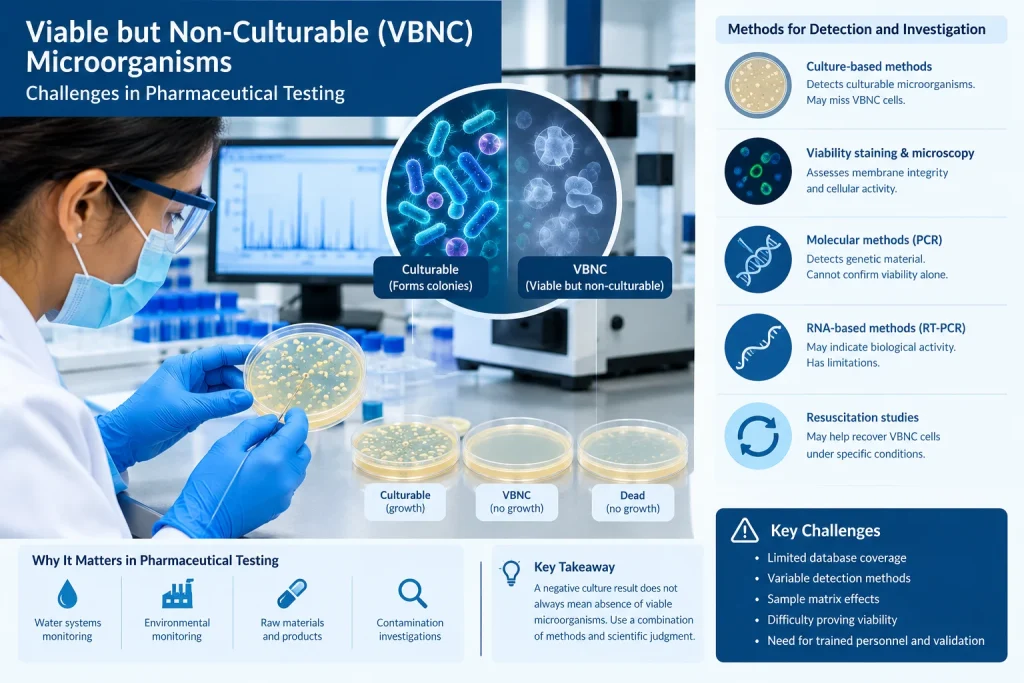
Viable but non-culturable (VBNC) microorganisms are microorganisms that remain viable but do not form visible colonies under the routine culture conditions used for their detection. This phenomenon presents an important challenge in microbiology because conventional culture-based methods rely on microorganisms growing on suitable media to produce detectable colonies.
In pharmaceutical microbiology, culture-based testing is widely used to assess microbial quality in pharmaceutical products, purified water, manufacturing environments, and other materials. However, certain environmental stresses may cause microorganisms to enter a VBNC state, potentially reducing their recovery under routine laboratory conditions.
Understanding VBNC microorganisms helps microbiologists recognize the limitations of culture-based testing, interpret unexpected results, and assess whether additional scientific investigation is necessary. It is important to note that not every culture-negative sample contains VBNC microorganisms, and their presence must not be assumed without supporting evidence.
What Are VBNC Microorganisms?
VBNC microorganisms are microbial cells that retain certain indicators of viability but cannot be cultured using the routine conditions under which they previously grew.
In this state, cells may retain membrane integrity or metabolic activity while failing to form visible colonies on conventional culture media. The degree of retained activity varies with the organism and environmental conditions.
The VBNC state has been studied in several bacterial species, including Escherichia coli, Vibrio cholerae, and Campylobacter jejuni. However, the ability to enter this state and the methods used to demonstrate it differ between organisms.
How does the VBNC state develop?
Microorganisms may encounter conditions that are unfavorable for growth but do not immediately cause complete cellular death. Some cells respond by changing their physiological state.
Factors associated with the induction of the VBNC state include:
- Nutrient limitation or starvation.
- Exposure to unfavorable temperatures.
- Changes in osmotic conditions.
- Oxidative or other environmental stresses.
- Exposure to certain chemical agents or preservatives.
These factors do not automatically induce a VBNC state in every microorganism. Their effects depend on the organism, the intensity and duration of exposure, and the surrounding environment.
VBNC vs. Culturable vs. Dead Microorganisms
Understanding the difference between culturability and viability is essential when interpreting microbiological test results.
| Characteristic | Culturable microorganisms | VBNC microorganisms | Dead microorganisms |
|---|---|---|---|
| Formation of colonies | Can form colonies under suitable conditions | Do not form colonies under the routine conditions being used | Cannot reproduce to form colonies |
| Viability indicators | Present | May remain detectable | Generally absent, although some indicators can persist temporarily |
| Metabolic activity | Often detectable | May be retained at reduced or variable levels | No sustained biological activity |
| Routine culture detection | Usually detectable when the method is suitable | May remain undetected | Not detected as viable growth |
| Additional assessment | Routine culture may be sufficient for the intended purpose | Specialized viability or physiological assessments may be needed | Requires suitable evidence to distinguish death from other states |
A key distinction is that culturability is not identical to viability. Failure to recover colonies under one set of conditions does not, by itself, establish that every microorganism in the sample is dead.
Why Are VBNC Microorganisms Important in Pharmaceutical Testing?
1. Limitations of conventional culture-based methods
Culture-based methods detect microorganisms that can grow under the prescribed conditions of the test. If a viable microorganism cannot grow under those conditions, it may not produce a visible colony.
Consequently, a negative culture result must be interpreted within the capabilities and limitations of the approved method. It should not automatically be interpreted as proof that no viable microorganisms are present under all possible conditions.
2. Pharmaceutical water systems
Pharmaceutical water systems require appropriate microbial monitoring and control. Microorganisms may experience nutrient limitation, sanitization exposure, temperature changes, or other stresses within water systems.
These conditions may influence microbial culturability. However, a low or negative culture result does not establish that VBNC organisms are present. Sampling limitations, low microbial concentration, recovery efficiency, and other factors must also be considered.
3. Environmental monitoring
Environmental monitoring uses defined sampling and incubation procedures to assess microbial contamination in controlled manufacturing environments.
If a sample produces no growth, the result indicates that no colonies were recovered under the conditions of the test. It does not independently establish why no growth occurred.
VBNC microorganisms may be one possible scientific consideration in a relevant investigation, but sampling errors, unsuitable recovery conditions, low contamination levels, and other explanations should also be evaluated.
4. Pharmaceutical products containing antimicrobial ingredients
Certain pharmaceutical formulations contain preservatives or other ingredients that inhibit microbial growth.
If these antimicrobial properties are not adequately addressed during method suitability testing, microbial recovery may be reduced. This can produce misleading results that resemble a detection problem.
Such findings must not automatically be attributed to VBNC microorganisms. Laboratories should first evaluate whether the approved method is suitable for the product and whether antimicrobial activity has been adequately neutralized where required.
How Can VBNC Microorganisms Be Investigated?
No single method can conclusively establish viability in every organism or sample type. The appropriate approach depends on the scientific question, sample matrix, and limitations of the method.
1. Culture-based methods
Routine culture remains an important approach for detecting microorganisms capable of growth under specified conditions.
Culture results provide evidence of culturability under those conditions. However, they may not detect all viable cells if recovery conditions are unsuitable or if microorganisms are in a non-culturable state.
In pharmaceutical laboratories, approved culture methods and their acceptance criteria must continue to be followed unless an alternative method has been appropriately assessed and authorized.
2. Viability staining and microscopy
Certain fluorescent stains can provide information about cellular properties such as membrane integrity. Microscopy may then be used to observe stained cells.
These approaches can help distinguish populations with different cellular characteristics, but membrane integrity alone does not necessarily prove that a cell is capable of reproduction or poses a specific microbiological risk.
Interpretation requires an understanding of the method’s limitations and suitable controls.
3. Molecular methods such as PCR
Polymerase chain reaction (PCR) can detect specific genetic sequences from microorganisms. This may be useful when investigating organisms that are difficult to detect through routine culture.
However, conventional PCR can detect DNA from both viable and nonviable cells. Therefore, a positive PCR result does not automatically establish that viable VBNC microorganisms are present.
Specialized approaches, such as viability PCR using appropriate pretreatment, may provide additional information, but they also have limitations and require suitable validation or verification for their intended application.
4. RNA-based methods
Reverse transcription PCR (RT-PCR) can detect selected RNA targets after conversion into complementary DNA. Depending on the target and experimental design, this may provide evidence of biological activity.
However, RNA detection is not an absolute measure of viability. RNA stability varies, and results depend on the target, sample preparation, and assay performance.
5. Resuscitation and recovery studies
Under certain conditions, microorganisms in a VBNC state may regain culturability. Research studies may investigate this possibility using organism-specific recovery conditions.
Such observations require careful interpretation because apparent recovery may also reflect the growth of a small population of cells that remained culturable. Appropriate experimental controls and study design are needed to distinguish these possibilities.
In pharmaceutical QC, additional recovery experiments must not be introduced informally to replace approved test results. Any alternative testing approach must be scientifically justified and handled through the applicable quality system.
Challenges in Detecting VBNC Microorganisms
Difficulty proving viability
A central challenge is distinguishing genuinely viable but non-culturable cells from dead cells, damaged cells, and microorganisms present below the detection capability of the method.
Different assays measure different biological properties. A combination of complementary methods may provide stronger evidence than any single measurement, but the interpretation must remain specific to the evidence obtained.
Method suitability and sample matrix effects
Pharmaceutical products may contain ingredients that interfere with microbial recovery or analytical detection. Water samples, surface samples, and product samples also have different characteristics.
Methods must therefore be suitable for the intended sample type. In pharmaceutical QC, method suitability and appropriate recovery controls are essential to demonstrate that the prescribed method can detect the relevant microorganisms under the test conditions.
Interpretation of molecular results
Molecular detection may identify microbial genetic material without establishing whether the organism is alive, dead, infectious, or capable of multiplying.
The result must be interpreted according to the target detected, the analytical method, and the purpose of the investigation.
Lack of universally applicable detection criteria
There is no single viability assay or acceptance threshold that applies to every organism, product, and pharmaceutical test. Method selection and result interpretation must consider the intended use and the applicable requirements.
Practical Example: An Unexpected Negative Result in a Pharmaceutical Water Sample
Consider a hypothetical pharmaceutical facility where routine microbial monitoring of a purified water sample produces no detectable growth under the approved culture method.
During a broader investigation, the team notices that the sampling location has a history of fluctuating microbial results.
The team should not immediately conclude that VBNC microorganisms are present. Instead, it should evaluate the evidence systematically.
Step 1: Review sampling records. Check sample collection, container suitability, transport conditions, holding time, and other relevant records.
Step 2: Review test performance. Confirm that media, incubation conditions, controls, and equipment met the approved requirements.
Step 3: Examine historical trends. Review results from related sampling locations and previous monitoring periods.
Step 4: Assess other possible causes. Consider low microbial concentration, sampling variability, recovery limitations, and any relevant system changes or sanitization activities.
Step 5: Determine whether additional investigation is justified. If evidence indicates a meaningful limitation in routine detection, a scientifically justified supplementary study may be considered through the applicable quality system.
Step 6: Document the conclusion. Record the evidence reviewed, the rationale for any further work, and the impact assessment. Do not report the presence of VBNC microorganisms unless sufficient evidence supports that conclusion.
This example illustrates why an unexpected negative result requires appropriate scientific interpretation rather than an unsupported assumption.
Strategies for Managing VBNC-Related Risks in Pharmaceutical Laboratories
Maintain suitable microbiological methods
Use approved methods that are appropriate for the sample type and intended purpose. Follow applicable method suitability, verification, and control requirements.
Monitor trends rather than isolated results
Evaluate microbial results over time and across related sampling locations. Recurring patterns may help identify process changes or potential gaps in microbial control.
Investigate unexpected results systematically
Review sample handling, method performance, environmental conditions, and relevant manufacturing records before deciding whether specialized investigation is necessary.
Evaluate alternative methods carefully
Alternative or rapid microbiological methods may provide useful information, but their suitability, specificity, sensitivity, and limitations must be assessed for the intended use.
Maintain documentation and data integrity
Document observations, test results, investigation decisions, and supporting evidence accurately. Additional testing should have a clear scientific rationale and should follow approved procedures.
Apply risk-based quality decisions
The significance of a microbiological result depends on the product, route of administration, intended use, organism, and other relevant factors. Quality decisions should be based on the totality of evidence and applicable requirements.
Frequently Asked Questions (FAQs)
1. What does VBNC stand for?
VBNC stands for viable but non-culturable. It describes microorganisms that retain certain indicators of viability but do not grow into visible colonies under the culture conditions being used.
2. Are VBNC microorganisms alive?
They may retain membrane integrity, metabolic activity, or other indicators of viability. However, viability is difficult to define using a single measurement, so the conclusion depends on the evidence and method used.
3. Can routine microbial testing detect VBNC microorganisms?
Routine culture-based testing may not detect them if they cannot grow under the prescribed conditions. Specialized methods may provide additional information, but their applicability must be assessed for the intended use.
4. Does a negative culture result mean that all microorganisms are dead?
No. It means that no microorganisms were recovered under the specified test conditions. Other explanations, including low microbial concentration and limitations in recovery, must also be considered.
5. Can PCR confirm the presence of viable VBNC microorganisms?
Conventional PCR detects targeted genetic material and cannot, by itself, reliably distinguish viable cells from nonviable cells. Additional viability-focused methods and appropriate evidence may be needed.
6. Why is the VBNC state relevant to pharmaceutical water systems?
Environmental stresses in water systems may influence microbial culturability. Understanding this possibility can help laboratories interpret unusual findings, but it does not replace routine monitoring, investigation, and established microbial control measures.
7. Should a pharmaceutical QC laboratory change its routine method because of possible VBNC microorganisms?
Not automatically. Any change or supplementary method should be supported by a scientific rationale, assessed for its intended use, and managed under the applicable quality system and regulatory requirements.
Conclusion
Viable but non-culturable microorganisms present a scientific challenge because the ability to form colonies does not capture every aspect of microbial viability. Environmental stress, nutrient limitation, and other conditions may affect the recovery of microorganisms under routine culture conditions.
In pharmaceutical microbiology, understanding the VBNC state can help laboratories interpret unexpected negative results, recognize the limitations of analytical methods, and determine when additional investigation may be justified.
The key is to avoid assuming that every negative culture indicates complete microbial absence or that every unexplained negative result is caused by VBNC microorganisms. Reliable conclusions require suitable methods, appropriate controls, scientific evidence, and documented quality decisions.
References
- Oliver, J. D. (2010). Recent findings on the viable but nonculturable state in pathogenic bacteria. FEMS Microbiology Reviews, 34(4), 415–425. Read the review.
- Zhang, X.-H., Ahmad, W., Zhu, X.-Y., Chen, J., & Austin, B. (2021). Viable but nonculturable bacteria and their resuscitation: implications for cultivating uncultured marine microorganisms. Marine Life Science & Technology, 3, 189–203. Read the review.
- U.S. Food and Drug Administration. Pharmaceutical Microbiology Manual. This resource discusses pharmaceutical microbiology testing and laboratory quality considerations. Access the official manual.
- U.S. Food and Drug Administration. Microbiological Quality Considerations in Non-sterile Drug Manufacturing: Guidance for Industry (Draft, September 2021). Consult the document’s current status before treating it as regulatory guidance. Read the draft.
Important: The VBNC state is an area of ongoing scientific research. The studies cited above provide scientific background; they do not establish a universal regulatory requirement to test pharmaceutical products specifically for VBNC microorganisms. Follow the applicable pharmacopoeial methods, current regulatory guidance, and approved laboratory procedures.