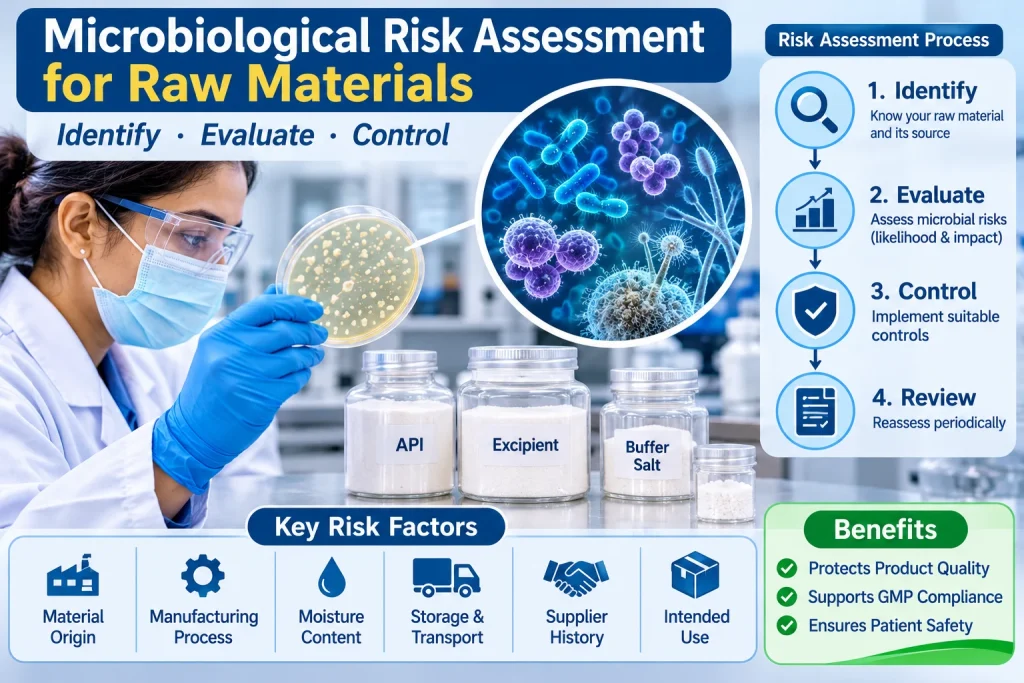
Microbiological Risk Assessment for Raw Materials is a systematic approach used to identify, evaluate, and control the potential risks of microbial contamination associated with materials used in pharmaceutical manufacturing. Raw materials can introduce bacteria, yeasts, moulds, bacterial endotoxins, or other microbiological hazards into a manufacturing process if their quality and suitability are not adequately controlled.
Raw materials may include active pharmaceutical ingredients (APIs), excipients, purified water used in processing, natural-origin materials, and biological materials. Their microbiological risks differ according to their source, composition, manufacturing process, storage conditions, intended use, and the characteristics of the final dosage form.
For example, a material used in a non-sterile oral tablet may present a different microbiological risk from an ingredient used in a sterile injectable product. Materials of natural origin may also require particular attention because their microbial quality can vary with harvesting, processing, and storage conditions.
A structured risk assessment helps pharmaceutical manufacturers establish scientifically justified specifications, supplier controls, sampling plans, testing strategies, and storage requirements. The approach aligns with the principles of ICH Q9(R1), which emphasizes science-based risk decisions and a level of documentation proportionate to the identified risk.
What Is Microbiological Risk Assessment for Raw Materials?
Microbiological risk assessment is the evaluation of potential microbial hazards associated with a raw material and their possible effects on product quality and patient safety.
It considers three fundamental questions:
- What might go wrong? For example, a raw material may contain an excessive microbial load or an objectionable microorganism.
- How likely is it to occur? The probability may depend on the material’s origin, supplier history, manufacturing process, and storage conditions.
- What are the consequences? Contamination may affect product quality, compromise sterility assurance, reduce product stability, or create a patient safety concern.
The assessment should be based on available scientific knowledge, historical data, material characteristics, and the intended use of the material. It should not rely solely on the supplier’s certificate of analysis or on a single microbiological test result.
Why Is Microbiological Risk Assessment Important?
A risk-based approach helps manufacturers identify possible contamination before a material enters production.
1. Protects product quality and patient safety
Microbial contamination may cause product deterioration, changes in appearance or odour, altered product characteristics, or potential patient harm. The significance depends on the organism, its concentration, the product formulation, and the route of administration.
2. Supports appropriate microbiological specifications
Not every raw material requires the same microbiological limits or testing strategy. Assessment helps establish suitable requirements based on applicable pharmacopoeial standards, approved product specifications, intended use, and relevant regulatory expectations.
3. Improves supplier qualification
Supplier information can reveal potential risks associated with manufacturing controls, environmental conditions, water quality, transportation, packaging, and historical contamination events.
4. Helps establish suitable sampling and testing plans
Risk assessment supports decisions about the type and extent of microbiological testing, sampling frequency, and the need for additional supplier oversight. Any reduced testing approach must be justified, approved, and consistent with applicable requirements.
5. Strengthens contamination control
Identifying contamination risks at the raw-material stage helps prevent them from being transferred into manufacturing equipment, processing areas, intermediate products, or finished products.
Major Factors Affecting Microbiological Risk
Several factors should be considered when assessing raw materials.
| Risk factor | What should be evaluated? |
|---|---|
| Material origin | Plant, animal, mineral, synthetic, or biological source |
| Manufacturing process | Water use, processing conditions, microbial controls, and contamination prevention |
| Material composition | Nutrient content, moisture, water activity, and ability to support microbial survival or growth |
| Supplier history | Previous contamination events, deviations, complaints, and corrective actions |
| Intended use | Sterile or non-sterile product, dosage form, route of administration, and process stage |
| Storage conditions | Temperature, humidity, container integrity, and storage duration |
| Transportation | Exposure to moisture, unsuitable temperatures, damaged packaging, or poor handling |
| Packaging system | Protection against moisture ingress, environmental exposure, and contamination during handling |
| Testing history | Microbial counts, organism identification, trends, and out-of-specification results |
| Downstream processing | Whether a validated process reduces the hazard and whether its effectiveness is established |
These factors should be evaluated together. For example, a material with a low moisture content may be less supportive of microbial growth during storage, but this does not establish that it is free from viable microorganisms or microbial toxins.
Types of Microbiological Hazards in Raw Materials
1. Excessive microbial counts
Raw materials may contain aerobic bacteria, yeasts, and moulds. Their significance depends on the material, applicable limits, intended use, and potential effect on the finished product.
Microbial enumeration results can help establish whether a material meets its approved microbiological requirements and whether the supplier’s process remains under control.
2. Specified or objectionable microorganisms
Some microorganisms may present a particular concern because of their pathogenic potential, ability to survive processing, or capacity to affect product quality.
The organisms of concern should be identified based on the applicable pharmacopoeial requirements, product characteristics, route of administration, and scientifically justified risk assessment. A universal list should not be applied to every raw material.
3. Bacterial endotoxins
Endotoxins are components associated with the outer membrane of Gram-negative bacteria. They can remain a concern even after viable bacteria have been destroyed.
This is particularly important for products where endotoxin requirements apply, such as many parenteral preparations. Microbial enumeration and endotoxin testing assess different hazards and should not be treated as interchangeable.
4. Fungal contamination
Yeasts and moulds may enter materials through agricultural sources, contaminated equipment, air, packaging, or unsuitable storage. Some fungi may produce mycotoxins under appropriate conditions, depending on the species and environment.
The risk assessment should consider the material’s source, susceptibility to fungal contamination, storage conditions, and whether additional testing is justified.
5. Microbial contamination associated with water
Water used during raw-material manufacture or processing can introduce microorganisms if the water system or process is inadequately controlled. Wet processing, insufficient drying, and moisture ingress during storage may increase the risk of microbial growth.
The assessment should therefore include relevant information about water quality and the supplier’s controls.
Step-by-Step Procedure for Microbiological Risk Assessment
Step 1: Identify and classify the raw material
Document the material name, grade, specification, manufacturer, supplier, source, and intended use.
Determine whether the material is used in a sterile or non-sterile product and identify the relevant manufacturing stage. Consider whether it is exposed to a validated microbial reduction step later in the process.
Do not assume that downstream processing automatically eliminates all microbiological hazards. Its effectiveness against the hazards identified must be established.
Step 2: Collect relevant information
Gather available evidence, including:
- Supplier qualification and audit information.
- Manufacturing process flow and contamination controls.
- Supplier microbiological specifications and certificates of analysis.
- Historical test results and trend data.
- Previous deviations, complaints, and contamination investigations.
- Storage, packaging, and transportation conditions.
- Applicable pharmacopoeial monographs and approved product requirements.
Missing or unreliable information should be recorded as an uncertainty that may require further investigation or additional controls.
Step 3: Identify potential microbiological hazards
Determine which hazards are relevant to the specific material.
For a plant-derived excipient, possible concerns may include environmental bacteria, moulds, and contamination associated with harvesting or drying. For a material used in an injectable product, endotoxin risk and the consequences of microbial contamination may require particular attention.
The assessment should identify plausible hazards rather than automatically assigning every possible microorganism to every material.
Step 4: Analyse and evaluate the risk
Evaluate the likelihood of contamination and the severity of its potential consequences. Consider detectability where the selected assessment method includes it.
A qualitative assessment may classify risks as low, medium, or high. A more formal assessment may use Failure Mode and Effects Analysis (FMEA) or another suitable quality risk management tool.
ICH Q9(R1) recommends that risk decisions be based on scientific knowledge and that the level of effort and documentation be proportionate to the risk.
Step 5: Define appropriate risk controls
Based on the assessment, establish suitable controls such as:
- Approved supplier qualification and periodic review.
- Material-specific microbiological specifications.
- Appropriate sampling and testing.
- Defined packaging and storage requirements.
- Supplier corrective and preventive action when needed.
- Additional investigation of recurring contamination trends.
- Review of process controls where microbial hazards may be introduced.
Controls must be consistent with applicable regulations, approved specifications, and the manufacturer’s quality system.
Step 6: Establish testing and acceptance criteria
Select appropriate microbiological methods according to the material and the hazards being assessed. Depending on the risk, these may include microbial enumeration, specified microorganism testing, or bacterial endotoxin testing where applicable.
Testing methods should be suitable for the material matrix. For example, the material may inhibit microbial recovery or interfere with an analytical test. Such interference should be evaluated where relevant.
Acceptance criteria must be scientifically justified and aligned with applicable pharmacopoeial requirements, approved specifications, and product-specific needs. Risk assessment must not be used to relax a mandatory requirement.
Step 7: Document and approve the assessment
Record the identified hazards, supporting evidence, risk ratings, selected controls, responsible functions, and final decision.
The assessment should be reviewed and approved according to the site’s quality management procedures. Relevant personnel may include Quality Assurance, Quality Control, microbiology, procurement, manufacturing, and supplier quality teams.
Step 8: Review the assessment periodically
Review the assessment when new information changes the risk profile. Relevant triggers include recurring microbial failures, supplier changes, process changes, changes in material source, adverse trends, or new product requirements.
Periodic review should also confirm that the selected controls remain effective.
Example of a Microbiological Risk Assessment Matrix
The following example illustrates how a pharmaceutical manufacturer might structure an initial qualitative assessment for a hypothetical plant-derived excipient.
| Potential hazard | Example cause | Initial risk | Possible control |
|---|---|---|---|
| Elevated microbial count | Inadequate drying or contaminated processing equipment | Medium to high, depending on intended use | Supplier process review, justified microbial limits, suitable testing |
| Fungal contamination | Moisture exposure during storage | Medium | Moisture control, packaging integrity checks, trend review |
| Specified objectionable organism | Contaminated source material or inadequate supplier controls | High where consequences are significant | Appropriate organism-specific controls and supplier investigation |
| Endotoxin contamination | Gram-negative bacterial contamination during processing | Depends on product and route | Evaluate whether endotoxin requirements apply; implement appropriate controls and testing |
| Contamination during transport | Damaged or compromised packaging | Depends on material and exposure | Shipment checks, packaging controls, supplier or transporter investigation |
Important: These ratings are illustrative, not universal acceptance decisions. The actual risk classification must be established using the site’s approved risk methodology, material-specific evidence, and intended product use.
A high risk does not automatically mean that a material must be rejected. It means that the risk requires appropriate evaluation and control before a justified disposition decision can be made.
How to Use FMEA for Raw-Material Risk Assessment
FMEA is a structured tool for identifying potential failure modes and prioritising actions.
A typical FMEA may consider:
- Severity (S): The consequence if contamination occurs.
- Occurrence (O): The estimated likelihood of the failure.
- Detectability (D): The likelihood that the failure will escape detection, where this factor is included in the chosen method.
Some organisations calculate a Risk Priority Number (RPN):
RPN = Severity × Occurrence × Detectability
For example, a hypothetical failure mode might receive ratings of 4 for severity, 3 for occurrence, and 3 for detectability. The resulting RPN would be 36.
This number is only an illustrative calculation. There is no universal RPN threshold that automatically determines acceptability for all pharmaceutical raw materials. The scoring scale, action thresholds, and decision rules must be defined in the organisation’s approved procedure. High-severity hazards should not be overlooked simply because a numerical score is low.
Microbiological Testing Considerations
The risk assessment should guide, rather than replace, appropriate microbiological testing.
Microbial enumeration
Microbial enumeration estimates the number of recoverable microorganisms in a defined quantity of material. Depending on the applicable method, results may be expressed as colony-forming units per gram (CFU/g) or per millilitre (CFU/mL).
Specified microorganism testing
Where required or justified, testing determines whether particular microorganisms are present in the tested quantity of material. Method selection should reflect the relevant pharmacopoeial method and product-specific risks.
Bacterial endotoxin testing
Endotoxin testing may be relevant for materials used in products with applicable endotoxin requirements. It measures endotoxin activity according to the method used and does not establish the absence of viable microorganisms.
Method suitability
Raw materials may contain substances that inhibit microbial growth or interfere with test reactions. Method suitability, including appropriate neutralisation or other justified measures, should be established where needed to ensure meaningful results.
Testing frequency and sample quantity should be established through applicable requirements and a documented risk-based rationale. A low-risk classification does not automatically justify eliminating required testing.
Roles of QA and QC in Risk Assessment
Quality Control (QC) provides microbiological test results, evaluates trends, investigates atypical or out-of-specification findings, and communicates relevant laboratory information.
Quality Assurance (QA) oversees the risk assessment process, verifies that applicable requirements are addressed, approves controls according to the quality system, and ensures that deviations and corrective actions are managed appropriately.
Supplier Quality and Procurement support supplier qualification, obtain relevant technical information, communicate quality requirements, and coordinate supplier investigations when needed.
Manufacturing and Microbiology teams contribute process knowledge, assess potential downstream impact, and help determine whether additional contamination controls are necessary.
A cross-functional approach supports decisions based on both laboratory evidence and an understanding of the manufacturing process.
Common Mistakes to Avoid
- Using the same risk rating for every raw material: Different materials and product uses can have very different microbiological risks.
- Relying only on the certificate of analysis: Supplier results are useful, but supplier qualification, historical performance, and appropriate verification remain important.
- Confusing microbial counts with endotoxin results: These tests address different hazards.
- Ignoring moisture and storage conditions: Microbial survival and growth depend on material characteristics and the surrounding environment.
- Assuming downstream processing eliminates all hazards: The effectiveness of the process must be established for the relevant risk.
- Using arbitrary risk scores: Ratings should follow an approved, scientifically justified methodology.
- Failing to review new evidence: Supplier changes, adverse trends, and contamination events may require reassessment.
GMP Documentation and Regulatory Considerations
A documented assessment may include the material details, intended use, hazard identification, supplier information, supporting test data, risk analysis, selected controls, approval records, and review history.
The exact documentation should be appropriate to the risk and consistent with the site’s quality system.
ICH Q9(R1) provides a framework for quality risk management and identifies materials management as one potential application. It should be used alongside applicable GMP regulations, pharmacopoeial requirements, approved specifications, and product-specific regulatory commitments. It does not replace mandatory requirements or establish one universal microbiological specification for all raw materials.
Frequently Asked Questions
1. Is microbiological risk assessment required for every raw material?
The need and formality of an assessment depend on applicable requirements and the material’s risk profile. A documented risk-based approach is useful for determining appropriate controls, but organisations must still meet all relevant regulatory and product-specific requirements.
2. Which raw materials may require particular attention?
Materials of natural or biological origin, materials processed using water, moisture-sensitive materials, and materials intended for products with stringent microbiological requirements may need particular attention. The actual risk depends on the source, process, intended use, and available evidence.
3. Can a raw material pass chemical testing but fail microbiological testing?
Yes. Chemical and microbiological tests assess different quality attributes. A material may meet its chemical specifications while failing a microbiological requirement.
4. Does a low microbial count mean the material is safe for sterile manufacturing?
Not by itself. Suitability depends on applicable requirements, the specific hazards, endotoxin considerations where relevant, and the validated manufacturing process. A low count does not demonstrate sterility.
5. When should the risk assessment be updated?
It should be reviewed when significant changes or new information may affect the risk, including supplier or source changes, repeated failures, adverse trends, process changes, or changes in intended product use.
6. Which guideline supports pharmaceutical quality risk assessment?
ICH Q9(R1), Quality Risk Management, provides internationally harmonised principles and examples of risk management tools applicable to pharmaceutical materials and manufacturing processes.
Conclusion
Microbiological Risk Assessment for Raw Materials is an important part of a science-based pharmaceutical quality system. By evaluating material origin, supplier performance, manufacturing controls, storage conditions, microbiological data, and intended use, manufacturers can identify relevant hazards and establish appropriate controls.
A well-designed assessment supports suitable testing strategies, effective supplier management, contamination prevention, and informed quality decisions. It should be reviewed when new evidence becomes available and must always remain consistent with applicable GMP requirements and approved product specifications.
The objective is not simply to classify a raw material as low or high risk. It is to understand the potential microbiological hazards, control them effectively, and protect the quality of the finished medicine.
References
- International Council for Harmonisation (ICH). ICH Q9(R1): Quality Risk Management. Official guideline: https://www.ema.europa.eu/en/scientific-guidelines/ich-q9-quality-risk-management
- U.S. Food and Drug Administration (FDA). Q9(R1) Quality Risk Management. https://www.fda.gov/regulatory-information/search-fda-guidance-documents/q9r1-quality-risk-management
- World Health Organization (WHO). Quality Assurance of Pharmaceuticals: A Compendium of Guidelines and Related Materials, Volume 2: Good Manufacturing Practices and Inspection. https://www.who.int/publications/i/item/9789240086081
This article is for professional educational purposes. Apply the current applicable pharmacopoeial requirements, local regulations, approved specifications, and site procedures when making material disposition decisions.