Cleanroom surface recovery studies are used to evaluate how effectively a microbiological sampling method recovers microorganisms from a surface. In pharmaceutical manufacturing, surface monitoring is an important part of environmental monitoring because microorganisms present on equipment, work surfaces, and other locations may pose a contamination risk to products and manufacturing operations.
However, the number of microorganisms recovered from a surface may not represent the total number originally present. Some organisms may remain attached to the surface, while others may be affected by the sampling device, collection technique, surface material, or environmental conditions.
A cleanroom surface recovery study helps laboratories understand these limitations and assess whether their selected sampling method is suitable for its intended purpose. The results support the interpretation of environmental monitoring data, the evaluation of sampling procedures, and contamination control decisions.
What Is a Cleanroom Surface Recovery Study?
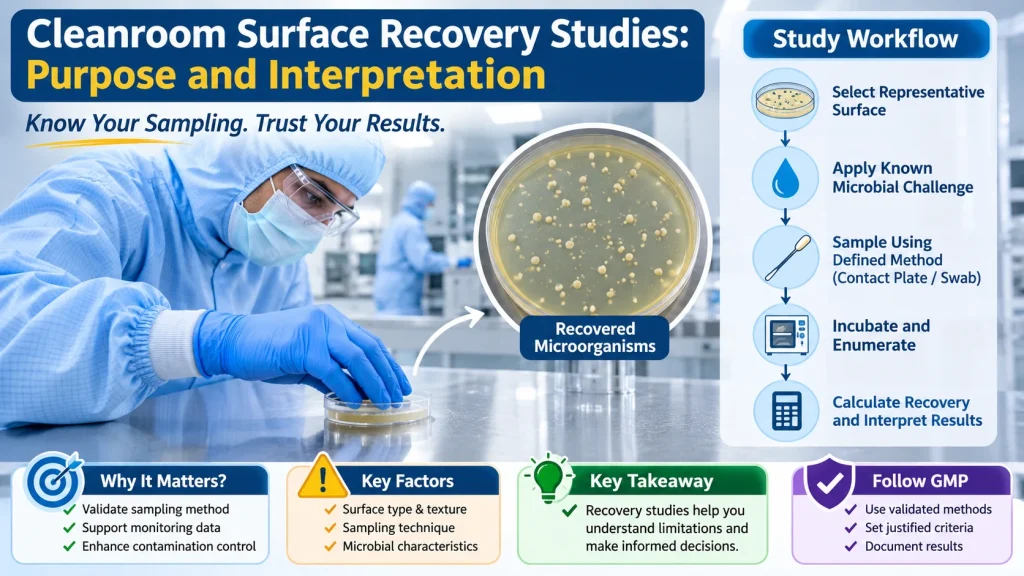
A cleanroom surface recovery study is a controlled evaluation designed to determine how effectively a defined sampling procedure retrieves microorganisms from a surface.
A known microbial challenge is applied to a representative surface, and the selected sampling method is used to recover the microorganisms. The recovered count is compared with an appropriate reference count to estimate recovery efficiency.
The study may evaluate contact plates, swabs, wipes, or other suitable sampling devices, depending on the routine environmental monitoring method.
The objective is not necessarily to recover every microorganism. Instead, it is to understand the performance and limitations of the complete sampling procedure under defined conditions.
https://pharmavk.com/surface-monitoring-contact-plates-vs-swabs/
Why Are Surface Recovery Studies Important?
1. Evaluating sampling method suitability
A sampling method that performs well on one surface may perform differently on another. For example, microbial recovery from smooth stainless steel may differ from recovery from a textured or irregular surface.
A recovery study provides evidence to support the selection of an appropriate sampling method for the intended surface and application.
2. Understanding environmental monitoring results
Environmental monitoring results are used to assess microbial contamination in controlled manufacturing areas.
If a sampling method has limited recovery efficiency, a low colony count may not reflect the complete microbial population present on the surface. Understanding this limitation helps microbiologists interpret results more scientifically.
3. Comparing sampling methods
A laboratory may need to assess whether a contact plate or swab is more suitable for a particular sampling location.
Recovery studies can provide comparative data when the methods are evaluated using an appropriate study design. Results must be interpreted in the context of the surface, organism, sampling technique, and intended use.
4. Supporting contamination control
Surface monitoring forms part of a broader contamination control strategy. Reliable sampling data can help identify contamination patterns and assess the effectiveness of cleaning and disinfection practices.
However, a recovery study alone does not demonstrate that a cleanroom is under control or that a disinfection procedure is effective.
5. Supporting method qualification and documentation
Recovery studies provide documented evidence about the performance of the sampling system. This information can support method selection, procedure development, risk assessments, and the justification of environmental monitoring practices.
Factors Affecting Microbial Recovery from Surfaces
Several factors can influence the number of microorganisms recovered during surface sampling.
1. Surface material and texture
The physical characteristics of a surface affect microbial attachment and recovery.
- Smooth stainless steel may allow more consistent contact with a sampling device.
- Rough or textured surfaces may retain microorganisms in small crevices.
- Plastic, glass, and other materials may exhibit different microbial attachment characteristics.
The actual recovery performance depends on the surface finish, organism, moisture conditions, and sampling procedure.
2. Sampling method
Different methods collect microorganisms in different ways.
Contact plates collect microorganisms through direct contact between the agar surface and a suitable test surface. Swabs are used to collect microorganisms by wiping a defined area, often where direct contact plating is impractical.
The methods are not automatically interchangeable. Each should be evaluated for its intended application.
3. Microorganism characteristics
Microorganisms differ in cell structure, surface properties, aggregation, and ability to attach to materials.
Consequently, recovery results obtained using one test organism may not represent the recovery performance for every microorganism that could be encountered in a pharmaceutical cleanroom.
4. Sampling technique
The way sampling is performed can influence recovery.
For contact plates, relevant factors include contact with the surface, applied pressure, and contact duration. For swabs, the sampling pattern, coverage, swab material, wetting solution, and operator technique may influence the result.
The procedure should define these factors sufficiently to support consistent sampling.
5. Drying and environmental conditions
The time between microbial application and sampling, surface moisture, temperature, and drying conditions can influence microbial attachment and survival.
Recovery studies should therefore control and document relevant conditions so that the findings are meaningful for the intended application.
6. Disinfectant residues and neutralization
Residual disinfectants can inhibit microbial growth after sampling and may reduce the number of colonies recovered.
Where relevant, the sampling medium or collection system should be evaluated for its ability to neutralize the disinfectant without adversely affecting the test microorganisms.
A low recovery result should not automatically be interpreted as evidence of effective disinfection because inadequate neutralization or poor sampling recovery may produce a similar outcome.
Common Methods Used for Cleanroom Surface Sampling
Contact plate method
Contact plates contain suitable agar medium and are pressed against an appropriate surface according to the approved procedure.
After sampling, the plate is incubated under specified conditions and examined for colony formation.
Advantages:
- Simple and convenient for suitable, relatively flat surfaces.
- Allows direct examination of recovered colonies.
- Can support routine environmental monitoring when the method is appropriate.
Limitations:
- Not suitable for every surface geometry.
- Direct contact may be inappropriate for certain critical or delicate surfaces.
- Results depend on contact conditions and recovery performance.
Swab method
Swabs are used to collect microorganisms from a defined surface area. The swab is then processed using the approved procedure, which may involve elution into a suitable recovery fluid before microbiological examination.
Advantages:
- Useful for irregular, curved, or hard-to-reach locations.
- Allows sampling of defined areas where contact plates cannot be used.
- Can be adapted to different surface geometries.
Limitations:
- Recovery depends on the swab material and collection technique.
- Microorganisms may remain attached to the swab or be incompletely released into the recovery fluid.
- More processing steps may introduce variability.
The sampling method should be selected based on the intended location, surface characteristics, contamination risk, and approved monitoring procedure.
How to Conduct a Surface Recovery Study
The detailed protocol should be scientifically justified and approved before the study begins. A typical study includes the following stages.
Step 1: Define the study objective
Specify what the study is intended to evaluate. For example, the objective may be to assess recovery from stainless steel using a contact plate or to evaluate a swab procedure for a difficult-to-access surface.
Step 2: Select representative surfaces
Choose surface materials and geometries that represent the intended routine sampling locations. Include relevant surface characteristics in the study rationale.
Step 3: Select suitable test microorganisms
Choose appropriate microorganisms based on the study purpose and relevant contamination risks. The selection should be justified rather than assumed to represent all possible environmental isolates.
Step 4: Establish a reference count
Determine the microbial challenge applied to the test surface using a suitable reference procedure. The reference count must be reliable enough to support the recovery calculation.
Step 5: Apply the microbial challenge
Apply the defined microbial suspension to the surface using a controlled procedure. Record relevant parameters, including the applied volume, challenge level, and any required drying or holding conditions.
Step 6: Perform the sampling procedure
Collect the microorganisms using the selected contact plate, swab, or other method. Follow the proposed routine procedure and record relevant sampling details.
Step 7: Recover and enumerate microorganisms
Process the samples using the approved method and suitable culture conditions. Include relevant controls to assess whether the study conditions and recovery procedure performed as intended.
Step 8: Calculate and review recovery
Calculate the percentage recovery for each valid test result. Evaluate variability between replicates and examine whether the results support the intended use of the sampling method.
Step 9: Document the conclusion
Record the study design, materials, test organisms, reference counts, recovered counts, calculations, deviations, limitations, and conclusion. Any acceptance criteria should be established and justified in the approved protocol before the study is performed.
How to Calculate Surface Recovery Efficiency
Recovery efficiency is commonly expressed as a percentage.
Formula:
Recovery efficiency (%) = (Number of microorganisms recovered ÷ Reference number of microorganisms applied or established) × 100
The reference count must be defined in the study protocol and determined using an appropriate procedure. The calculation should use comparable units and account for any relevant dilution or processing factors.
Worked example
Suppose a study establishes a reference count of 100 CFU on a test surface. After sampling and processing, the method recovers 65 CFU.
Recovery efficiency = (65 ÷ 100) × 100
Recovery efficiency = 65%
This means that the method recovered 65% of the reference count under the specified study conditions.
It does not mean that the remaining 35% were necessarily dead. They may have remained on the surface, failed to transfer to the collection device, or not been recovered or detected by the subsequent procedure.
A recovery percentage should therefore be interpreted as a measure of the performance of the evaluated method under the study conditions, not as a universal characteristic of the surface or microorganism.
How Should Recovery Study Results Be Interpreted?
Results should be reviewed against predefined, scientifically justified criteria and the intended use of the method.
| Study finding | Possible interpretation | Recommended review |
|---|---|---|
| Consistently high recovery | The method performs well under the evaluated conditions | Confirm that the study conditions represent routine use |
| Consistently low recovery | The method may have limitations for the evaluated surface or organism | Review surface characteristics, sampling technique, and processing |
| High variability between replicates | The procedure may be sensitive to technique or other uncontrolled factors | Review repeatability, operator technique, and study conditions |
| Different recovery across surface materials | Surface characteristics may influence collection efficiency | Evaluate whether separate method conditions or justifications are needed |
| Unexpectedly low recovery after disinfection | Residual disinfectant inhibition or reduced viable recovery may be involved | Assess neutralization, controls, sampling conditions, and the disinfection process separately |
A low recovery percentage does not automatically mean that the study has failed, and a high percentage does not automatically establish suitability. The conclusion depends on the predefined acceptance criteria, the intended application, the variability observed, and the overall scientific evidence.
There is no single recovery percentage that should be assumed acceptable for every cleanroom surface sampling method. Criteria should be justified for the specific study and intended use.
Common Errors During Surface Recovery Studies
Inconsistent sampling technique
Different contact pressure, contact duration, swabbing pattern, or sampled area can lead to variable results. Training and standardized procedures help reduce these differences.
Incorrect reference count
An unreliable reference count can distort the calculated recovery percentage. The reference method should be appropriate and its limitations understood.
Failure to evaluate neutralization
Residual disinfectants may inhibit microbial growth during recovery and incubation. Where applicable, neutralization effectiveness and potential toxicity to the test organisms should be evaluated.
Inadequate replication
Too few replicates may not reveal the variability of the method. Replication should be justified according to the study objective and expected variability.
Using one organism to represent every microorganism
Recovery can differ between organisms. The choice of test organisms should reflect the purpose and limitations of the study.
Applying results beyond the studied conditions
A recovery percentage established for one surface, organism, sampling device, or procedure should not automatically be applied to different conditions without scientific justification.
Regulatory and GMP Considerations
Surface monitoring is an important component of environmental monitoring in pharmaceutical manufacturing, particularly where microbial contamination could affect sterile products.
EU GMP Annex 1 emphasizes risk-based selection of monitoring locations, suitable sampling methods, understanding of recovery efficiency, and the interpretation of environmental monitoring data within the contamination control strategy.
The FDA Pharmaceutical Microbiology Manual also identifies surface monitoring, sampling technique, neutralizing media, operational conditions, and trend evaluation as important considerations during pharmaceutical manufacturing inspections.
These expectations support a scientifically justified sampling program. They should not be interpreted as imposing one universal recovery percentage or one identical study protocol for every facility.
The laboratory should maintain approved procedures, appropriate training records, relevant study data, justified acceptance criteria, and documentation of how the results support the selected sampling method.
Frequently Asked Questions (FAQs)
1. What is a cleanroom surface recovery study?
It is a controlled study used to assess how effectively a sampling procedure recovers microorganisms from a defined surface under specified conditions.
2. What is the difference between surface monitoring and a surface recovery study?
Routine surface monitoring assesses microbial contamination at selected locations. A surface recovery study evaluates the performance of the sampling procedure used to collect microorganisms from those surfaces.
3. Which method is better: contact plates or swabs?
Neither method is universally better. Contact plates are useful for suitable flat surfaces, while swabs are useful for irregular or difficult-to-access locations. Selection should be based on the intended application and supporting evidence.
4. Does 100% recovery mean that the method is always reliable?
No. It indicates that the recovered count matched the reference count under the evaluated conditions. Additional assessment of variability, study design, controls, and representativeness is still necessary.
5. Is a 50% recovery rate always acceptable?
No universal acceptance percentage applies to every cleanroom surface recovery study. The acceptance criteria must be justified for the particular method, surface, organism, and intended use.
6. Why is disinfectant neutralization important?
Residual disinfectants may continue to inhibit microorganisms after sampling, potentially reducing colony recovery. Suitable neutralization helps ensure that the test reflects the sampling method’s performance rather than continued disinfectant activity.
7. Does a surface recovery study prove that a cleanroom is microbiologically controlled?
No. It provides evidence about sampling method performance. Cleanroom control must be assessed using the broader environmental monitoring program, process knowledge, contamination control measures, and trend data.
Conclusion
Cleanroom surface recovery studies help pharmaceutical microbiology laboratories understand how effectively their sampling procedures recover microorganisms from surfaces. The findings support method selection, environmental monitoring interpretation, and the evaluation of potential sampling limitations.
Reliable studies require appropriate reference counts, representative surfaces, justified test organisms, controlled sampling procedures, relevant controls, and predefined acceptance criteria. Factors such as surface texture, sampling technique, microbial characteristics, and disinfectant neutralization can all affect recovery.
Ultimately, recovery studies strengthen environmental monitoring when their findings are interpreted within their intended scope. They support informed quality decisions but do not replace routine monitoring, contamination investigations, or the broader pharmaceutical contamination control strategy.
References
- European Commission. EudraLex Volume 4, EU Guidelines for Good Manufacturing Practice, Annex 1: Manufacture of Sterile Medicinal Products. Access the European Commission’s GMP guidance.
- U.S. Food and Drug Administration. Pharmaceutical Microbiology Manual. Read the official FDA manual.
- U.S. Food and Drug Administration. Guidance for Industry: Sterile Drug Products Produced by Aseptic Processing—Current Good Manufacturing Practice. Read the FDA guidance.
- United States Pharmacopeia. General Chapter <1116>, Microbiological Control and Monitoring of Aseptic Processing Environments. Visit USP.
- United States Pharmacopeia. Understanding Surface Sampling Recovery Efficiency: A Case Study in Microbiological Control. Read the USP white paper.
Note: Always consult the current applicable guidance and approved site procedures. The specific recovery study design and acceptance criteria should be justified for the intended sampling method and surface.