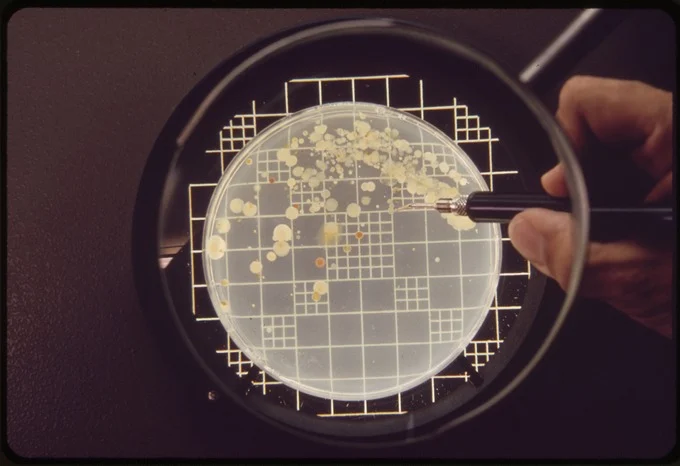
Introduction
Colony counting errors in microbial enumeration can affect the reliability of microbiological results in pharmaceutical quality control laboratories. Microbial enumeration is used to estimate the number of viable microorganisms present in a sample, usually by counting colonies that develop under specified culture conditions. Results are commonly expressed as colony-forming units (CFU) per gram (CFU/g) or per millilitre (CFU/mL).
Although the method appears straightforward, several factors can influence the final count. Overlapping colonies, uneven sample distribution, incorrect dilution calculations, unsuitable incubation conditions, poor visibility, and transcription mistakes may lead to inaccurate results.
In pharmaceutical microbiology, these errors can affect microbial limits testing, bioburden monitoring, environmental monitoring, and other microbiological assessments. An incorrectly reported count may lead to unnecessary investigations or an incorrect assessment of product quality.
Understanding the causes of colony counting errors and applying consistent laboratory practices helps improve accuracy, reproducibility, and data integrity.
What Is Microbial Enumeration?
Microbial enumeration is the process of estimating the number of viable microorganisms in a sample using a suitable microbiological method.
Common approaches include:
- Plate count method: Colonies are counted after inoculating a suitable culture medium and incubating under specified conditions.
- Membrane filtration: Microorganisms are retained on a suitable membrane, which is then cultured under defined conditions.
- Most Probable Number (MPN): A statistical method used to estimate microbial concentration from patterns of positive and negative growth results.
- Validated alternative methods: Certain rapid or automated technologies may be used when their suitability and performance have been appropriately established.
The method selected depends on the sample, expected microbial concentration, product characteristics, and applicable test requirements.
What Does CFU Mean?
CFU stands for colony-forming unit. It represents a viable unit capable of producing a visible colony under the conditions of the test.
A colony does not necessarily originate from a single microbial cell. A group of cells may produce one colony, while some viable microorganisms may not grow under the selected culture conditions.
Therefore, CFU results are estimates of recoverable microorganisms rather than exact counts of every individual microbial cell in a sample.
Common Colony Counting Errors in Microbial Enumeration
https://pharmavk.com/serial-dilution-calculator/
1. Counting overlapping colonies incorrectly
When colonies grow close together, their boundaries may become difficult to distinguish. Two or more colonies may appear as one, resulting in an underestimation of the count.
Example: A plate contains several closely spaced colonies. If the analyst records one colony where two distinct colonies should be counted, the reported result may be lower than the actual count.
Prevention:
- Select appropriate sample dilutions according to the approved method.
- Use suitable lighting and a consistent viewing background.
- Follow predefined rules for distinguishing colonies.
- Record plates that are too crowded for reliable enumeration according to the applicable procedure.
2. Counting debris or artefacts as colonies
Particles from the sample, precipitated material, agar defects, or other artefacts may resemble microbial colonies.
This is particularly relevant when samples are turbid, contain suspended particles, or produce precipitates during preparation.
Prevention:
- Examine colony characteristics using an established counting procedure.
- Distinguish growth from non-microbial artefacts using appropriate observations and investigation where necessary.
- Use a suitable magnifying aid when permitted by the method.
- Document unusual plate appearances.
Colony appearance alone is not sufficient to establish microbial identity.
3. Missing small or faint colonies
Small, translucent, or poorly defined colonies can be overlooked, especially when the plate has an uneven background or the lighting is inadequate.
Some microorganisms may also produce colonies that are less prominent than others under the selected incubation conditions.
Prevention:
- Use adequate and consistent lighting.
- Examine the entire plate systematically.
- Use a suitable magnifier or validated counting aid where appropriate.
- Follow the specified incubation conditions and read the plates within the required timeframe.
4. Incorrect dilution calculations
Errors in serial dilution preparation or calculation can significantly affect the final CFU result.
Common causes include using the wrong dilution factor, overlooking a dilution step, recording an incorrect plated volume, or making arithmetic errors.
For example, a plate count may be correct while the final CFU/mL calculation is wrong because the analyst used the reciprocal of the wrong dilution.
Prevention:
- Verify dilution labels and the sequence of dilution steps.
- Record the actual sample volume plated or filtered.
- Use a formula appropriate to the method.
- Independently verify calculations where required by the laboratory procedure.
5. Uneven distribution of microorganisms
If microorganisms are not distributed evenly throughout the sample, different aliquots may produce different counts.
This can occur when a sample is inadequately mixed, contains aggregates, or separates during handling.
Prevention:
- Follow the approved sample mixing and homogenization procedure.
- Use suitable mixing equipment when required.
- Minimize unnecessary delays between mixing and sampling.
- Assess whether the sample preparation method is appropriate for the product matrix.
Mixing should be performed as specified in the approved method; excessive or unsuitable mixing may also affect recovery in some sample types.
6. Incorrect incubation conditions
Incubation temperature, duration, atmosphere, and other specified conditions influence colony development.
If plates are incubated under conditions different from those required by the method, colonies may develop differently or may not be detected at the appropriate reading time.
Prevention:
- Follow the specified incubation temperature and duration.
- Use qualified or appropriately monitored incubation equipment.
- Record incubation details as required.
- Investigate temperature excursions or deviations from the approved procedure.
7. Swarming or spreading microbial growth
Certain microorganisms can spread across the agar surface, obscuring individual colonies. This can make accurate enumeration difficult or impossible.
Prevention:
- Follow the approved method and culture conditions.
- Assess whether the selected medium and method are suitable for the expected organisms.
- Document plates affected by spreading growth.
- Apply the method’s predefined rules for reporting results that cannot be reliably counted.
Do not estimate a precise count from a plate when the method does not support reliable enumeration.
8. Inconsistent counting between analysts
Two trained analysts may interpret ambiguous colonies differently. Differences can arise from overlapping growth, small colonies, irregular morphology, or unclear counting rules.
Prevention:
- Train analysts using representative examples.
- Establish documented counting criteria.
- Use risk-based second-person verification for appropriate tests.
- Evaluate recurring differences and provide refresher training when needed.
Second-person verification should follow a predefined procedure. It should not be used to select whichever count is more favourable.
9. Recording and transcription errors
Even when colonies are counted correctly, errors may occur when results are transferred from the plate to worksheets, laboratory information systems, or final reports.
Examples include transposed digits, omitted counts, incorrect sample identifiers, and entry of results against the wrong dilution.
Prevention:
- Record results directly and promptly in the approved record.
- Verify the sample identity and dilution before entering results.
- Check calculations and transcribed values.
- Apply appropriate data review and correction procedures.
Original data should remain traceable, and any corrections should be documented according to applicable data-integrity requirements.
Summary of Colony Counting Errors and Their Prevention
| Error | Possible impact | Preventive control |
|---|---|---|
| Overlapping colonies | Underestimation | Appropriate dilution and consistent counting rules |
| Debris counted as colonies | Overestimation | Careful examination and documented interpretation |
| Small colonies overlooked | Underestimation | Adequate lighting and systematic plate examination |
| Incorrect dilution factor | Incorrect calculated CFU | Verified dilution records and calculations |
| Inadequate mixing | Variable counts between aliquots | Approved homogenization and sampling procedure |
| Incorrect incubation | Altered or incomplete colony development | Controlled incubation conditions |
| Spreading growth | Unreliable enumeration | Suitable method and predefined reporting rules |
| Analyst-to-analyst differences | Inconsistent results | Training, counting criteria and appropriate verification |
| Transcription error | Incorrect reported result | Direct recording and independent data checks |
How to Calculate CFU Correctly
Accurate colony counting must be followed by a calculation appropriate to the method.
For a simple plate-count example involving one plated dilution and one plated volume:
CFU/mL = Number of colonies ÷ (Dilution × Volume plated in mL)
Here, the dilution is expressed as a fraction of the original sample. For example, a 10⁻³ dilution is entered as 0.001.
Example calculation
Suppose:
- Colonies counted = 85
- Sample dilution = 10⁻³
- Volume plated = 1 mL
Then:
CFU/mL = 85 ÷ (0.001 × 1)
Result = 85,000 CFU/mL, or 8.5 × 10⁴ CFU/mL.
This example assumes that the selected plate is suitable for counting and that the method uses the stated plated volume and dilution.
For duplicate plates, multiple selected dilutions, membrane filtration, or other enumeration methods, use the calculation and result-selection rules specified in the approved procedure. Do not apply this simplified formula without considering the actual method.
What Is a Countable Plate?
A countable plate is one on which colonies can be enumerated reliably according to the criteria established for the specific method.
The acceptable counting range is not universal. It depends on factors such as the test method, organism, culture medium, and applicable pharmacopoeial or laboratory requirements.
A plate with too many colonies may show confluent growth or overlapping colonies. A plate with very few colonies may provide a less precise estimate because random variation has a greater relative effect.
For this reason, USP General Chapter <1227>, Validation of Microbial Recovery from Pharmacopeial Articles, discusses the relationship between the number of colonies counted and the precision of the estimate.
Laboratories should use the counting ranges and reporting conventions defined in the current applicable method rather than adopting a generic range for every microorganism and test.
How to Investigate an Unexpected Colony Count
An unexpectedly high, low, or inconsistent count should be evaluated through a documented, scientifically justified process.
Step 1: Verify the raw data
Check the original plate counts, sample identifiers, dilution records, plated volumes, and calculations.
Step 2: Review test execution
Assess sample mixing, dilution preparation, inoculation technique, incubation conditions, and adherence to the approved procedure.
Step 3: Examine plate characteristics
Review whether colonies overlap, spread, appear unusually small, or are difficult to distinguish from artefacts.
Step 4: Check controls and method suitability
Review applicable media quality controls, growth promotion results, method suitability, and other relevant controls.
Step 5: Assess the pattern of results
Compare relevant replicate plates, dilution levels, previous results, and related samples where appropriate. Differences may reflect normal method variability, sample heterogeneity, or a genuine change in microbial levels.
Step 6: Document the investigation and conclusion
Record the evidence reviewed, any confirmed laboratory error, the assessment of result validity, and the actions taken.
Repeat testing should not be performed simply because a result is unexpected. Retesting and result invalidation must follow the approved procedure and be scientifically justified.
Good Laboratory Practices for Reliable Colony Counting
Reliable enumeration requires consistent laboratory conditions, trained personnel, suitable methods, and complete records.
Important practices include:
- Use culture media that meet applicable quality requirements.
- Verify that incubation equipment is functioning within specified conditions.
- Follow the approved sample preparation and dilution procedure.
- Use consistent lighting, background, and counting tools.
- Apply documented criteria for ambiguous, crowded, or spreading colonies.
- Record counts and calculations accurately.
- Apply risk-based second-person review when specified.
- Maintain traceability between plates, worksheets, electronic records, and final reports.
- Trend relevant results to identify recurring inconsistencies or emerging contamination concerns.
USP General Chapter <1117>, Microbiological Best Laboratory Practices, highlights the importance of aseptic technique, control of media and test strains, equipment control, training, and careful recording and evaluation of microbiological data.
Common Mistakes to Avoid
- Counting a crowded plate even when individual colonies cannot be distinguished reliably.
- Applying the same countable range to every organism and method without justification.
- Changing a recorded count without retaining an appropriate audit trail or correction history.
- Rounding results in a way that conflicts with the approved reporting procedure.
- Ignoring differences between replicate plates without evaluating their significance.
- Repeating a test until an acceptable result is obtained.
- Treating every difference between analysts as proof of laboratory error.
- Reporting more numerical precision than the method supports.
Frequently Asked Questions
1. What are the most common colony counting errors?
Common errors include overlooking small colonies, counting debris as growth, misinterpreting overlapping colonies, using an incorrect dilution factor, and making transcription mistakes.
2. Why can two analysts obtain different colony counts?
Differences can arise from ambiguous colony boundaries, uneven growth, spreading organisms, lighting conditions, and individual interpretation. Consistent counting criteria and appropriate verification help reduce avoidable variability.
3. What does TNTC mean in microbial enumeration?
TNTC means “too numerous to count.” It is used when the number of colonies exceeds the applicable method’s reliable counting range. The result should be handled according to the method’s reporting rules; TNTC does not mean that no estimate of the microbial concentration is possible using an appropriate alternative dilution or procedure.
4. Does a higher colony count always indicate contamination?
Not necessarily. A higher result may reflect actual microbial contamination, sample heterogeneity, differences in recovery, or a laboratory issue. The result should be assessed against the method, controls, historical data, and applicable acceptance criteria.
5. Why is sample mixing important before microbial enumeration?
Suitable mixing helps distribute microorganisms more consistently within the sample, improving the representativeness of the aliquot tested. The mixing method must be appropriate for the product and specified procedure.
6. Should all plates be counted?
Plates should be assessed and selected according to the approved method. Plates with confluent growth, spreading colonies, or counts outside the method’s reliable range may require specific reporting or interpretation rules.
7. How can laboratories improve colony counting accuracy?
Laboratories can improve accuracy through validated or suitable methods, consistent counting criteria, trained analysts, appropriate incubation and media controls, verified calculations, risk-based second-person review, and complete documentation.
Conclusion
Colony counting errors in microbial enumeration can arise at several stages, including sample preparation, dilution, incubation, visual examination, calculation, and result recording. Even small mistakes can affect the interpretation of microbiological quality data.
Pharmaceutical microbiology laboratories can reduce these errors by following approved methods, standardizing colony recognition, maintaining suitable culture conditions, verifying calculations, and ensuring traceable documentation.
The objective is not to eliminate all natural variation in microbiological testing, but to control avoidable errors and interpret results scientifically. Consistent practices and appropriate investigation help laboratories generate reliable data for pharmaceutical quality decisions.
References
- United States Pharmacopeia (USP). General Chapter <61>, Microbial Enumeration Tests. Official USP harmonization information.
- United States Pharmacopeia (USP). General Chapter <1117>, Microbiological Best Laboratory Practices. Official USP reference.
- United States Pharmacopeia (USP). General Chapter <1227>, Validation of Microbial Recovery from Pharmacopeial Articles. Consult the current official USP–NF text for the applicable counting and recovery guidance.
- U.S. Food and Drug Administration (FDA). Microbiological Pharmaceutical Quality Control Labs: Guide to Inspections. FDA reference.
Note: Always consult the current official pharmacopoeial text, approved laboratory procedures, and applicable product-specific requirements for counting criteria, calculations, acceptance limits, and result reporting.