Neutralization validation in disinfectant testing is an important part of evaluating disinfectant efficacy in pharmaceutical microbiology. When a disinfectant is tested against microorganisms, its antimicrobial activity has to be stopped at the right point so surviving microorganisms can be recovered and accurately measured.
If residual disinfectant keeps acting during sampling, dilution, or microbial recovery, it can kill microorganisms after the intended contact time producing an artificially low microbial count and a misleading read on disinfectant effectiveness. This article walks through what neutralization validation in disinfectant testing involves, why it matters, the 7-step process, key controls, and common challenges.
What Is Neutralization Validation in Disinfectant Testing?
Neutralization validation in disinfectant testing is a study performed to demonstrate that a neutralizer or neutralization procedure can adequately stop a disinfectant’s antimicrobial activity under the defined test conditions. The neutralization system needs to achieve two things:
- Neutralize the residual disinfectant activity
- Avoid inhibiting or killing the microorganisms used for recovery
USP guidance describes using neutralizing agents or other approaches to remove antimicrobial activity, and states their efficacy and absence of toxicity to microorganisms should be demonstrated.
Why Is Neutralization Important in Disinfectant Efficacy Testing?
A disinfectant efficacy test exists to determine how effectively the disinfectant reduces target microorganisms during the defined exposure period:
Microorganism + Disinfectant → Defined Contact Time → Neutralization → Microbial Recovery
If neutralization is inadequate, the sequence breaks down:
Microorganism + Residual Disinfectant → Continued Killing → Lower Recovery
In that case, the resulting microbial count reflects continued disinfectant activity rather than actual efficacy at the intended contact time. Effective neutralization ensures the test result genuinely represents the defined exposure period.
What Is a Neutralizer?
A neutralizer is a substance or validated procedure used to stop or reduce a disinfectant’s antimicrobial activity. The right approach depends on the disinfectant chemistry:
| Disinfectant / Interfering Substance | Example Neutralization Approach |
|---|---|
| Aldehydes | Glycine |
| Quaternary ammonium compounds | Lecithin or polysorbate |
| Iodine | Polysorbate or thiosulfate |
| Halogens | Thiosulfate |
| Phenolics | Dilution or other suitable approaches |
| Alcohol | Dilution |
| Mercurials | Thioglycollate or other suitable approaches |
These examples aren’t a universal formulation or selection table the neutralizer should be scientifically selected and demonstrated suitable for the specific disinfectant and test system.
Objectives of Neutralization Validation
- Demonstrating effective neutralization of residual disinfectant
- Preventing continued antimicrobial activity after the intended contact time
- Demonstrating adequate recovery of microorganisms
- Confirming the neutralizer itself doesn’t inhibit the test microorganisms
- Establishing the suitability of the selected neutralization procedure
- Supporting reliable interpretation of disinfectant efficacy results
- Providing documented evidence for the selected test method
How Does Neutralization Validation in Disinfectant Testing Work?
The exact study design depends on the disinfectant, microorganism, neutralizer, test method, and laboratory procedure, but a typical study follows seven steps with appropriate control groups.
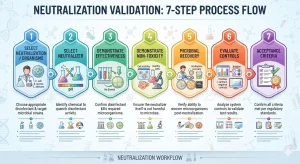
Step 1: Select the Disinfectant and Test Microorganisms
The disinfectant and relevant microorganisms should be identified according to the approved disinfectant efficacy study. The microorganism panel may include standard strains and, where scientifically justified, relevant environmental isolates representing the intended application and contamination-control strategy.
https://pharmavk.com/?s=Environmental+Monitoring
Step 2: Select a Suitable Neutralization Approach
A suitable neutralizer is selected based on the disinfectant’s chemistry chemical neutralization, dilution, membrane filtration, or a combination. USP describes dilution, adding neutralizing agents, membrane filtration, or combinations of these as possible ways to remove antimicrobial activity when appropriate.
Step 3: Demonstrate Neutralizer Effectiveness
The study needs to show the neutralization procedure actually stops the disinfectant from continuing to inhibit or kill microorganisms simply adding a substance labeled “neutralizer” doesn’t by itself demonstrate effectiveness.
Step 4: Demonstrate Neutralizer Non-Toxicity
The neutralizer itself shouldn’t significantly inhibit the test microorganisms a critical part of neutralization validation in disinfectant testing. If the neutralizer is toxic to the microorganisms, recovery may drop even after the disinfectant has already been neutralized. USP specifically calls for demonstrating both neutralizer efficacy and absence of toxicity.
Step 5: Perform Microbial Recovery
After neutralization, microorganisms are recovered using the validated recovery procedure and compared against appropriate controls, to determine whether the neutralization procedure allows acceptable microbial recovery.
Step 6: Evaluate the Controls
Controls are essential for distinguishing disinfectant activity from neutralizer toxicity or other test-system effects. Depending on the method, this may include microbial, neutralizer, disinfectant, neutralization, and recovery controls with the exact set defined in the approved protocol.
Step 7: Establish Acceptance Criteria
Acceptance criteria should be scientifically justified and set before the study runs, demonstrating that residual disinfectant activity has been adequately neutralized, the neutralizer doesn’t adversely affect microbial recovery, and the recovery method suits the microorganisms being tested. Criteria shouldn’t simply be copied from another study without considering the specific disinfectant, organism, method, and application.
Important Controls in Neutralization Validation
| Control | Main Purpose |
|---|---|
| Microbial control | Establishes expected microbial recovery |
| Neutralizer control | Checks whether the neutralizer affects microorganisms |
| Disinfectant control | Demonstrates disinfectant activity |
| Neutralization control | Demonstrates whether residual activity has been stopped |
| Recovery control | Helps assess recovery performance |
The exact control design should be based on the validated method and applicable pharmacopoeial or internal requirements.
Neutralization Validation vs. Disinfectant Efficacy Testing
These two activities are related but serve different purposes:
| Parameter | Neutralization Validation | Disinfectant Efficacy Testing |
|---|---|---|
| Main purpose | Demonstrate that disinfectant activity can be stopped | Evaluate antimicrobial effectiveness |
| Main question | Can residual disinfectant be neutralized without harming recovery? | How effectively does the disinfectant reduce microorganisms? |
| Focus | Neutralizer and recovery system | Disinfectant performance |
| Microbial recovery | Critical | Used to determine microbial reduction |
| Controls | Essential | Essential |
| Result | Suitability of neutralization method | Disinfectant efficacy under defined conditions |
https://pharmavk.com//disinfectant-efficacy-testing-pharmaceutical-industry/
What Happens If Neutralization Is Inadequate?
Inadequate neutralization can lead to continued antimicrobial activity during recovery, causing reduced microbial recovery, an artificially high apparent log reduction, incorrect assessment of disinfectant effectiveness, invalid or questionable results, and the need for investigation or method modification. USP guidance notes that when antimicrobial activity interferes with recovery, the procedure may need modification more dilution, a suitable neutralizing agent, membrane filtration, or a combination.
Common Challenges in Neutralization Validation
Disinfectant Chemistry
Different disinfectants need different neutralization strategies a neutralizer effective for one may not suit another.
Neutralizer Toxicity
A neutralizer can itself affect microbial recovery, so suitability must be demonstrated rather than assumed.
Incomplete Neutralization
Residual disinfectant activity can continue during recovery and skew the result.
Excessive Dilution
Dilution may reduce disinfectant activity but can also reduce the number of microorganisms available for recovery the method needs to balance neutralization and recovery requirements.
Surface Effects
For surface-based studies, recovery from the test surface introduces additional variables, so the recovery method needs to suit the surface material and test design.
Neutralization Validation in Pharmaceutical Manufacturing
In pharmaceutical manufacturing, disinfectant efficacy sits within the broader contamination-control strategy. EU GMP Annex 1 states that disinfection processes should be validated to demonstrate suitability and effectiveness for their intended use and surface material fully applicable since August 2024.
https://pharmavk.com/?s=PUPSIT
That means disinfectant studies should be considered in the context of actual or justified intended use, rather than treating laboratory antimicrobial activity as the only consideration. Relevant factors include surface material, disinfectant concentration, contact time, application method, relevant microorganisms, environmental conditions, organic load where applicable, neutralization and recovery, cleanroom practices, and the facility’s contamination control strategy.
Best Practices for Neutralization Validation
- Define the study objective clearly
- Select appropriate test microorganisms
- Understand the disinfectant chemistry
- Select a scientifically appropriate neutralization approach
- Demonstrate neutralizer effectiveness and non-toxicity
- Include appropriate controls
- Define acceptance criteria before testing
- Use an appropriate microbial recovery method
- Document all test conditions and results
- Investigate unexpected recovery failures
- Reassess the method when disinfectant formulation, concentration, application, or test conditions change
Frequently Asked Questions
What is neutralization validation?
Neutralization validation demonstrates that residual disinfectant activity can be effectively stopped without adversely affecting recovery of the microorganisms used in the test.
Why is neutralization required in disinfectant testing?
It prevents the disinfectant from continuing to kill or inhibit microorganisms after the defined exposure period, helping ensure the microbial recovery result represents the intended test conditions.
Is neutralization the same as dilution?
No. Dilution can reduce antimicrobial activity, while chemical neutralization uses a suitable neutralizing agent. Membrane filtration or combinations of approaches may also apply depending on the method.
Can one neutralizer be used for every disinfectant?
Not necessarily. Neutralizer suitability depends on the disinfectant chemistry and test system its effectiveness and microbial compatibility need to be demonstrated for each case.
What is neutralizer toxicity?
It’s when the neutralizer itself inhibits or damages the microorganisms being recovered, potentially producing artificially low recovery.
What happens if neutralization fails?
The study may need investigation and the method modified using an appropriate validated approach a suitable neutralizer, more dilution, membrane filtration, or a combination.
Conclusion
Neutralization validation in disinfectant testing is a key part of reliable disinfectant efficacy evaluation. The goal isn’t simply adding a neutralizer it’s demonstrating that residual disinfectant activity is adequately stopped while microorganisms remain recoverable. A sound study considers the disinfectant chemistry, test microorganisms, neutralization method, recovery procedure, controls, and scientifically justified acceptance criteria. Integrated with disinfectant efficacy studies and the broader contamination-control strategy, effective neutralization helps ensure microbiological results accurately represent the intended test conditions.
References