Introduction
Maximum Valid Dilution (MVD) is an important concept in bacterial endotoxin testing (BET). It defines the maximum allowable dilution of a test specimen at which the endotoxin limit can still be determined using the selected assay conditions.
In pharmaceutical testing, some products can interfere with endotoxin detection. Product characteristics such as pH, viscosity, formulation components, or other matrix effects may affect the assay response. Dilution can help reduce such interference, but the dilution used for testing should not exceed the calculated MVD.
USP General Chapter <85> provides the calculation of MVD based on the endotoxin limit, sample concentration, and the labeled sensitivity (λ) of the endotoxin reagent.
What Is Maximum Valid Dilution?
Maximum Valid Dilution (MVD) is the maximum allowable dilution of a specimen at which the endotoxin limit can be determined.
In simple terms, MVD establishes the upper limit for dilution during bacterial endotoxin testing.
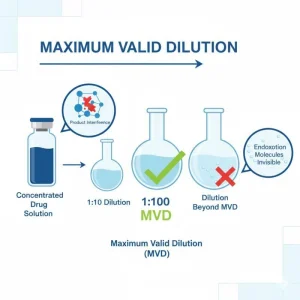
For example, if the calculated MVD is 100, a dilution factor of up to 1:100 may be used under the applicable test conditions.
A dilution beyond the MVD is generally not appropriate because the endotoxin concentration may be reduced below the level at which the applicable assay can reliably determine compliance with the endotoxin limit.
USP <85> specifically defines MVD as the maximum allowable dilution at which the endotoxin limit can be determined.
Why Is Maximum Valid Dilution Important?
Products may interfere with bacterial endotoxin testing.
Interference can result in:
-
Inhibition: The product reduces the assay response to endotoxin.
-
Enhancement: The product increases the assay response.
-
Matrix effects: Product characteristics affect the performance of the test system.
Dilution may help reduce product-related interference.
However, dilution cannot be increased indefinitely. The calculated Maximum Valid Dilution establishes the maximum dilution factor that can be used while maintaining the ability to evaluate the endotoxin limit.
The purpose is therefore to balance interference control with appropriate endotoxin detection.
Maximum Valid Dilution Formula
The general USP formula for MVD is:
MVD = (Endotoxin Limit × Concentration of Sample Solution) / λ
Where:
-
MVD = Maximum Valid Dilution
-
Endotoxin Limit = Maximum permitted endotoxin concentration for the product
-
Concentration = Concentration of the sample solution being tested
-
λ (lambda) = Labeled sensitivity of the endotoxin reagent, expressed in EU/mL
USP <85> describes this calculation and explains that the concentration term depends on how the endotoxin limit is expressed.
How to Calculate Maximum Valid Dilution
Consider a simplified example.
Suppose:
-
Endotoxin limit = 0.5 EU/mL
-
Sample concentration = 1
-
λ = 0.01 EU/mL
Then:
MVD = (0.5 × 1) / 0.01
MVD = 50
Therefore, the calculated Maximum Valid Dilution is 50.
The laboratory can evaluate appropriate dilutions up to this calculated MVD according to the validated procedure and applicable compendial requirements.
The actual MVD calculation for a specific product should use the appropriate endotoxin limit and concentration defined for that product.
What Is λ in BET?
The symbol λ (lambda) represents the labeled sensitivity of the endotoxin reagent in the applicable assay.
For example, a reagent may have a labeled sensitivity of:
λ = 0.01 EU/mL
The value of λ is important because it directly affects the calculated MVD.
A lower λ value represents a more sensitive assay condition and can result in a higher calculated MVD when the other parameters remain unchanged.
The applicable assay and reagent should be used according to the approved and validated test procedure.
How Is MVD Used in Bacterial Endotoxin Testing?
A simplified workflow is:
Product → Determine Endotoxin Limit → Calculate MVD → Evaluate Interference → Select Suitable Dilution → Perform BET
The laboratory may evaluate different dilutions below the calculated MVD when investigating product interference.
The selected dilution should provide suitable test performance and comply with the applicable acceptance criteria.
USP <85> includes procedures for evaluating interfering factors and describes testing sample solutions at dilutions that do not exceed the MVD.
MVD and Product Interference
When product interference is observed, Maximum Valid Dilution provides an important boundary for evaluating higher sample dilutions.
For example, a pharmaceutical formulation may interfere with the endotoxin assay because of:
-
Extreme or unsuitable pH
-
High viscosity
-
Chelating substances
-
Protein-related effects
-
Formulation components
-
Other matrix effects
In such situations, dilution may reduce the interference.
However, the laboratory should not simply select the greatest possible dilution. The dilution should be scientifically justified and remain within the applicable MVD.
FDA has also recognized that product-related factors can interfere with endotoxin testing and that assay suitability needs to be established for the product being tested.
MVD and the Test for Interfering Factors
Before routine testing of a product, the suitability of the bacterial endotoxin test should be demonstrated under the applicable procedure.
The purpose is to determine whether the product causes inhibition or enhancement of the endotoxin response.
A commonly evaluated parameter is spike recovery.
The product is challenged with a known quantity of endotoxin, and the resulting response is evaluated against the appropriate controls.
The selected dilution should demonstrate that the test system can detect endotoxin appropriately in the presence of the product matrix.
USP <85> provides specific procedures and controls for evaluating interfering factors.
MVD vs Selected Test Dilution
Understanding Maximum Valid Dilution is important because the calculated MVD represents the maximum allowable dilution, whereas the selected test dilution may be lower.
For example:
Calculated MVD = 100
The laboratory may determine that:
-
1:10 → interference observed
-
1:20 → acceptable
-
1:40 → acceptable
-
1:80 → acceptable
If the validated procedure supports it, 1:20 may be selected as the routine test dilution even though the MVD is 100.
Therefore:
MVD = maximum allowable dilution
while
Selected dilution = dilution demonstrated to be suitable for the test
The selected dilution should be supported by the applicable method suitability or interference study.
What Happens If Dilution Exceeds the MVD?
Diluting a product beyond its calculated MVD can compromise the ability of the test to determine whether the product complies with its endotoxin limit.
The reason is that dilution decreases the endotoxin concentration present in the test solution.
Therefore, an apparently negative result obtained at an excessive dilution may not provide an appropriate basis for concluding that the original product complies with its endotoxin limit.
USP <85> establishes the MVD specifically to define this upper dilution boundary.
MVD in LAL and Recombinant Reagent Methods
Historically, bacterial endotoxin testing has commonly used Limulus Amebocyte Lysate (LAL) reagents.
Current pharmacopeial and regulatory developments also include recombinant-reagent approaches.
USP General Chapter <86> addresses bacterial endotoxin testing using recombinant reagents, including recombinant Factor C and recombinant cascade reagents. FDA’s 2026 guidance also reflects the broader use of recombinant reagents and states that the selected method should be demonstrated suitable for its intended use.
Therefore, technical discussions of MVD should not be limited to the phrase “LAL test” when the applicable method uses a recombinant reagent.
Common Mistakes When Applying MVD
Exceeding the Maximum Valid Dilution can compromise the ability to appropriately assess the product against its endotoxin limit.
1. Treating MVD as the Routine Test Dilution
MVD is the maximum allowable dilution, not necessarily the dilution that should routinely be used.
2. Diluting Beyond the MVD
A dilution beyond the calculated MVD may prevent meaningful assessment against the endotoxin limit.
3. Ignoring Product Interference
A calculated MVD alone does not demonstrate that a particular dilution is suitable for the product.
4. Selecting a Dilution Without Method Suitability
The selected test dilution should be supported by appropriate interference or suitability studies.
5. Using an Incorrect Endotoxin Limit
The endotoxin limit must be established appropriately for the product and route/dosing conditions.
FDA’s current guidance notes that finished-product endotoxin acceptance criteria should be based on the maximum dose that can be delivered within one hour, with specific considerations for different routes and dosing situations.
Best Practices for MVD in BET
A robust approach to Maximum Valid Dilution should include:
-
Establish the applicable endotoxin limit.
-
Determine the appropriate sample concentration.
-
Confirm the sensitivity (λ) of the selected assay.
-
Calculate the MVD using the applicable formula.
-
Evaluate potential product interference.
-
Perform appropriate method-suitability studies.
-
Select a suitable dilution that does not exceed the MVD.
-
Follow the approved test procedure.
-
Use appropriate positive and negative controls.
-
Document calculations, dilutions, and test results.
-
Reassess method suitability when significant changes occur to the product or test method.
Frequently Asked Questions
What does MVD stand for?
MVD stands for Maximum Valid Dilution.
What is the purpose of MVD?
MVD establishes the maximum allowable dilution of a specimen at which the endotoxin limit can be determined.
What is the formula for MVD?
The general formula is:
MVD = (Endotoxin Limit × Concentration of Sample Solution) / λ
where λ represents the applicable labeled sensitivity of the endotoxin reagent.
Can the test dilution be higher than the MVD?
The test dilution should not exceed the applicable MVD because excessive dilution may prevent appropriate determination of compliance with the endotoxin limit.
Is MVD the same as the selected dilution?
No. MVD is the maximum allowable dilution. The selected dilution may be lower if it provides suitable assay performance and adequately controls product interference.
Why is dilution used in BET?
Dilution may help reduce product-related interference with endotoxin detection. However, the selected dilution must remain within the applicable MVD.
Does MVD apply only to LAL testing?
MVD is associated with bacterial endotoxin testing and its calculation depends on the applicable assay sensitivity. Current compendial and regulatory frameworks also recognize recombinant-reagent approaches, so the specific method and applicable requirements should be considered.
Conclusion
Maximum Valid Dilution (MVD) is an important concept in bacterial endotoxin testing because it establishes the upper dilution boundary for determining compliance with an endotoxin limit.
The calculation uses the endotoxin limit, sample concentration, and assay sensitivity (λ). Dilution can help reduce product interference, but the selected dilution should be supported by appropriate method-suitability studies and should not exceed the calculated MVD.
Understanding the difference between MVD and the selected test dilution is particularly important in pharmaceutical QC. A scientifically justified dilution strategy helps laboratories manage product interference while maintaining an appropriate basis for endotoxin testing.
References
-
USP General Chapter <85> Bacterial Endotoxins Test.
-
FDA, Pyrogen and Endotoxins Testing: Questions and Answers — March 2026.
-
FDA, Questions and Answers on Quality-Related Controlled Correspondence — Microbiology (Endotoxin Testing).
-
USP General Chapter <86> Bacterial Endotoxins Test Using Recombinant Reagents.