Revalidation of LAF (Laminar Air Flow)
Laminar airflow refers to the smooth, uninterrupted flow of air in parallel layers, with
minimal disruption or turbulence between the layers. This principle is widely used in various
industries, especially in cleanrooms, laboratories, healthcare facilities, and manufacturing
processes where maintaining a sterile and controlled environment is crucial.
Un Scheduled Re validation :
- Re validate the equipment in the following cases.
- Change of location.
- Break down of Critical parts.
Scheduled Re validation :
- Particle count test, Air velocity and HEPA filter integrity test shall be carried out for yearly once.
- Recovery test and Air flow pattern shall be carried out for two year once .
- Plate Exposure shall be carried out for every 15 days or every week.
Revalidation intervals vary depending on industry standards, the specific application, and
regulatory requirements.
1) Air velocity
2) HEPA filter integrity test
3) Particle count test
4) Recovery test
5) Air flow pattern
1) Air velocity
- Turn on the anemometer and hold it steady in the airflow for a sufficient duration to
get a stable reading. - Take multiple measurements at different locations within the airflow to ensure
consistency or variations across the area being tested. - Anemometer range as 0 – 1500 FPM
Anemometer
- V1, V2, V3, V4, V5 multiple readings and divided by 5.
- Record the readings obtained at each point and analyze the data to ensure that the air
velocity meets the required specifications or standards. - Acceptance Criteria Air velocity should be 90 ± 20 feet/minute
HEPA filter integrity test
- Filter integrity test perform before Air velocity.
- Poly alpha olefin (PAO) shall be used for the generation of particles/fumes. by using
compressed gas. - Provide compressed air to fume generator at pressure 1.5-2kg/cm²
- Concentrate of the aerosol challenge upstream of filter should be 20mg/m³ and 80
mg/m³ - Concentration lower than 20 mg/m³can reduce the Sensitivity of leak test detection.
- Scan the upstream concentration and set photometer.
Acceptance Criteria - During scanning percentage of the PAO penetration shown by photometer should be
less than 0.001%
NVPC non viable particle counter
- Range: 0.3,0.5,0.7,1,5 µ and 10 micron
- 100 LPM flow samples 1 m3 in 10 minutes Calculates and creates reports for ISO
14644-1 - It takes ten minutes for one reading. We take two readings, one on the left side and
one on the right of the LAF. - After gather all data, calculate, and print.
- Acceptance criteria0.5µ: 3525.0µ: 29
Recording
After completion of each study, a report shall be prepared by the validation team
members which shall include the following information.
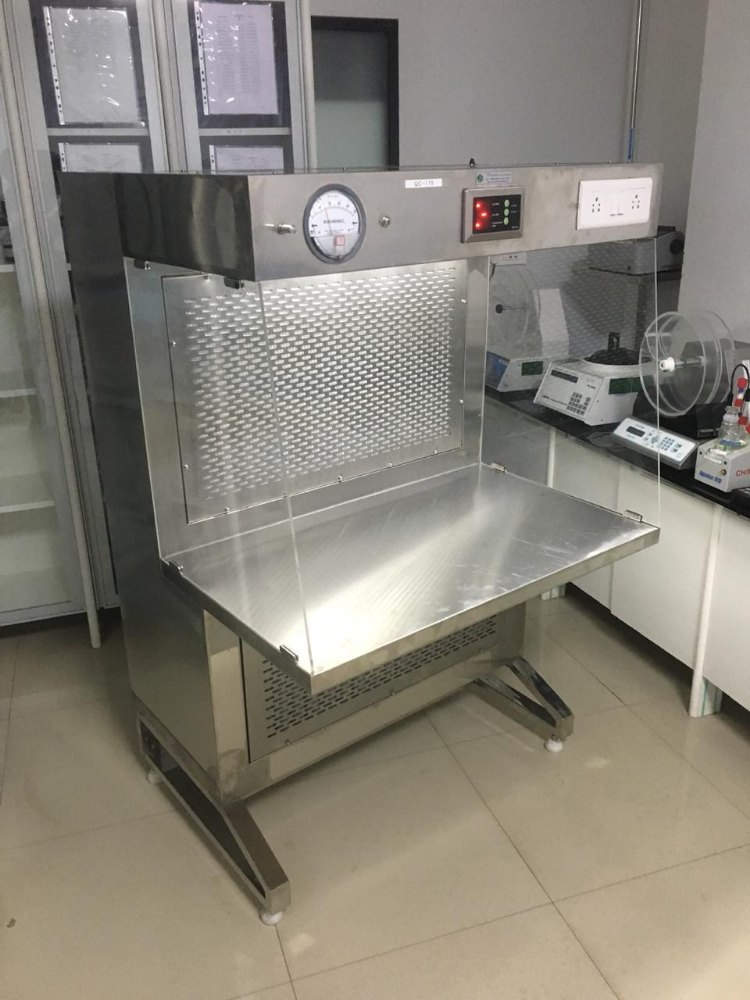
LAF units use laminar air drawn through HEPA filters to create a particle-free
working environment.
Tabulated Data
Trend Analysis Plots
Validation Team Members and their Signatures
Conclusions
Quality Assurance Department Certification
4) Recovery test
A recovery test for laminar air flow (LAF) determines how well an operating room
(OR) ventilation system can remove airborne particles after a brief exposure to a
particulate source. The test also determines how long it takes for the cleanroom to
recover from a challenge concentration to the Target Cleanliness Level.
To perform a performance qualification for LAF, scan the downstream side of the
filter with a photometer probe. The probe should scan the entire filter face and frame
at a position about 1 to 2 inches from the face of the filter. Scanning should be done at
the rate of maximum 2 feet per minute
5) Air flow pattern
- Airflow pattern Test to show air flow direction.
- Visualization is carried out by using fog generator and canister and taking Video
Graph. - The purpose of the airflow visualization test is to show the actual airflow pattern
throughout the unidirectional clean room. - The test can also be used to demonstrate the effects on airflow caused by equipment.
The test determining the airflow patterns within a room using ISO 14644 guides.