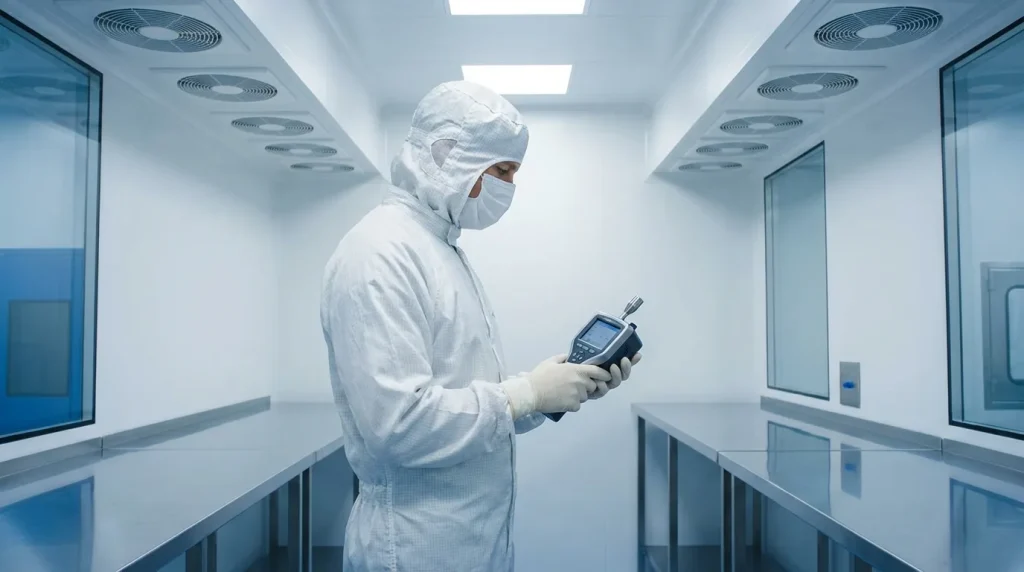
In pharmaceutical manufacturing, cleanrooms are designed to maintain controlled environmental conditions that minimize the risk of particulate and microbial contamination.
The Heating, Ventilation and Air Conditioning (HVAC) system plays a major role in maintaining these conditions by controlling airflow, air changes, temperature, humidity, pressure differentials and filtration.
But what happens when the HVAC system shuts down unexpectedly or is switched off for maintenance?
During a shutdown, airflow may stop or become inadequate, room pressure differentials may be disturbed, and airborne particles may accumulate. Even after the system restarts, the cleanroom may not immediately return to its qualified environmental condition.
This is why cleanroom HVAC recovery time is important. It helps determine how long a cleanroom needs to regain its specified cleanliness conditions before it can be considered suitable for the intended activities.
What Is Cleanroom Recovery Time?
Cleanroom recovery time is the time required for a cleanroom to return to its specified cleanliness condition after a disturbance.
In pharmaceutical facilities, this concept is associated with the ability of the HVAC system to remove airborne particles and restore the required environmental conditions.
Recovery or clean-up time may be evaluated during cleanroom qualification using defined test conditions.
It is important to distinguish between two situations:
- Clean-up time: The time required for a room to return to its specified particle cleanliness condition after an operational activity or particle challenge.
- Recovery after HVAC shutdown: The time and verification needed to restore the room’s qualified environmental conditions following an interruption of HVAC operation.
These concepts are related, but they are not automatically interchangeable. The restart and release requirements after a shutdown should be established through a documented procedure and risk assessment.
https://pharmavk.com/cleanroom-surface-recovery-studies/
What Happens During an HVAC Shutdown?
When a cleanroom HVAC system stops operating, several environmental conditions may be affected.
1. Airflow May Be Interrupted
The HVAC system supplies and circulates filtered air throughout the cleanroom.
If airflow stops, the normal removal and dilution of airborne particles may be reduced or interrupted.
Activities such as personnel movement, equipment operation and material handling may contribute additional particles.
2. Pressure Differentials May Change
Pharmaceutical cleanrooms often operate with controlled pressure relationships between adjacent rooms.
These pressure differences help maintain the intended airflow direction and reduce the risk of contamination transfer.
During an HVAC shutdown, pressure differentials may decrease or become unstable.
This can affect the intended protection between areas of different cleanliness classifications.
3. Airborne Particles May Accumulate
When normal air circulation is interrupted, particles generated by personnel, equipment and other activities may remain suspended or settle on surfaces.
After restarting the HVAC system, sufficient time and verification may be necessary to establish that airborne particle levels have returned to the required condition.
4. Temperature and Humidity May Fluctuate
Depending on the duration of the shutdown and the facility design, temperature and relative humidity may move outside their specified ranges.
Such changes can affect material storage conditions, process requirements and environmental control.
5. Contamination Control May Be Compromised
If the cleanroom is accessed during or after the shutdown without appropriate controls, the risk of contamination may increase.
Therefore, the impact of the interruption must be assessed before manufacturing or other critical activities resume.
Why Is Recovery Time Important?
1. To Restore the Required Cleanroom Classification
Cleanrooms are classified according to specified airborne particle concentration limits.
After an HVAC interruption, the room may not immediately meet its required classification.
Recovery assessment helps establish when the specified cleanliness condition has been restored.
2. To Maintain Pressure Differential Control
Pressure differentials help control airflow between rooms and protect areas from contamination transfer.
Recovery verification should include checking the required pressure relationships before the area is released for its intended use.
3. To Reduce the Risk of Contamination
Airborne particles can carry microorganisms or contribute to contamination of exposed materials and product-contact surfaces.
Allowing the room to recover and verifying its environmental condition helps reduce the risk of resuming operations under unsuitable conditions.
However, particle recovery alone does not demonstrate that microbial contamination is absent.
4. To Support Aseptic Process Protection
In sterile manufacturing, maintaining environmental control is especially important when sterile product, components or product-contact surfaces are exposed.
An HVAC interruption may affect the environmental conditions protecting these materials.
The manufacturer should assess the impact on the operation, including exposed product, equipment and materials, before deciding whether activities can resume.
5. To Establish a Scientifically Justified Restart Procedure
Without a defined recovery procedure, employees may restart operations based only on assumptions or a fixed waiting period.
A qualified recovery time provides a documented basis for determining when the required environmental conditions have been restored.
6. To Support GMP Compliance
Good Manufacturing Practices require pharmaceutical facilities to maintain suitable premises and environmental controls.
Documented recovery studies, environmental monitoring, deviation management and appropriate qualification activities help demonstrate that cleanroom conditions are adequately controlled.
Factors That Affect Cleanroom Recovery Time
Recovery time is not identical for every cleanroom. It depends on several factors.
| Factor | Possible effect on recovery |
|---|---|
| Air changes per hour | Influences the rate of airborne particle removal |
| HEPA filter performance | Affects the removal of airborne particles |
| Room volume | Influences the amount of air that needs to be cleaned |
| Airflow pattern | Influences particle movement and removal |
| Personnel occupancy | Can introduce additional airborne particles |
| Equipment and material arrangement | May obstruct airflow or create stagnant areas |
| Duration of HVAC shutdown | May influence the extent of environmental disturbance |
| Pressure differential | Affects airflow direction between rooms |
| HVAC system design | Determines how effectively environmental conditions are restored |
The recovery time should be established under conditions representative of the actual room and its intended use.
How Is Cleanroom Recovery Time Evaluated?
Recovery time is generally established during cleanroom qualification using a defined and documented test procedure.
A typical assessment involves the following steps.
Step 1: Define the Test Conditions
Identify the cleanroom, its classification, operating conditions and the purpose of the recovery study.
Define the initial environmental condition and the particle challenge or disturbance to be evaluated.
Step 2: Establish the Initial Particle Condition
Measure airborne particle concentrations at predefined sampling locations using a suitable particle counter.
The selected locations should represent areas where particle accumulation or poor airflow recovery may occur.
Step 3: Introduce or Identify the Defined Disturbance
Conduct the study using an approved particle challenge or a representative operational disturbance, as specified in the qualification protocol.
The test should follow an established and reproducible procedure.
Step 4: Restore Normal HVAC Operation
Operate the HVAC system under the defined conditions and monitor particle concentrations at the specified intervals.
Step 5: Monitor Particle Reduction
Record particle concentrations over time to determine how quickly the room returns to its specified cleanliness condition.
Step 6: Establish the Recovery Time
Evaluate the results against the predefined acceptance criteria.
The recovery time should be justified, documented and included in the applicable cleanroom procedures.
Step 7: Approve and Document the Results
Prepare a recovery study report describing the test conditions, sampling locations, particle measurements, results and conclusion.
The approved recovery time should be incorporated into relevant procedures where applicable.
Important: A particle recovery study does not replace other cleanroom qualification tests, such as HEPA filter integrity testing, airflow volume measurement, pressure differential verification or microbial monitoring.
What Should Be Checked Before Restarting Cleanroom Activities?
After an HVAC shutdown, the responsible teams should evaluate the condition of the facility before allowing routine activities to resume.
| Checkpoint | What should be verified? |
|---|---|
| HVAC operation | System functioning under approved operating conditions |
| HEPA filtration | Filter integrity status, where affected or required |
| Airflow | Required airflow volume and direction |
| Pressure differential | Required pressure relationships between rooms |
| Temperature and humidity | Specified environmental limits |
| Particle concentration | Required cleanliness condition restored |
| Environmental monitoring | Additional monitoring based on risk assessment |
| Cleaning and disinfection | Performed where required by the shutdown assessment |
| Equipment and materials | Potential impact of exposure during the shutdown |
| Documentation | Shutdown, recovery and approval records completed |
The exact checks depend on the duration and cause of the shutdown, the affected area, the process and the site’s approved procedures.
Practical Example from a Pharmaceutical Cleanroom
Imagine a Grade C cleanroom used for pharmaceutical manufacturing.
During a power interruption, the HVAC system stops operating for a period of time.
When the power supply is restored, the HVAC system starts again. However, the production team should not immediately assume that the room has returned to its qualified condition.
The engineering team verifies that the HVAC system is functioning correctly.
The responsible personnel then assess:
- Pressure differentials between adjacent rooms
- Airflow and system operating parameters
- Temperature and humidity
- Airborne particle concentrations
- Any maintenance or facility issues caused by the interruption
If required, additional cleaning, disinfection and environmental monitoring are performed according to the approved procedure and risk assessment.
The room is released for its intended activities only after the required conditions have been verified and the appropriate authorization has been obtained.
This example demonstrates that restarting the HVAC system is not the same as restoring the cleanroom to its qualified state.
What Should Be Documented After an HVAC Shutdown?
Proper documentation helps maintain traceability and supports investigation if environmental conditions are affected.
The records may include:
- Date and time of HVAC shutdown
- Reason for the shutdown
- Duration of the interruption
- Affected cleanroom areas
- HVAC maintenance or repair details
- Environmental conditions before and after restart
- Pressure differential records
- Particle monitoring results, where required
- Cleaning and disinfection records, where applicable
- Risk assessment and deviation records
- Recovery verification and QA release approval
Any deviation from approved environmental conditions should be handled through the site’s quality management system.
Common Mistakes to Avoid
| Common mistake | Possible impact |
|---|---|
| Allowing operations immediately after HVAC restart | Room conditions may not have recovered |
| Using the same recovery time for every cleanroom | May not reflect differences in room design and classification |
| Relying only on elapsed time | Does not demonstrate that required conditions have been restored |
| Ignoring pressure differentials | Airflow direction may remain unsuitable |
| Checking particles without considering other parameters | Incomplete assessment of environmental control |
| Ignoring the duration and cause of shutdown | Potential risks may be overlooked |
| Failing to document restart activities | Reduced traceability |
| Resuming operations without appropriate approval | Potential GMP and product quality risks |
Conclusion
Recovery time is an important part of cleanroom environmental control because an HVAC shutdown can disturb airflow, pressure differentials and airborne particle levels.
Simply restarting the HVAC system does not confirm that the cleanroom has returned to its qualified condition.
A scientifically established recovery time, supported by qualification studies, environmental verification and documented procedures, helps ensure that cleanroom activities resume under suitable conditions.
In pharmaceutical manufacturing, the key principle is simple: a cleanroom should be verified as suitable for use before critical operations resume, rather than relying only on the time elapsed after HVAC restart.
Frequently Asked Questions (FAQs)
1. What is cleanroom recovery time?
It is the time required for a cleanroom to return to its specified cleanliness condition after a defined disturbance, as established through an appropriate recovery study.
2. Is recovery time the same for every cleanroom?
No. Recovery time depends on room design, air changes, airflow patterns, filtration, occupancy and the conditions of the recovery study.
3. Can production restart immediately after HVAC restoration?
Not automatically. The affected area should be assessed, required environmental conditions verified and appropriate authorization obtained before resuming activities.
4. What is the difference between clean-up time and HVAC shutdown recovery time?
Clean-up time generally describes the time required to restore particle cleanliness after an operational disturbance or particle challenge. HVAC shutdown recovery involves assessing the restoration of environmental controls after an interruption of HVAC operation.
5. Does particle recovery confirm that the cleanroom is microbiologically clean?
No. Particle measurements do not directly demonstrate microbial cleanliness. Microbiological monitoring and other contamination-control measures should be considered according to the applicable procedure and risk assessment.
6. What is the recovery time guidance mentioned in EU GMP Annex 1?
EU GMP Annex 1 gives a guidance value of less than 20 minutes for the clean-up period in the context of restoring the at-rest particle cleanliness condition after operations, line clearance or cleaning. This is not a universal fixed waiting time after every HVAC shutdown.
7. When should cleanroom requalification be considered after an HVAC shutdown?
Requalification should be considered when the interruption affects the operation of the cleanroom or clean-air installation. The need and extent should be determined through change management and risk assessment, considering the nature of the interruption and any remedial work.
References
- European Commission. EudraLex Volume 4, EU Guidelines for Good Manufacturing Practice, Annex 1: Manufacture of Sterile Medicinal Products (2022).
Read EU GMP Annex 1 - World Health Organization (WHO). WHO Good Manufacturing Practices for Heating, Ventilation and Air-Conditioning Systems for Non-Sterile Pharmaceutical Products, TRS 1010, Annex 8 (2018).
Read WHO HVAC Guidelines - World Health Organization (WHO). WHO Good Manufacturing Practices for Heating, Ventilation and Air-Conditioning Systems for Non-Sterile Pharmaceutical Products (Part 2): Interpretation of Guidelines, TRS 1019, Annex 2 (2019).
Read WHO HVAC Interpretation Guidelines - World Health Organization (WHO). WHO Good Manufacturing Practices for Pharmaceutical Products: Main Principles, TRS 986, Annex 2 (2014).
Read WHO GMP Guidelines