In pharmaceutical microbiology, microbial enumeration is performed to determine the number of viable microorganisms present in a sample. The accuracy of this test depends not only on the culture medium and incubation conditions but also on how the sample is prepared before testing.
One important factor is diluent selection in microbial enumeration.
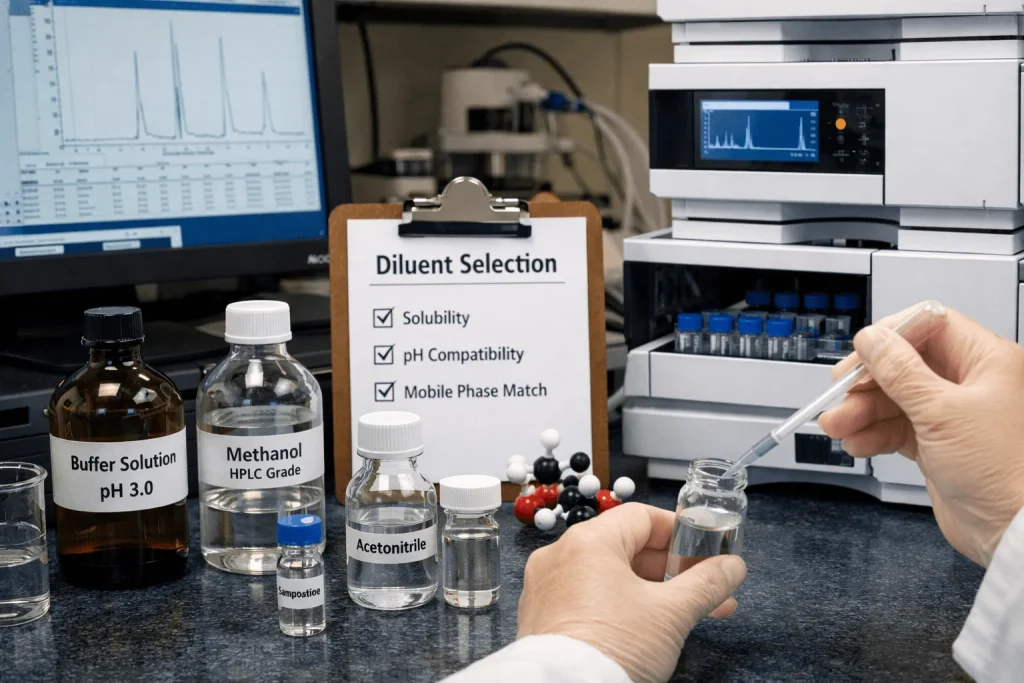
A diluent is a liquid used to dissolve, suspend or dilute a sample before microbiological analysis. Selecting an unsuitable diluent can affect microbial survival, recovery and distribution within the sample, potentially leading to inaccurate colony counts.
Therefore, the diluent must be suitable for the product, compatible with the microorganisms being tested and appropriate for the intended test method.
https://pharmavk.com/colony-counting-errors-microbial-enumeration/
What Is a Diluent in Microbial Enumeration?
A diluent is a sterile liquid used during sample preparation and serial dilution to obtain a suitable concentration of microorganisms for enumeration.
In pharmaceutical microbiology, commonly used diluents include:
- Buffered Sodium Chloride-Peptone Solution, pH 7.0
- Phosphate Buffer Solution, pH 7.2
- Soybean-Casein Digest Broth (SCD Broth)
- Other suitable sterile diluents specified in an approved procedure
The selection depends on the product’s physical and chemical properties and the requirements of the microbiological test.
Why Is Diluent Selection Important?
1. To Maintain Microbial Viability
The main purpose of microbial enumeration is to recover viable microorganisms from the sample.
An unsuitable diluent may create conditions that reduce microbial viability before the sample is transferred to the culture medium.
For example, a diluent with an unsuitable pH or potentially inhibitory ingredients may affect microbial survival and result in lower colony counts.
A suitable diluent helps maintain conditions that support microbial recovery during sample preparation.
2. To Prevent Inhibition of Microbial Growth
Some pharmaceutical products contain antimicrobial ingredients, preservatives or other substances that can interfere with microbial recovery.
If these substances remain active during testing, they may inhibit microbial growth and produce falsely low results.
In such cases, the laboratory may need to evaluate suitable approaches, including:
- Increasing the dilution factor
- Using an appropriate neutralizing agent
- Increasing the volume of diluent
- Applying membrane filtration, where suitable
Any neutralizing agent must be demonstrated to be effective against the interfering substance and non-toxic to the microorganisms being recovered.
3. To Ensure Proper Sample Dispersion
Some pharmaceutical samples do not dissolve easily in water.
For example, oily, fatty or poorly water-soluble products may form clumps or uneven suspensions during sample preparation.
An appropriate diluent or compatible surface-active agent may help distribute the sample more uniformly.
Poor dispersion can cause microorganisms to remain trapped within product particles or unevenly distributed in the suspension, affecting the reliability of enumeration.
4. To Maintain Suitable pH Conditions
Microorganisms may be affected by highly acidic or alkaline conditions.
If the sample changes the pH of the diluent significantly, microbial recovery may be affected.
Buffered diluents help maintain a suitable pH during sample preparation.
For example, the International Pharmacopoeia describes the use of buffered sodium chloride-peptone solution at pH 7.0 and phosphate buffer at pH 7.2 for relevant sample preparations. Where necessary, the prepared sample may be adjusted to pH 6–8 in accordance with the specified procedure.
The appropriate pH must be established based on the applicable method and product characteristics.
5. To Support Accurate Serial Dilution
Serial dilution reduces the concentration of microorganisms in a sample to obtain countable colonies.
If the diluent itself affects microbial viability, the number of microorganisms recovered at subsequent dilution levels may decrease.
Using a suitable diluent helps maintain microbial recovery throughout the dilution process and supports more reliable enumeration.
Common Diluents Used in Pharmaceutical Microbiology
| Diluent | General purpose |
|---|---|
| Buffered Sodium Chloride-Peptone Solution | Sample dilution and microbial recovery |
| Phosphate Buffer Solution | Provides buffered conditions during sample preparation |
| Soybean-Casein Digest Broth | Used for suitable sample preparation and microbial recovery procedures |
| Peptone-containing diluents | Provide a suitable environment for microorganisms during dilution, depending on formulation |
| Neutralizing diluents | Help reduce the effect of antimicrobial substances in a sample |
Note: These diluents are not automatically interchangeable. Their suitability must be established for the specific product and test method.
Factors to Consider Before Selecting a Diluent
Before selecting a diluent for microbial enumeration, the laboratory should evaluate the following factors:
| Factor | Why it matters |
|---|---|
| Product solubility | Determines whether the sample can dissolve or disperse properly |
| Product pH | May affect microbial survival during preparation |
| Antimicrobial activity | May require neutralization or another suitable recovery approach |
| Microbial compatibility | Ensures the diluent does not inhibit the test organisms |
| Sample viscosity | May affect mixing, pipetting and sample distribution |
| Surface-active agent compatibility | Helps prevent interference with microbial recovery |
| Test method requirements | Ensures compatibility with the approved procedure |
How Is Diluent Suitability Evaluated?
Diluent suitability should be considered as part of the overall suitability of the microbial enumeration method.
A typical evaluation involves the following activities:
Step 1: Review the product characteristics
Understand the product’s solubility, pH, viscosity and potential antimicrobial properties.
Step 2: Select a suitable diluent
Choose a diluent based on the product characteristics and the applicable pharmacopoeial method or approved procedure.
Step 3: Prepare the sample
Prepare the sample using the specified dilution, mixing and handling conditions.
Step 4: Evaluate microbial recovery
Where required, perform method suitability testing using appropriate challenge microorganisms and compare recovery from the product preparation with a suitable control preparation.
Step 5: Evaluate inhibition or toxicity
Determine whether the diluent, neutralizer or sample preparation procedure interferes with microbial recovery.
Step 6: Document the results
Record the diluent composition, preparation details, sample dilution, test conditions, recovery results and conclusion according to the approved procedure.
Practical Example from a Pharmaceutical Microbiology Laboratory
Imagine a microbiologist is performing microbial enumeration of a pharmaceutical product containing a preservative.
The sample is prepared using a diluent that does not adequately neutralize the preservative activity.
After incubation, the microbiologist observes very low microbial recovery.
At first, the result may appear to indicate a low microbial count. However, the preservative may have continued to inhibit the microorganisms during sample preparation and testing.
The laboratory should review the method suitability data and investigate whether the selected diluent is appropriate.
Depending on the product and test method, the laboratory may evaluate a suitable neutralizer, increased dilution or membrane filtration.
The effectiveness of the selected approach and the absence of toxicity to the test microorganisms must be demonstrated.
This example highlights an important point: a low microbial count does not always mean that the original sample contained very few microorganisms. Inadequate recovery can also influence the result.
https://pharmavk.com/serial-dilution-microbial-enumeration/
Common Mistakes During Diluent Selection
| Common mistake | Possible impact |
|---|---|
| Selecting a diluent without considering product properties | Poor sample preparation |
| Using an unsuitable pH | Reduced microbial recovery |
| Ignoring preservative activity | False-low microbial counts |
| Using an unqualified neutralizer | Continued inhibition or microbial toxicity |
| Inadequate sample mixing | Uneven microbial distribution |
| Using an unsuitable surface-active agent | Interference with microbial recovery |
| Not documenting diluent preparation | Reduced traceability |
Conclusion
Diluent selection is an important part of microbial enumeration because it directly influences sample preparation and the recovery of viable microorganisms.
A suitable diluent should support microbial recovery without introducing inhibitory effects or interfering with the test method.
Pharmaceutical microbiology laboratories should consider product characteristics, pH, solubility, antimicrobial activity and method requirements before selecting a diluent.
Ultimately, reliable microbial enumeration depends not only on counting colonies correctly but also on ensuring that microorganisms can be recovered appropriately from the original sample.
Frequently Asked Questions (FAQs)
1. What is the main purpose of a diluent in microbial enumeration?
A diluent is used to dissolve, suspend or dilute a sample before testing, helping prepare it for microbial recovery and enumeration.
2. Which diluent is commonly used in pharmaceutical microbiology?
Buffered Sodium Chloride-Peptone Solution, pH 7.0, phosphate buffer solution, pH 7.2, and Soybean-Casein Digest Broth are examples used in specified sample preparation procedures.
3. Can an unsuitable diluent affect microbial counts?
Yes. An unsuitable diluent may inhibit microorganisms, affect their viability or result in poor sample dispersion, potentially producing inaccurate counts.
4. Why are neutralizing agents sometimes added to diluents?
Neutralizing agents help reduce the antimicrobial activity of preservatives or other interfering substances so that microorganisms can be recovered during testing.
5. Is the same diluent suitable for every pharmaceutical product?
No. Diluent selection depends on the product’s physical and chemical characteristics, potential antimicrobial activity and the requirements of the test method.
6. Why is method suitability important in microbial enumeration?
Method suitability demonstrates that microorganisms can be recovered adequately in the presence of the product under the specified test conditions.
References
- United States Pharmacopeia (USP). General Chapter <61> – Microbiological Examination of Nonsterile Products: Microbial Enumeration Tests.
Read USP General Chapter 61 - World Health Organization (WHO). The International Pharmacopoeia – Microbial Enumeration Tests, 13th Edition, 2025.
Read the WHO International Pharmacopoeia - United States Pharmacopeia (USP). General Chapter <62> – Microbiological Examination of Nonsterile Products: Tests for Specified Microorganisms.
Visit United States Pharmacopeia - European Pharmacopoeia (Ph. Eur.). General Chapter 2.6.12 – Microbiological Examination of Non-Sterile Products: Microbial Enumeration Tests.
Visit the European Directorate for the Quality of Medicines (EDQM)