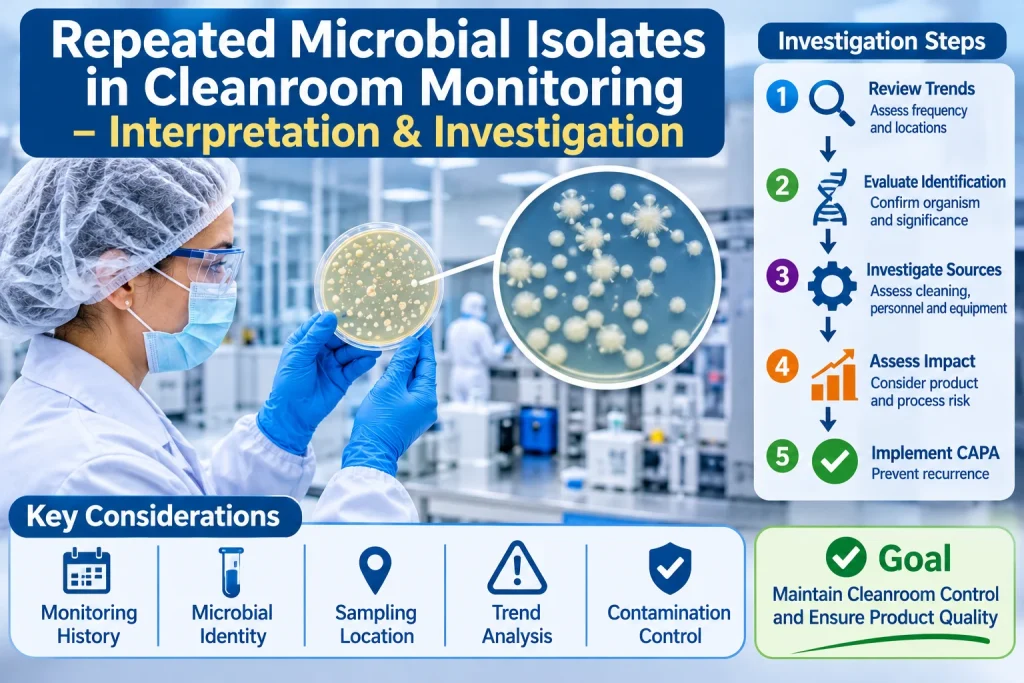
Repeated Microbial Isolates in Cleanroom Monitoring are microorganisms recovered repeatedly during environmental monitoring from the same or different locations within a pharmaceutical manufacturing facility. Their repeated occurrence may indicate persistent contamination sources, inadequate cleaning and disinfection, personnel-related contamination, or weaknesses in environmental control.
https://pharmavk.com/cleanroom-surface-recovery-studies/
Environmental monitoring (EM) is an important component of contamination control in pharmaceutical manufacturing, particularly in facilities producing sterile medicinal products. It provides information about the microbiological condition of cleanrooms, equipment surfaces, personnel, and the surrounding environment during operations.
However, identifying the same microorganism multiple times does not automatically establish a contamination failure. The findings must be interpreted using historical monitoring data, sampling locations, operational activities, microbial identification results, and the effectiveness of existing controls.
For example, repeated recovery of a skin-associated microorganism from personnel monitoring samples may suggest a personnel hygiene or gowning issue. In contrast, repeated recovery of a spore-forming microorganism from equipment surfaces may warrant investigation of cleaning effectiveness, material transfer, and potential environmental reservoirs.
A systematic approach to interpreting repeated microbial isolates helps pharmaceutical microbiology and Quality Assurance (QA) teams identify emerging trends, investigate potential contamination sources, assess product impact, and implement appropriate corrective and preventive actions (CAPA). https://pharmavk.com/Why-is-CAPA-Correct/
What Are Repeated Microbial Isolates?
Repeated microbial isolates are microorganisms recovered on multiple occasions during microbiological monitoring. The recurrence may involve the same identified species, a similar microbial group, or a confirmed strain recovered from different samples.
The significance depends on several factors:
- Frequency of recovery over time.
- Sampling location and cleanroom classification.
- Whether the samples were collected during routine operations or after cleaning.
- Microbial identity and potential significance.
- Colony counts and applicable alert or action limits.
- Association with particular operators, equipment, materials, or activities.
- Previous contamination events and investigation findings.
It is important to distinguish repeated species identification from confirmed strain recurrence. Two isolates identified as the same species are not necessarily the same strain. Where establishing a common source is important, additional strain-typing or molecular methods may be considered, subject to method suitability and the investigation objective.
Why Is Interpretation of Repeated Isolates Important?
1. Identifies persistent contamination sources
Repeated findings may reveal contamination sources that routine cleaning or standard operating practices have not adequately controlled.
2. Detects adverse environmental trends
An area may show a deterioration in microbiological control even when individual results remain within established limits. Increasing recovery frequency or a change in microbial flora may therefore warrant attention.
3. Supports product quality risk assessment
Microorganisms recovered from critical processing locations may present a different level of concern from those recovered in supporting areas. The assessment should consider whether exposed product, product-contact surfaces, containers, or closures could have been affected.
4. Evaluates cleaning and disinfection effectiveness
Repeated recovery of an organism after disinfection may indicate a possible weakness in the cleaning process, disinfectant application, contact time, surface accessibility, or contamination control practices.
5. Strengthens contamination control strategy
Trending and investigation findings can help improve sampling plans, personnel practices, cleaning procedures, material transfer controls, and other elements of the site’s contamination control strategy (CCS).
Common Sources of Repeated Microbial Isolates
1. Personnel-related contamination
Personnel may introduce microorganisms through skin shedding, inadequate gowning practices, improper glove handling, or contact with contaminated surfaces.
Example: A similar skin-associated microorganism is repeatedly recovered from glove samples collected after critical interventions.
Investigation focus: Review gowning qualification, glove disinfection, intervention practices, personnel monitoring trends, and the timing of sample collection.
2. Inadequate cleaning and disinfection
Microorganisms may persist when surfaces are not adequately cleaned, disinfectant preparation is incorrect, contact time is insufficient, or difficult-to-access locations are missed.
Example: The same microbial species is repeatedly recovered from a particular equipment surface after routine disinfection.
Investigation focus: Review the cleaning sequence, disinfectant concentration, expiry or in-use period, contact time, surface accessibility, and relevant recovery method limitations.
3. Environmental reservoirs
Microorganisms may persist in drains, wet areas, damaged surfaces, equipment joints, or other locations that are difficult to clean or dry.
Example: Similar isolates are recovered repeatedly near a wet utility area and adjacent floor surfaces.
Investigation focus: Evaluate moisture sources, drainage, surface condition, cleaning effectiveness, airflow and material movement where relevant.
4. Material and equipment transfer
Personnel, mobile equipment, containers, and incoming materials can transfer microorganisms between areas.
Example: A microorganism repeatedly appears near a material transfer hatch following the movement of supplies.
Investigation focus: Review transfer disinfection, packaging removal, material movement, equipment cleaning, and the sequence of activities.
5. Utility-related contamination
Water systems, compressed gases, or other relevant utilities may be potential contamination sources depending on the process and the organism recovered.
Example: Repeated recovery of a similar water-associated microorganism from locations close to a wet process or water outlet prompts further investigation.
Investigation focus: Review relevant utility monitoring results, sampling locations, maintenance history, and possible routes of contamination transfer.
These examples describe possible causes, not automatic conclusions. The actual source should be established through documented investigation wherever possible.
How to Interpret Repeated Microbial Isolates
Step 1: Review the environmental monitoring history
Collect historical data for the relevant sampling point, room, equipment, and nearby locations.
Review:
- Date and time of recovery.
- Sampling method and location.
- Colony counts and applicable limits.
- Cleanroom status and activity at the time of sampling.
- Microbial identification results.
- Cleaning, disinfection, and maintenance records.
- Previous deviations and CAPA.
This helps determine whether the finding is isolated, recurrent, increasing, or associated with a specific activity.
Step 2: Evaluate microbial identification results
Review the identification method, confidence of the result, and available identification records.
The level of identification should be appropriate to the risk and applicable requirements. For example, EU GMP Annex 1 requires identification to species level for microorganisms detected in Grade A and B areas. Identification in Grade C and D areas should also be performed in defined circumstances, including exceeded limits, potential loss of control, difficult-to-control organisms, or to maintain knowledge of typical environmental flora.
A recurring species may be significant, but species-level identification alone does not prove that all recovered isolates share a common source.
Step 3: Assess the frequency and distribution
Determine how often the organism has been recovered and whether the findings are clustered around particular locations, activities, or periods.
Consider the following patterns:
- Repeated recovery from one sampling point.
- Recovery from multiple adjacent locations.
- Increasing recovery frequency over several monitoring periods.
- Recovery after specific interventions or maintenance activities.
- Repeated findings following cleaning or disinfection.
- A change in the type of organisms recovered from an area.
There is no single universal recurrence threshold that automatically establishes a deviation in every cleanroom. The site’s approved trending procedure and applicable requirements should define when investigation or escalation is required.
Step 4: Consider the organism’s characteristics
Evaluate whether the microorganism is commonly associated with personnel, environmental dust, water, or other potential sources. Consider its ability to form spores, tolerate environmental stress, or persist under relevant conditions.
Microbial identity should inform the investigation rather than dictate its conclusion. A common environmental organism can still be important if repeatedly recovered from a critical location.
Step 5: Evaluate the potential product impact
Assess whether the findings could have affected product quality or the state of control.
Relevant considerations include:
- Cleanroom classification and actual sampling location.
- Proximity to exposed product and product-contact surfaces.
- Whether the sample was collected during a critical operation.
- Timing relative to manufacturing and cleaning.
- Organism identity and potential significance.
- Associated personnel, equipment, and process monitoring results.
- Batch records and other relevant evidence.
For sterile manufacturing, environmental monitoring findings from critical areas require particular attention. The investigation should determine which batches or operations may be implicated and document the rationale for the impact assessment.
Step 6: Identify the most probable source
Use the combined evidence to develop and evaluate potential root causes.
Useful tools may include the 5 Whys, fishbone diagrams, process mapping, and comparison of microbial identification results across locations and dates.
Where appropriate, additional sampling, targeted inspections, or strain typing may help distinguish between possible sources. Repeat sampling alone should not be used to dismiss the original finding.
Step 7: Implement CAPA and verify effectiveness
Actions should address the established or most probable cause.
Examples include improving cleaning practices, correcting disinfectant preparation, repairing damaged surfaces, revising material transfer procedures, or providing targeted retraining when supported by evidence.
Effectiveness checks should be defined in advance and should use appropriate follow-up data to determine whether the problem has been controlled.
Practical Example: Repeated Isolates from an Equipment Surface
Consider a hypothetical pharmaceutical cleanroom where a similar microorganism is recovered from the same equipment surface on three separate occasions over several weeks.
| Observation | Interpretation or action |
|---|---|
| Similar species recovered repeatedly | Review identification results and historical trends |
| Samples collected after routine disinfection | Examine cleaning sequence, disinfectant use, contact time, and sampling conditions |
| Equipment has joints that are difficult to access | Inspect the surface design and cleaning accessibility |
| Nearby samples show similar findings | Evaluate a wider potential contamination source |
| Follow-up monitoring improves after corrective action | Review the evidence against predefined CAPA effectiveness criteria |
The recurrence should trigger an assessment according to the site’s procedures and risk criteria. The number of recoveries alone does not prove the source or automatically determine the severity of the event.
If the same species is found in all three samples, further evidence may still be needed to establish whether the isolates came from a single persistent source.
Role of Microbial Identification and Strain Typing
Microbial identification helps characterise environmental isolates and supports interpretation of cleanroom monitoring data.
Common identification approaches include:
- Phenotypic methods: Assessment of colony and cellular characteristics and selected biochemical reactions.
- Automated identification systems: Instruments or platforms that use validated identification databases and analytical methods.
- Molecular methods: DNA-based techniques that may be used for identification or further characterisation.
- Strain typing: Methods used to compare isolates more closely when investigating a possible common source.
The appropriate method depends on the organism, the required level of discrimination, laboratory capabilities, and the purpose of the investigation.
Identification methods have limitations. Closely related organisms may be difficult to distinguish using some methods, while different strains of the same species may share the same identification result. Strain typing can strengthen source investigations, but its use should be scientifically justified.
Common Mistakes When Interpreting Repeated Isolates
- Assuming the same species means the same source: Species-level identification does not necessarily establish a common strain or contamination route.
- Ignoring results that remain within limits: Repeated recoveries or changing microbial flora may indicate an adverse trend even without an individual limit excursion.
- Focusing only on colony counts: Organism identity, location, timing, and potential product impact also matter.
- Repeating sampling without investigating: A later negative result does not automatically invalidate the earlier finding.
- Applying the same response to every cleanroom grade: Investigation depth and urgency should reflect the process, location, risk, and applicable requirements.
- Using retraining as the default CAPA: Personnel training should be addressed when supported by evidence; equipment, facility, and procedural factors must also be considered.
- Closing the investigation without effectiveness evidence: CAPA should be evaluated using appropriate, predefined criteria.
Documentation Requirements
The investigation record should contain sufficient information to support the conclusions and demonstrate that the finding was appropriately assessed.
Include, as applicable:
- Original monitoring results and sample details.
- Microbial identification results and method information.
- Historical trends and related monitoring data.
- Review of manufacturing, cleaning, disinfection, and maintenance records.
- Potential root causes and supporting evidence.
- Product impact and batch assessment.
- Corrective and preventive actions.
- Follow-up monitoring and effectiveness results.
- Investigation review, approval, and closure rationale.
Documentation should follow the site’s quality management procedures and applicable GMP requirements.
Frequently Asked Questions
1. What do repeated microbial isolates indicate?
They may indicate a persistent contamination source, recurring transfer route, cleaning weakness, or an emerging environmental trend. The actual significance depends on the evidence, location, organism, and operational context.
2. Does the same microorganism recovered repeatedly mean the cleanroom is contaminated?
Repeated recovery is evidence that the organism was detected on multiple occasions. It warrants interpretation according to the monitoring programme and risk criteria, but it does not automatically prove a widespread or uncontrolled contamination event.
3. Should every repeated isolate be identified to species level?
Identification requirements depend on the cleanroom grade, process, applicable regulations, and the site’s procedures. EU GMP Annex 1 specifically requires species-level identification for microorganisms detected in Grade A and B areas.
4. When should strain typing be considered?
It may be useful when determining whether isolates recovered from different locations or dates are closely related and whether a common contamination source is plausible. It is not necessary for every routine environmental isolate.
5. Can a cleanroom monitoring trend require investigation even when counts are within limits?
Yes. Increasing frequency, consecutive alert-level breaches, changes in microbial flora, or repeated recovery of organisms of concern may indicate deterioration in environmental control. Trending procedures should define appropriate assessment and escalation.
6. Is resampling enough to close an investigation?
Not by itself. Resampling can provide additional evidence, but the original result, historical data, possible causes, and product impact must still be assessed. A subsequent negative result does not automatically demonstrate that the original problem has been resolved.
Conclusion
Interpretation of Repeated Microbial Isolates in Cleanroom Monitoring is an important part of pharmaceutical contamination control. Recurring organisms can provide valuable information about personnel practices, cleaning effectiveness, environmental reservoirs, material transfer, and the overall state of control.
An effective assessment combines historical monitoring data, microbial identification, sampling context, investigation of potential sources, and product impact evaluation. Where necessary, additional characterisation methods can help clarify whether isolates may share a common source.
By following a risk-based approach, documenting evidence, and verifying CAPA effectiveness, pharmaceutical manufacturers can turn recurring environmental monitoring findings into meaningful improvements in contamination control.
References
- European Commission. EudraLex Volume 4, EU GMP Annex 1: Manufacture of Sterile Medicinal Products.
https://health.ec.europa.eu/system/files/2020-02/2020_annex1ps_sterile_medicinal_products_en_0.pdf - Health Canada. Good Manufacturing Practices Guide, Annex 1: Manufacture of Sterile Drugs — Environmental and Process Monitoring.
https://www.canada.ca/en/health-canada/services/drugs-health-products/compliance-enforcement/good-manufacturing-practices/guidance-documents/gmp-guidelines-annex-1-manufacture-sterile-drugs-0119/environmental-process-monitoring.html - U.S. Food and Drug Administration. Pharmaceutical Microbiology Manual.
https://www.fda.gov/media/88801/download - United States Pharmacopeia. Microbial Characterization, Identification, and Strain Typing. General Chapter ⟨1113⟩. Consult the current official USP–NF edition for applicable requirements.
This article is intended for professional education. Apply current regulatory requirements, the site’s approved environmental monitoring programme, contamination control strategy, and quality procedures when assessing actual findings.