Market Complaint Handling in Pharmaceutical Industry: 8 Essential Steps
Market Complaint Handling in Pharmaceutical Industry is a quality-system activity used to receive, assess, investigate, document, and appropriately close complaints related to medicinal products after distribution. A complaint may involve appearance, packaging, labeling, product quality, damaged containers, missing information, contamination, or other suspected quality defects.
A well-controlled complaint system helps pharmaceutical companies spot potential product-quality problems and decide whether further investigation, corrective and preventive action (CAPA), or other risk-reduction measures are needed. EU GMP Chapter 8 requires written procedures for handling complaints and investigating potential quality defects, while 21 CFR 211.198 covers written procedures and records for U.S. drug-product complaints.
What Is Market Complaint Handling in Pharmaceutical Industry?
Market Complaint Handling in Pharmaceutical Industry refers to the controlled process a company uses to manage complaints received from customers, healthcare professionals, distributors, patients, or other sources about a marketed medicinal product. The process generally includes receiving the complaint, recording available information, assessing and classifying its potential risk, investigating the reported issue, reviewing relevant batch and quality records, evaluating samples where appropriate, identifying root cause, determining CAPA where required, assessing the need for further market action, and documenting the investigation and conclusion.
EU GMP Chapter 8 states that complaints should be documented and assessed to determine whether they represent a potential quality defect or another issue.
https://pharmavk.com/qa-review-vs-qc-review/
Why Is Market Complaint Handling Important?
A complaint can surface a problem that wasn’t caught during manufacturing or release testing broken tablets, discoloration, leakage, incorrect labeling, missing tablets, damaged packaging, foreign particles, container-closure problems, unusual odor, suspected contamination, or an incorrect product or strength.
A single complaint doesn’t necessarily prove a quality defect exists. But the information still needs proper assessment so potential risks aren’t overlooked, and complaint records should be reviewed for recurring or specific problems. EU GMP Chapter 8 emphasizes investigation, root-cause identification, CAPA where appropriate, and consideration of risk-reducing actions.
Types of Pharmaceutical Complaints
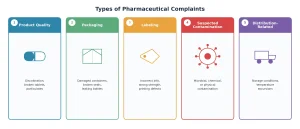
Product Quality Complaints
Relate directly to the product’s quality or physical condition color change, broken tablets, cracked capsules, particulate matter, leakage, unusual odor, or product deterioration.
Packaging Complaints
Involve the container or packaging system damaged containers, broken seals, leaking bottles, defective blister packs, missing components, or improper packaging.
Labeling Complaints
Cover incorrect label information, missing information, wrong strength, incorrect batch details, printing defects, or illegible labels.
Suspected Contamination Complaints
May involve possible microbial, chemical, or physical contamination these need particularly careful assessment given their potential impact on quality and patient safety.
Distribution-Related Complaints
Relate to storage conditions, transportation, temperature excursions, damaged shipments, or distribution handling.
The investigation should determine whether the reported problem traces back to manufacturing, packaging, storage, transportation, or another part of the supply chain.
Market Complaint Handling in Pharmaceutical Industry: 8 Essential Steps
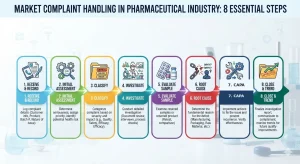
1. Receive and Record the Complaint
Collect and document the available information product name, strength and dosage form, batch/lot number, manufacturing or expiry date, nature of the complaint, date received, complainant information, market or location, quantity involved, product condition, photographs or evidence, and sample availability. FDA requires maintaining records of written and oral complaints under 21 CFR 211.198.
2. Perform an Initial Assessment
Assess the complaint’s nature and potential significance potential patient impact, product quality, severity, batch information, distribution status, whether similar complaints have been received, whether an adverse event may be involved, and whether the issue could indicate a broader quality defect. This helps determine the appropriate investigation pathway.
3. Classify the Complaint
| Factor | Example Consideration |
|---|---|
| Severity | Potential impact on patient safety |
| Occurrence | Frequency of similar complaints |
| Detectability | Ability to detect the defect before use |
| Extent | Number of batches or units potentially affected |
| Product type | Sterile, non-sterile, high-risk product, etc. |
| Distribution | Markets and quantities potentially affected |
The classification system should be defined by the organization’s approved procedure and risk-management framework.
4. Investigate the Complaint
The investigation should match the nature and potential risk of the reported issue, reviewing batch manufacturing and packaging records, QC test results, certificates of analysis, deviations, OOS investigations, change controls, environmental monitoring data, stability information, distribution records, previous complaints, and retention or returned samples. EU GMP Chapter 8 specifically identifies review of relevant records and, where appropriate, checking or testing reference/retention samples as part of quality-defect investigations.
5. Evaluate the Product or Complaint Sample
When a complaint sample is available, it may be evaluated for appearance, packaging integrity, labeling, physical defects, identification, microbial contamination, chemical characteristics, or other relevant quality attributes. The testing performed should be scientifically justified and appropriate for the reported defect.
6. Identify the Root Cause
Possible causes may involve the manufacturing process, packaging operation, equipment, raw materials, human factors, laboratory testing, storage, transportation, distribution, or supplier issues. Appropriate tools include 5 Why analysis, fishbone diagrams, Fault Tree Analysis, Failure Mode and Effects Analysis, or process mapping selected to match the complexity and risk of the problem.
https://pharmavk.com/Why-is-CAPA-Correct/
7. Determine CAPA and Other Actions
If the investigation finds a systemic or recurring issue, CAPA may include procedure revision, additional training, equipment improvement, process modification, additional monitoring, supplier action, increased sampling, packaging improvement, or process revalidation where justified. EU GMP Chapter 8 specifically covers identifying and implementing appropriate CAPA and assessing CAPA effectiveness.
8. Close and Trend the Complaint
The investigation record should explain what was reported, what was investigated, what evidence was reviewed, what was determined, whether a root cause was identified, whether CAPA was required, whether further action was necessary, and the final conclusion. Complaint data should also be periodically trended to catch recurring or emerging problems.
Complaint Investigation: Important Records to Review
| Record / Source | Why It May Be Reviewed |
|---|---|
| Batch Manufacturing Record | Verify manufacturing activities |
| Batch Packaging Record | Investigate packaging or labeling issues |
| QC Results | Review product testing |
| OOS Investigation | Check previous laboratory failures |
| Deviation Records | Identify related process events |
| CAPA Records | Determine whether similar issues were previously addressed |
| Change Controls | Identify recent process or material changes |
| Stability Data | Evaluate potential product deterioration |
| Distribution Records | Assess storage and transportation |
| Retention Samples | Compare complaint sample with retained product |
| Previous Complaints | Identify recurring trends |
Not every investigation requires every record scope the review to the actual complaint.
Example of Market Complaint Investigation
Reported issue: A customer reports that tablets from Batch ABC123 look different from previous batches (discoloration).
Initial assessment: QA records the complaint and collects product name, batch number, expiry date, complaint description, photographs, and sample availability.
Investigation: Reviews batch manufacturing records, packaging records, raw material information, in-process/finished-product results, stability data, retention sample, previous complaints, and relevant deviations and changes.
Root cause assessment: If evidence points to a manufacturing or packaging-related cause, the company assesses its significance and determines appropriate corrective action.
CAPA: Depending on findings, this may include process controls, additional training, procedure revision, or other appropriate actions.
Closure: The final conclusion is documented and approved per the company’s complaint-handling procedure.
When Can a Complaint Lead to Product Recall?
Not every complaint results in a recall. A recall or other market action may be considered when an identified or suspected quality defect presents a significant risk and affected product may remain in distribution based on an appropriate risk assessment and applicable regulatory requirements. EU GMP Chapter 8 describes assessing the risk posed by a quality defect and deciding on risk-reducing actions such as batch or product recalls.
Complaint Trending and Recurring Problems
A company may monitor complaint numbers, category, product, batch, manufacturing site, market, defect type, severity, recurrence, and time trends. For example, several complaints involving the same packaging defect across different batches may point to a systemic problem needing further investigation. FDA has identified inadequate complaint trending and failure to implement effective CAPA as recurring quality-system deficiencies in inspection findings.
Common Mistakes in Complaint Handling
- Delayed complaint assessment: a complaint should be assessed promptly, not left unresolved without justification
- Incomplete information: missing batch numbers, product details, or descriptions can make investigations difficult
- Inadequate investigation: simply responding to the complainant without investigating a potential quality defect isn’t sufficient
- Failure to review trends: individual complaints may look unrelated until evaluated together
- Weak root cause analysis: closing a complaint with a superficial cause can miss the underlying problem
- CAPA without effectiveness assessment: implemented CAPA should be evaluated for actual effectiveness
- Poor traceability: complaint records should connect clearly to relevant batch and quality records
Best Practices for Market Complaint Handling
- Maintain written complaint-handling procedures
- Record complaints consistently, with sufficient product and batch information
- Perform timely initial assessment using a documented risk-based approach
- Conduct investigations appropriate to the reported issue
- Review relevant batch and quality records, and evaluate samples when appropriate
- Identify potential root causes and implement CAPA where required
- Assess CAPA effectiveness and trend complaints periodically
- Escalate significant quality defects per applicable procedures
- Maintain complete investigation records
- Consider recall or other risk-reduction measures when scientifically and regulatorily justified
Frequently Asked Questions
What is a market complaint in the pharmaceutical industry?
Information received after a product has entered distribution that alleges or indicates a potential issue involving the product, its quality, packaging, labeling, or related characteristics.
Who handles market complaints in pharma?
Responsibilities vary by organization, but QA or the designated Quality Unit commonly coordinates complaint handling and investigation, with input from QC, manufacturing, packaging, regulatory affairs, and supply chain.
What information should be recorded for a pharmaceutical complaint?
Product name, strength, batch number, expiry date, complaint description, date received, complainant information, market, quantity, photographs, and sample availability, per the company’s procedure.
Are all pharmaceutical complaints investigated?
Complaints should be assessed per the applicable procedure to determine the appropriate investigation and handling pathway. Potential quality defects require appropriate investigation EU GMP Chapter 8 requires procedures for documenting and assessing complaints.
What is the role of QA in market complaint handling?
QA or the designated Quality Unit typically coordinates or oversees complaint assessment, investigation, documentation, risk assessment, CAPA, trending, and escalation according to the company’s quality system.
Can a market complaint lead to CAPA?
Yes. If an investigation identifies a systemic or recurring issue, CAPA may be required to correct the problem and prevent recurrence. EU GMP Chapter 8 specifically addresses CAPA and effectiveness assessment in quality-defect investigations.
Can a market complaint lead to product recall?
Potentially. If a quality defect presents an unacceptable risk and affected product is in distribution, recall or another risk-reducing action may be considered per the applicable quality system and regulatory requirements.
Conclusion
Market Complaint Handling in Pharmaceutical Industry is a core piece of the pharmaceutical quality system. A complaint should be more than a customer-service record when it points to a potential quality defect, it needs proper assessment, investigation, documentation, and a conclusion backed by evidence.
Effective complaint handling connects customer feedback with batch records, laboratory information, manufacturing processes, risk assessment, root cause analysis, CAPA, and complaint trending. A well-controlled system helps organizations catch recurring problems and decide when additional quality or market action is needed.
References