How Is an OOS Microbiology Result Investigated?
OOS Investigation in Pharmaceutical Microbiology follows a structured, multi-phase process designed to determine whether a failure stems from a laboratory error or a true manufacturing and product defect. Out-of-Specification (OOS) results in pharmaceutical microbiology are critical deviations that indicate a product, process, or environmental sample doesn’t meet predefined acceptance criteria and they can affect product release, regulatory compliance, and patient safety.
Understanding the common causes, following a proper investigation sequence, and implementing effective preventive measures are core responsibilities for microbiologists, QA, and QC personnel. This article walks through both.
What Is an OOS Result in Pharmaceutical Microbiology?
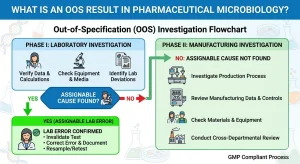
An OOS result is any microbiological test result that falls outside the specifications or acceptance criteria established for a product, process, or environmental sample whether that’s a sterility test, a microbial limit test, an environmental monitoring result, or another compendial method. Under FDA’s OOS guidance, an OOS finding triggers a structured, two-phase investigation: Phase I in the laboratory, and where the lab phase doesn’t identify an assignable cause Phase II extending into the manufacturing process itself.
Common Causes of OOS Results
Product and Process-Related Causes
Contamination during manufacturing or sampling, or improper sterilization or cleaning validation, can produce a genuine OOS result tied to the product or process itself rather than the lab.
Laboratory-Related Causes
Poor aseptic technique during testing, or expired, improperly stored, or contaminated media and reagents, can produce an OOS result that’s actually a laboratory error rather than a true product defect.
https://pharmavk.com/ph-in-microbiological-culture-media/
Human Error
Incorrect labelling or sample identification, and errors in data recording or transcription, round out the most common root causes seen in OOS investigations.
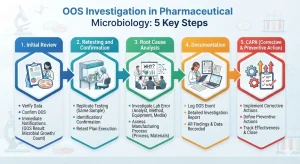
OOS Investigation in Pharmaceutical Microbiology: 5 Key Steps
1. Initial Review
The analyst and supervisor conduct an initial assessment of the OOS result checking the raw data, calculations, instrument performance, and testing conditions for any obvious, identifiable laboratory error before anything else happens.
2. Retesting and Confirmation
Where appropriate and scientifically justified by the approved procedure, retesting may be performed to help confirm or rule out a laboratory-based cause. Retesting should follow a predefined, approved plan rather than being decided informally after seeing an unwanted result.
3. Root Cause Analysis (RCA)
If the initial review doesn’t identify a clear laboratory error, the investigation expands potentially into manufacturing, sampling, materials, or environmental conditions using structured tools like 5 Why analysis, fishbone diagrams, or process review to identify the actual root cause.
4. Documentation
The investigation record should capture what was reviewed, what testing was performed, what evidence was found, and how the conclusion was reached whether that conclusion is a confirmed laboratory error or a genuine product/process-related failure.
https://pharmavk.com/qa-review-vs-qc-review/
5. Corrective and Preventive Actions (CAPA)
Once a root cause is identified, appropriate CAPA is implemented to address it and reduce the risk of recurrence which might mean retraining, procedure revision, equipment maintenance, or a change managed through the change-control system.
https://pharmavk.com/change-control-in-pharmaceutical-manufacturing/
Best Practices to Prevent OOS Results
- Strict adherence to aseptic techniques in laboratories and cleanrooms
- Regular training and competency assessment of personnel
- Routine environmental monitoring and trend analysis
- Validated cleaning, sterilization, and equipment maintenance programs
- Proper media preparation, storage, and growth promotion testing
- Robust SOPs and data integrity practices for documentation
Frequently Asked Questions
What is an OOS result in microbiology?
A test result such as a sterility, microbial limit, or environmental monitoring result that falls outside the predefined specification or acceptance criteria for that product, process, or sample.
Is every OOS result caused by a manufacturing defect?
No. Many OOS results trace back to laboratory error poor technique, contaminated media, or data errors rather than a genuine product or process failure, which is exactly why the investigation starts in the lab before expanding further.
What is Phase I vs. Phase II of an OOS investigation?
Phase I is the laboratory-focused investigation, checking for an assignable lab-based cause. If Phase I doesn’t identify one, Phase II expands the investigation into the manufacturing process, sampling, and materials.
Can retesting be used to simply discard an unwanted OOS result?
No. Retesting should follow a predefined, scientifically justified, approved procedure it’s not meant to be applied selectively after the fact just because an initial result was unwelcome.
Does every OOS result require CAPA?
Where a root cause is identified laboratory or product/process-related appropriate CAPA should be implemented to prevent recurrence. The scope of CAPA should match the nature and risk of what was found.
Conclusion
OOS Investigation in Pharmaceutical Microbiology is a critical event that demands a systematic investigation, thorough documentation, and effective CAPA implementation not a shortcut to explain away an inconvenient result. By understanding common causes, following a stepwise investigation process, and adhering to applicable regulatory guidance, microbiologists and QA/QC teams can minimize OOS occurrences, maintain product quality, and protect patient safety. Preventive measures, continuous training, and strong environmental control all help reduce the risk of future deviations.
References