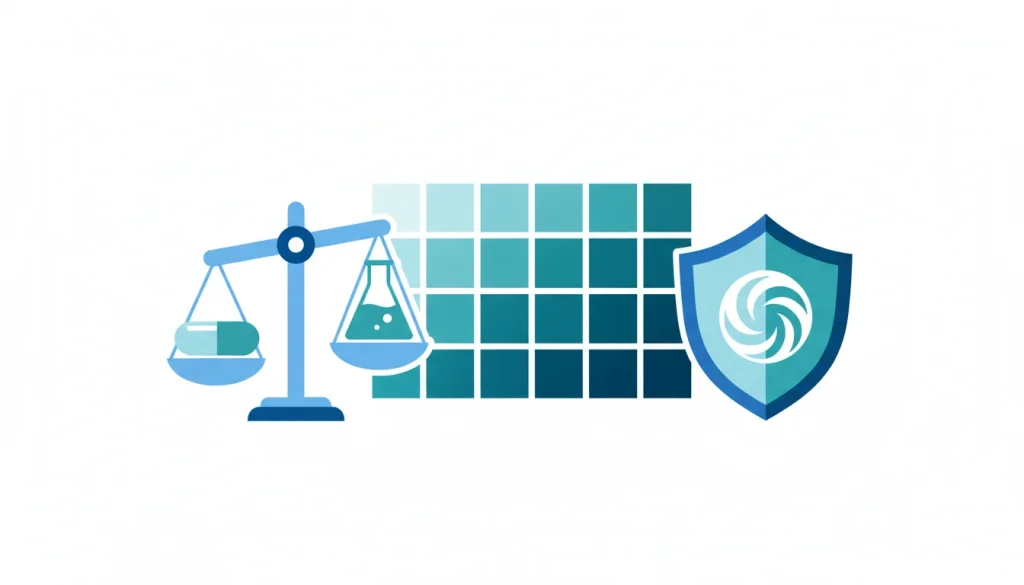
Quality Risk Management (QRM) is a systematic process for assessing, controlling, communicating, and reviewing risks to product quality. The international guideline ICH Q9 describes the approach, and regulators expect companies to apply it across the product lifecycle.
1. Two Basic Principles
- The evaluation of risk to quality should be based on scientific knowledge and linked to protecting the patient.
- The level of effort and documentation should match the level of risk.
2. The QRM Process
Risk assessment has three parts: identifying what could go wrong, analysing how likely it is and how severe the effect would be, and evaluating whether the risk is acceptable.
Risk control decides what to do about unacceptable risks. This may mean reducing the risk, for example by adding a check or changing a process, or accepting it with a clear justification.
Risk communication shares the results with the people who need them, such as management, QA, and operations.
Risk review checks the outcome over time, especially after changes or new information.
3. Common Risk Management Tools
- FMEA (Failure Mode and Effects Analysis): ranks failures by severity, occurrence, and detectability.
- HACCP: identifies hazards and critical control points in a process.
- Fishbone diagram: maps possible causes of a problem.
- Risk ranking and filtering: compares and prioritises risks.
- Preliminary hazard analysis: an early, high-level look at hazards.
4. A Simple FMEA Example
For each possible failure, the team scores severity, occurrence, and detectability, often on a scale of 1 to 5 or 1 to 10, and multiplies them to get a risk priority number. For example, a missing in-process weight check on a tablet line may score high on severity and low on detectability, so it receives a higher priority for action.
5. Where QRM Is Used
- Change control and deviation impact assessments
- Equipment qualification and process validation
- Supplier qualification
- Cleaning validation and contamination control
- Audit planning and inspection readiness
Conclusion
Quality Risk Management helps companies focus their resources where risks are greatest. When it is applied consistently and documented clearly, it supports better decisions and safer products.
This article is for general educational purposes. Always follow your own company procedures and applicable regulations.