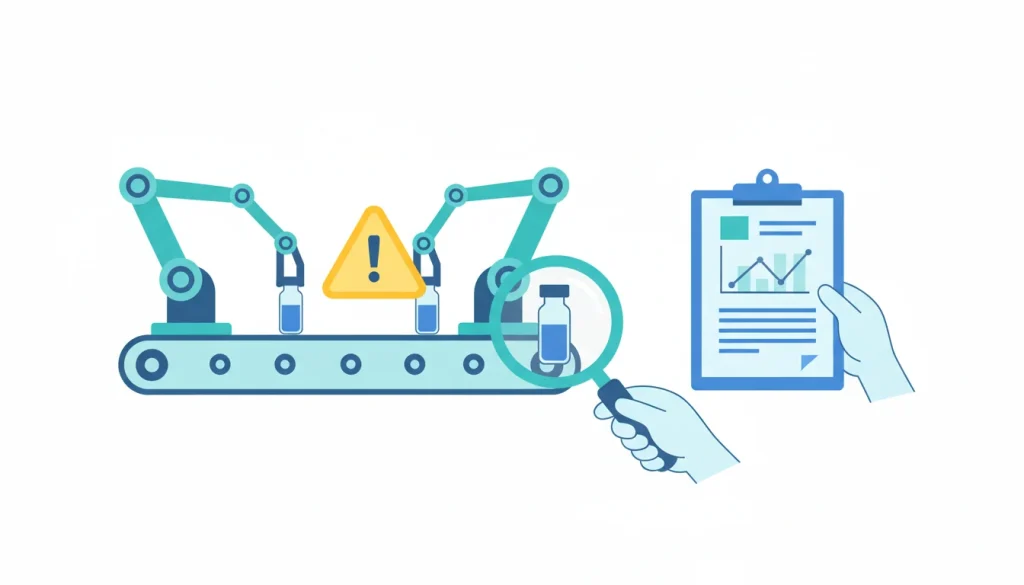
A deviation is any departure from an approved procedure, specification, or standard in pharmaceutical operations. Deviations happen in every plant. What matters is how quickly and properly they are handled.
A good deviation management system protects product quality, supports data integrity, and shows regulators that the company controls its processes.
1. Types of Deviations
- Planned deviation: a temporary, approved departure from a procedure, decided in advance with a justification.
- Unplanned deviation: an unexpected event, such as an equipment failure, a missed step, or a documentation error.
Deviations are usually classified by risk as minor, major, or critical, depending on their possible effect on product quality, patient safety, or data integrity.
2. Steps in Deviation Handling
Step 1: Report immediately. The person who finds the deviation informs their supervisor and quality assurance without delay and records it.
Step 2: Contain the issue. Take immediate action, such as stopping the activity or quarantining the affected material.
Step 3: Classify the deviation. QA assigns a risk level based on its potential impact.
Step 4: Investigate. Find the root cause using tools such as the 5 Whys or a fishbone diagram. Review related batches, equipment, and previous events.
Step 5: Assess product impact. Decide whether the affected batch or other batches can be released, reprocessed, or rejected.
Step 6: Define actions. Where needed, raise a CAPA to prevent recurrence.
Step 7: Review and close. QA approves closure once the investigation and actions are complete and documented.
3. What a Good Deviation Report Contains
- Clear description of what happened, when, where, and who found it
- Product, batch, equipment, and process involved
- Immediate actions taken
- Root cause and evidence
- Impact assessment on product quality
- Corrective and preventive actions with owners and dates
- QA approval and closure date
4. Common Problems
- Reporting deviations late or not at all
- Investigations that stop at “operator error”
- Weak impact assessments that ignore other batches
- Overdue deviations with no clear owner
- Repeat deviations with no trend review
5. Tips for Better Control
- Encourage a culture where staff report problems without fear
- Set clear timelines for investigation and closure
- Trend deviations by area, product, and cause
- Train investigators in root cause analysis
Conclusion
Deviation management is a key part of pharmaceutical quality assurance. Timely reporting, solid investigation, and effective follow-up reduce risk and help a company stay inspection-ready.
This article is for general educational purposes. Always follow your own company procedures and applicable regulations.